Johann Moritz Rugendas (Augsburg, Germany 1802 - Weilheim, Germany 1858)
Johann Moritz Rugendas was a painter, draftsman and engraver. From childhood, he practiced drawing and engraving with his father, Johann Lorenz Rugendas II (1775–1826). He attended Albrecht Adam's studio (1786–1862) between 1815 and 1817, before joining the Munich Academy of Fine Arts. Influenced by the travel accounts of the naturalists J. B. Von Spix (1781–1826) and C. Fr. of Martius (1794–1868), in addition to the work of Thomas Ender (1793–1875), came to Brazil in 1821 as a documentary designer of the Langsdorff expedition.
In 1824, he abandoned the expedition, but continued, independently, to register human types, customs, landscapes, fauna and flora of the country. He traveled through Mato Grosso, Bahia and Espírito Santo, returning to Rio de Janeiro later that year. During his first stay in Brazil, he did not perform oil paintings, focusing on the drawings, occasionally colored with watercolor.
Between 1825 and 1828, he lived between Paris, Augsburg and Munich, during which time dedicated to the publication of his work Voyage Pittoresque Dans Le Brésil. In 1828, he went to Italy, where he had contact with new techniques, being especially interested in the use of colors and oil sketches. Stimulated by the naturalist Alexander Humboldt (1769–1859), he traveled to Mexico in 1831, with the aim of gathering material for a new publication. There, he began his oil paintings, using the techniques assimilated in Italy.
From 1834, he traveled through South America, passing through Chile, Argentina, Peru and Bolivia. In 1845, he arrived again in Rio de Janeiro, where he portrayed members of the imperial family and was invited to participate in the General Exhibition of Fine Arts. The following year, he definitely returned to Europe. In exchange for an annual and lifetime pension, he ceded his collection of drawings and watercolors to King Maximilian II of Bavaria.
Critical Comment
Johann Moritz Rugendas belongs to the seventh generation of a family of designers, painters, engravers and printers. He is initiated into the artistic activity by his father, Johann Lorenz Rugendas II (1775 - 1826), director and teacher at the Augsburg School of Drawing, as a child. He frequents the studio of the academic painter of Battles Albrecht Adam (1786 - 1862) until 1817, when he moved to Munich to study at the Academy of Fine Arts in Munich with Lorenzo Quaglio II (1793 - 1869). The influence of academic teaching will be permanent in the entire production of the artist, who tends to value the drawing in his compositions and the representation of the themes according to the ideal and universal re-elaboration of the observation of the individual. Langsdorff to take part in his scientific expedition through Brazil as a draftsman-illustrator. Thus began the work of one of the main illustrators of the New World in the 19th century. He arrived in Rio de Janeiro in 1822, in the midst of political effervescence with the country's independence process. Problems of various orders delay the beginning of exploratory trips across the Brazilian continent for two years. Despite living isolated with the other participants of the expedition at Fazenda Mandioca, owned by the consul, Rugendas constantly goes to the capital, making friends with the artists of the French artistic mission. In this period it portrays the natural landscape, fauna, flora, physical types and views of the city of Rio de Janeiro. In 1824, they finally left for Minas Gerais, passing through São Paulo. Rugendas soon disagrees with Langsdorff and leaves the group - later replaced by Adrien Taunay (1803-1828) and Hercule Florence (1804-1879) -, continuing his wanderings alone. The exact itinerary followed by the artist is not known, but from the drawings made it is known that it passes through São Paulo, Minas Gerais, Mato Grosso, Espírito Santo, Bahia and Pernambuco. Return to Rio de Janeiro in 1825, leaving for Europe soon after with the intention of publishing the set of drawings made.
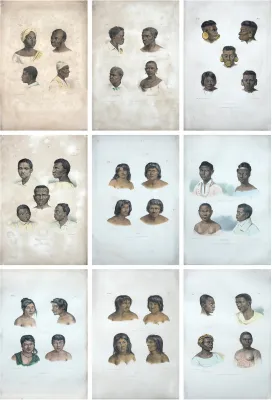
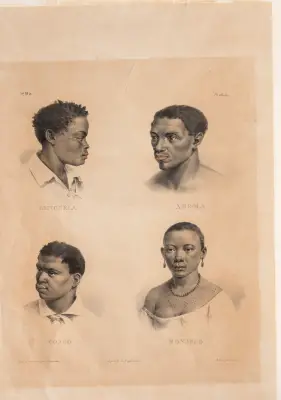
One hundred lithographs based on Brazilian drawings by Rugendas are published in the volume Voyage Pittoresque Dans LE Brésil (French-German bilingual edition, 1827/1835). Designed as a travel book aimed at the general public, it has the participation of 22 lithographers and Victor Aimé Huber in the preparation of texts. To this day, the book is considered one of the most important iconographic documents about Brazil in the 19th century. It contains the following subdivisions: landscapes, types and customs, uses and customs of the Indians, the life of Europeans, Europeans in Bahia and Pernambuco, uses and customs of blacks. However, it should be noted that the Brazilian work of Rugendas is not always a faithful copy of reality. The illustrations of plants and animals obey a detailed and objective character; In these cases the artist draws under the tutelage of naturalists. Regarding the landscapes, Diener speaks of "a faithful image of the natural surroundings", apprehended more in his unity than in the details. With the exception, of course, of the engravings in which the lithographer recreates another image based on the original drawing (such as the entrance board of Barra do Rio de Janeiro engraved by the romantic artist P. Bonigton). But it is in the scenes of the daily life of the Brazilian population of the time and in the ethnographic portraits that we perceive the artist committed to creating idealized images, more programmatic than real. The bodies of blacks and Indians are represented in a classic style, the traits smoothed and Europeanized, as well as the situation of slaves is alleviated (work is shown as an almost playful activity on boards such as cassava root preparation and coffee harvest, for example). At the time of its publication, Voyage Pittoresque received criticism for its undocumented character. But it achieves success with the general public, circulating in Brazil in a French edition with great success, perhaps because of the benevolent way in which it portrays the 19th century society. Humboldt (1769 - 1859), whose influence leads him to the decision to become "the illustrator of the new territories of the world". He plans a second trip to the American continent (1831 to 1847), passing through Mexico, Chile, Peru, Uruguay, Argentina and Brazil. To carry out this task, he seeks to improve his painting. He becomes familiar with the advanced artistic currents (neoclassicism and romanticism) and remains a season in Rome studying. From 1829 until his departure, he paints canvases of Brazilian themes based on his drawings. They are idyllic spaces that reflect current ideas at the time about the new world as a earthly paradise and a habitat of the good savage.
The graphic and pictorial set carried out by Rugendas in his years of experience in America represents one of the fundamental materials of knowledge of society and the American landscape in 19th century. In his second visit to Rio de Janeiro (1845-1846) he found an extraordinary welcome by the Brazilian Crown, who orders several portraits. Participates in the General Exhibition of Fine Arts (1845 and 1846) at the invitation of Félix Taunay (1795 - 1881). He returns to Europe without returning to the subjects of his first Brazilian experience. He sells the whole of his work to Maximilian II of Bavaria in exchange for a lifetime pension, losing it years later for not performing pictorial production based on his American works, as he had agreed. He dies in a financial situation that is not very favorable and embittered by the certainty of artistic failure.
Criticism
"Humboldt and Martius are preliminary references for a first approximation of the synthesis performed by Rugendas on his picturesque album. Humboldt and Bonpland to Latin America is generally inseparable from the construction of the landscape of the tropics. In particular, the model of Atlas Pittoresque.Vue des Cordillères et des Monuments du Peuple Indigène de L'America offers a solution of scientific conception expressed by art (...) Appropriating the pictorial vision of a scientific matrix, recommended by Humboldt, Rugendas approaches the picturesque, seeking the regional characteristics of the country, which are defined and manifested simultaneously in the conformation of the soil, in the cut of the mountains in relation to the plain, in the geographical geology, in the geobotany. Its drawings have the ability to transform physical aspects into the cosmogonic sphere of human life. Complete interdependence, taking care of the individualization of units that form the landscape and emphasizing the way they take place in the set. (...) In the original drawings of Rugendas, the great gesture that sustains the overall vision shows, the way in which he first draws the whole and then he intensifies some part". Moraes. The Brazil of Travelers. São Paulo: Metalivros; Salvador: Fundação Emílio Odebrecht, 1994. v. 1, p. 77. Volume 1: Imaginary of the New World.
"Rugendas He is inserted in the history of art as one of the greatest creators of American iconography, as a versatile painter, whose thematic range ranges from naturalistic studies of the landscape to the most sophisticated compositions of historical theme. His knowledge of America is based on the twenty years of travel, when he traveled from Mexico to southern Chile, making on the continent the largest route carried out by a traveler in the 19th century. At the end of his great American trip, Rugendas took a retrospective look at the work carried out during this fundamental stage of his career; This autobiographical recapitulation materialized in the selection of oil painting, which he presented at the General Exhibition of Fine Arts in Rio de Janeiro in 1845. Brazilian".
Pablo Diener and Maria de Fátima Costa
DIENER, Pablo; COSTA, Maria de Fátima. The America of Rugendas:  Obras and Documents. Angel Edition BOJADSEN, Edilberto Fernando Verza. São Paulo: Estação Liberdade, 1999. p.13-14.
Steps
Staatliche Graphische Sammlung Munich collection - Munich (Germany)
Städtische Kunstsannlungen Augsburg Collection (Germany)
Archive of the Academy of Sciences of Saint Petersburg - Saint Petesburg (Russia)
Brasiliana Collection / Fundação Estudar - São Paulo SP
Itaú Collection - São Paulo SP
Brazilian Society of English Culture Collection - Rio de Janeiro RJ
Fundação Biblioteca Nacional - Rio de Janeiro RJ
Ibero-Amerikanisches Institut, Preusscher Kulturbesitz - Berlin (Germany)
Museum of Fine Arts - Caracas (Venezuela)
Montevideo Historical Museum - Cabildo (Uruguay)
National Historical Museum - Rio de Janeiro RJ
National Museum of Fine Arts - MNBA - Rio de Janeiro RJ
National Museum of Fine Arts - Santiago (Chile)
National Museum of History - Rio de Janeiro RJ
Museum für völkerkunde, Preusscher Kulturbesitz - Berlin (Germany)
Castro Maya Museums - Rio de Janeiro RJ
State Palaces and Gardens - Potsdam-Sanssouci (Germany)
Collective exhibitions
1845 - Rio de Janeiro RJ - 6th General Exhibition of Fine Arts, at AIBA - receives the Imperial Order of Cruzeiro do Sul
1846 - Rio de Janeiro RJ - 7th General Exhibition of Fine Arts, Na Aiba
Posthetic exhibitions
1948 - Rio de Janeiro RJ - Retrospective of painting in Brazil, at MNBA
1966 - Austin (United States) - Art of Latin America Since Independence, at The University of Texas at Austin. Archer M. Huntington Art Gallery
1966 - New Haven (United States) - Art of Latin America Since Independence, at The Yale University Art Gallery,
1966 - San Diego (States) United States) - Art of Latin America Since Independence, at the La Jolla Museum of Art
1966 - New Orleans (United States) - Art of Latin America Since Independence, at the Isaac Delgado Museum of Art
1966 - San Francisco (United States) - Art of Latin America since Independence, at the San Francisco Art Museum
1969 - Rio de Janeiro RJ - Rugendas, at MIS/SP
1977 - São Paulo SP - 33 Original Drawings of Rugendas: Pirajá da Silva Collection
1977 - São Paulo SP - Individual, at the Pinacoteca do Estado
1983 - Recife PE - 50 years of Casa-Grande & Senzala, at the Joaquim Nabuco Foundation. Central Administration
1984 - Aracaju SE - 50 years of big house & Senzala
1984 - Brasília DF - 50 years of big house & Senzala
1984 - Lisbon (Portugal) - 50 years of Casa-Grande & Senzala, at the Gulbenkian Museum of the Calouste Gulbenkian Foundation
1984 - Salvador BA - 50 years of Casa-Grande & Senzala
1984 - São Paulo SP - Tradition and Rupture: Synthesis of Brazilian Art and Culture, at the Bienal Foundation
1984 - Vitória ES - 50 years of Casa-Grande & Senzala
1985 - São Paulo SP - 100 works Itaú, at Masp
1990 - Rio de Janeiro RJ - Rugendas x Photography
1990 - São Paulo SP - Rugendas x Photography
1990 - Curitiba PR - Rugendas x Photography
1990 - Belo Horizonte MG - Rugendas x Photography
1990 - Salvador BA - Rugendas x Photography
1990 - São Paulo SP - The art collection of the municipality of São Paulo, at MASP
1991 - São Paulo SP - A Mata, at MAC/USP
1992 - Rio de Janeiro RJ - Nature: Four Centuries of Art in Brazil, at CCBB
1992 - São Paulo SP - O Olhar de Sérgio on Brazilian Art: Drawings and Paintings, at the Municipal Library Mário de Andrade
1992 - Zurich (Switzerland) - Brasilien: Entdeckung und selbstendeckung, at Kunsthaus Zürich
1994 - Lisbon (Portugal) - Rio de Janeiro: Capital of Além-Mar, at the Rafael Bordalo Pinheiro Museum
1994 - Rio de Janeiro RJ - Rio de Janeiro: Capital D'Além-Mar, at CCBB
1994 - São Paulo SP - O Brasil dos Viajantes, at MASP
1994 - São Paulo SP - A critical look at the 19th century collection, at the Pinacoteca do Estado
1995 - Belo Horizonte MG - The heirs of the night: fragments of the imaginary Negro, at the Belo Horizonte Culture Center
1995 - São Paulo SP - Today's Brazil in the Mirror of the 19th Century: German and Brazilian artists redo the Langsdorff expedition, at Masp
1996 - London (United Kingdom) - Brazil Through European Eyes, at Christie's
1996 - Rio de Janeiro RJ - Today's Brazil in the Mirror of the 19th Century: German and Brazilian artists redo the Langsdorff Expedition, at Fundação Casa França-Brazil
1998 - Brasília DF - Brazilian like me, like me, like?, at the Ministry of Foreign Affairs
1999 - Rio de Janeiro RJ - Brazil rediscovered, in the Imperial Palace
1999 - São Paulo SP - Brazilian Like me, like who?, at the Brazilian Art Museum. Cultural Hall
2000 - Rio de Janeiro RJ - Visions of Rio in the Geyer collection, at CCBB
2000 - São Paulo SP - Brazil + 500 Rediscovery Show: Black with body and soul and the distant look, at the Foundation Bienal
2000 - São Paulo SP - O Café, at Banco Real
2001 - Rio de Janeiro RJ - Brazilian Watercolor, at the Light Cultural Center
2002 - Niterói RJ - Brazilian art on paper: 19th century and XX, at Solar do Jambeiro
2002 - São Paulo SP - Rugendas in Mexico, at the Latin America Memorial
2003 - São Paulo SP - Vistas do Brasil: Brasiliana Collection, at the Pinacoteca do Estado
2004 - São Paulo SP - Paper Office, at CCSP
Source: Itaú Cultural