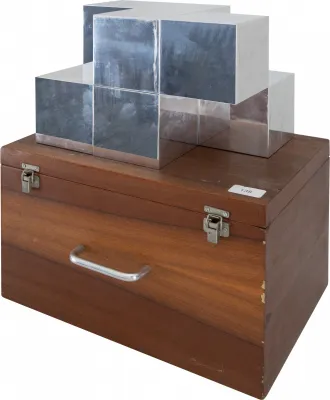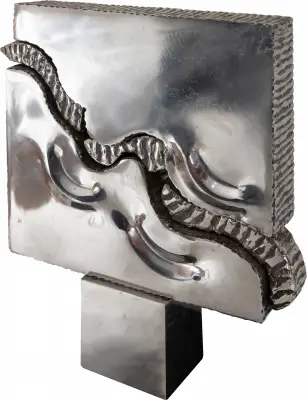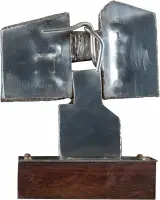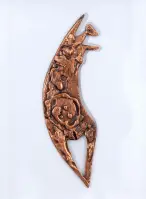

Jeanete Musatti (São Paulo SP 1944)
Jeanete Musatti is a visual artist who lives and works in São Paulo. She occupies a singular place in the Brazilian contemporary art scene. Her delicate architectures of memory, although originating in an autobiographical context, break with nostalgic first-person narrative. Her work is woven from the past only insofar as that past serves to contextualize the present. It functions as a repository of elements that awaken sensations in constant transit between the individual and the collective.
The symbolic construction of her work is aimed not only at those who keep alive their nonconformity in the face of public and private violence, but also, and especially, at those devoted to reconquering the deepest inner territories, linked to identity and sensibility. Sociological, cultural and political commentary appears in varying degrees of acidity and forcefulness, softened by the intimacy of a poetics with a surrealist bent.
Musatti belongs to the fertile lineage of Art History that begins with the visual semantics of Cubist collage and that, through Marcel Duchamp, builds a bridge between modern and contemporary art: the assembly of symbolic links, the association of ideas from apparently disparate elements, the interpenetration of signs. By articulating her kaleidoscope of minimal forms, Jeanete Musatti reveals the vastness of the unsaid that inhabits and structures human experience in the world.
Critical Texts
An exhibition within an exhibition: the world of the minimal, by Jeanete Musatti
Ricardo Resende - 2008
To paraphrase the American art critic Arthur C. Danto, Jeanete Musatti's art "transfigures the commonplace" of things1; it works with situations of apparent banality, which no longer matter in the everyday life of contemporary society, and transforms them into art objects, small installations, art in miniature. The situations created in these artistic "environments" (enclosed or not in a display case) represent real events that usually go unnoticed because of their simplicity, given the great anxiety and amount of information that surround contemporary urban life.
In this simple gesture of accumulating (collecting) and arranging her small "finds", gathered in antique shops, family homes, city streets, beach sands and the woods she walks through, the São Paulo artist draws up a cartography of her path, of her existence, as can be seen in the work Estreito de Corintho [Strait of Corinth], from 2006. It consists of photographs arranged in a column fixed beside a "display case" on a base containing a scene from the history of humanity. One sees the remains of two temples and the image of a statue mired in the very sand that formed them, like the existence and history of humanity crumbling with the passage of time. In the column of photographs, it is interesting to note a single micro statuette placed with its back turned, looking at the landscape seen in the photograph in front of it. Could this be a way of portraying herself observing, highlighting our insignificant scale before what we see in the world?
Jeanete Musatti's trajectory is a long path spanning more than forty years, an artistic career centered on the observation and collection of these small objects and their transfigurations/reinterpretations, followed by their cataloguing, giving them a museological meaning as she transforms them into her artworks. Her works are the re-creation of her inner world or, to better place them within one of the categories of art, such "arrangements" deal with what we might call "inner landscapes", small sublime landscapes that demand of the viewer a bending gesture, almost a reverence toward these small windows of her soul and imagination, which open not onto the outside world but, rather, into herself.
The artist's action lies in displacing scenes of everyday life into the exhibition space of display cases, showcases, glass boxes, or onto a tabletop. Nothing more than an investigation and exhibition of the intimate. As we immerse our gaze in Jeanete Musatti's world of the minimal, we encounter the silence essential to the existence of a work of art.
The procedure of building archives, currently in vogue in contemporary art, has been present in Jeanete Musatti's work since the beginning of her career: art transformed into something like an archive, a small museum of curiosities, a keepsake of memory and of lived visual, aesthetic or sensory experiences, the whole organized so as to form a magnetized artistic field, as we can see in the untitled work from 2004/2008, in which she places a carcass or sea shell inside a small cradle and two silhouettes of small birds standing side by side as if watching this scene. All are made of cast metal or brass. These arranged objects, no matter the place or surface they are on, have an impressive visual intensity.
In this exhibition, the artist placed them on a kind of shelf, with the back covered by two photographs. Both share the same nest, or fur, which leads us to the idea of a bird's nest. The first photo shows a statuette of what may be a ballerina, the kind we usually see in music boxes, emerging from the threads that form this shelter. She shares the coziness of the place with a few stones.
The other nest holds two fossil shells. One is a snail shell and the other is one of those commonly found on beaches. The result of this "arrangement", as happens in many of the artist's works, gives rise to a surreal, somewhat phantasmagoric atmosphere, like a frightening memory game or a nightmare, even though the figures are delicate; two birds that announce something.
In another work in this show, Delicadezas da Alma [Delicacies of the Soul], from 2008, there are several small frames that function as boxes in which the artist creates a cartography in the form of isolated scenes of human delicacies. The scenes are made up of small images of human figures, perhaps from the France of Louis XV. The background is a tangle of lines that create an organized sense, in color. In some, they seem to be a representation of a gestural expressionist painting, almost a little action painting.
***
The task of writing a text about Jeanete Musatti, after the beautiful essay by Casimiro Xavier de Mendonça, which traces a detailed path through the artist's work, plus the competent text by the art critic and historian Aracy Amaral, makes my work an arduous task. It seems that everything that could be said has already been said.
After reading Casimiro Xavier de Mendonça, who also deserves to be remembered here for his critical work, I saw no other way than to address and reflect on the problematization of the use of the display case and confined spaces for her "small archaeologies", as the artist herself refers to her work, in this text published in the booklet titled "Jeanete Musatti", by the publisher "Ex Libris".
Collecting or simply gathering data (objects) or mere traces (texts and images) of their passages through the world, we have in recent art history Allan Kaprow in the 1960s, Sophie Calle in the 1970s and countless artists of those and subsequent generations who use display cases, boxes, suitcases, plastic bags, bases or shelves as supports for their works. Marcel Duchamp, Arman, Christian Boltanski, Joseph Beuys, Damien Hirst, Jeff Koons, Rosângela Rennó, Farnese de Andrade, Nina Morais, Amélia Toledo, Arthur Bispo do Rosário, Nelson Leirner and the more recent Brazilians Carla Zaccagnini, Mabe Bethônico and Cláudia Sampaio, among others, carry out this desire to create, as Elisabeth Roudinesco defines it, an "absolute archive": "I myself have reflected on the question of the archive in psychoanalysis, the way of constituting an archive, the 'tragic and restless relationship', as Derrida says, that one can have with the archive, with the specter of the absolute archive, with this mad idea according to which we can archive everything."2
The "archaeological" procedure of accumulating things is therefore already old in the history of art. Many artists have created or create these "commonplaces" with their "collections", fruits of their archival observations. They would be ways of trying to grasp or "look at the world through a frame"3, as Bernadette Panek writes in her doctoral thesis, a study I draw on to think about the function of the display case in Jeanete Musatti's work: not a neutral, protected space, but an unlimited place where fragments of life are observed through accumulated and rearranged objects.
Even when Musatti does not isolate the "scene" in a display case or box, leaving the objects loose in space, the fact that they are placed and treated as miniatures or frozen fragments of a lived scene is a way of isolating them from the so-called real world. The difference in scale and the isolation itself are forms of distancing or of representing reality.
"Another limit set by the display case may be the determination of an isolated field of action. In this way, the artist brings about the creation of an autonomous world, with its own character, independent of the outside world, delimiting and organizing elements so that they coexist and, in a certain way, relate to one another in that same space. He builds a small world, creates specific situations and practically denies external influences. He proposes a relationship in order to eternalize certain neighboring relations only within that area."4
Jeanete Musatti captures time in her display cases. She seems to have the desire to eternalize it through museified objects and situations. The display cases that house miniature scenes therefore function as a freezing or concentrator of time. Jeanete Musatti's work is always illusion or the diminished representation of a reality. By working with miniatures or simply displacing objects, she reduces the world to a small scale.
Drawing, painting, collaging, collecting, gathering are ways of wanting to give meaning to one's own life. Jeanete Musatti belongs to the world of small things, a world on a smaller scale.
Notes
i As Danto describes in the book whose title inspires the first lines of this text, "The Transfiguration of the Commonplace", a thing is a thing and has no meaning other than that of a thing which, "as a class, has no 'aboutness'"; it is just a thing.
ii ROUDINESCO, Elisabeth. A análise e o Arquivo. Jorge Zahar Editor: Rio de Janeiro, 2001, pp. 8-9.
iii PANEK, Bernadette. In: O espaço isolado da vitrine: espaço de autoria [The Isolated Space of the Display Case: A Space of Authorship]. Thesis presented to the Graduate Program in Arts, Concentration Area Theory, Teaching and Learning, Research Line Art History, of the Escola de Comunicações e Artes da Universidade de São Paulo, as a partial requirement for the degree of Doctor of Arts, under the supervision of Prof. Dr. Domingos Tadeu Chiarelli. The researcher devotes her academic work to analyzing the use of the display case as an integral space of the artwork.
iv Ibidem.
Solo Exhibitions
2008
Uma exposição dentro de uma exposição [An Exhibition within an Exhibition], Galeria Nara Roesler, São Paulo, Brazil
2004
Galeria Nara Roesler, São Paulo, Brazil
2002
Instalações [Installations], Galeria Nara Roesler, São Paulo, Brazil
1999
Objeto e Pinturas [Object and Paintings], Galeria Nara Roesler, São Paulo, Brazil
1995
Instituto Moreira Salles, Casa da Cultura de Poços de Caldas, Poços de Caldas, Brazil
Museu Guido Viaro, Curitiba, Brazil
Galeria Nara Roesler, São Paulo, Brazil
1991
Museu de Arte Moderna do Rio de Janeiro, Rio de Janeiro, Brazil
Galeria Montesanti Roesler, São Paulo, Brazil
1988
Centro Cultural Cândido Mendes, Rio de Janeiro, Brazil
1987
Caixas [Boxes], Galeria Millan, São Paulo, Brazil
1985
Caixas [Boxes], Galeria Tina Presser, Porto Alegre, Brazil
1984
Objetos [Objects], Galeria G.B. Arte, Rio de Janeiro, Brazil
1983
Objetos [Objects], Galeria Arco Arte Contemporânea, São Paulo, Brazil
1982
Caixas [Boxes], Galeria Paulo Figueiredo, São Paulo, Brazil
1979
Sonhos de Pondji, Aquarelas e lançamento do livro Sonhos de Pondji [Pondji's Dreams, Watercolors and launch of the book Sonhos de Pondji], Ed. Massao Ohno, Paço das Artes, São Paulo, Brazil
1973
Estruturas e Desenhos [Structures and Drawings], Masp, São Paulo (curated by Maria Bardi), Brazil
Group Exhibitions
2008
Bordando Arte [Embroidering Art], Pinacoteca do Estado de São Paulo, São Paulo, Brazil
Arte pela Amazônia [Art for the Amazon], Fundação Bienal de São Paulo, São Paulo, Brazil
Um Século de Arte Brasileira: Coleção Gilberto Chateaubriand [A Century of Brazilian Art: Gilberto Chateaubriand Collection], Museu de Arte de Santa Catarina, Florianópolis, Brazil
XI Leilão Pratos para a Arte [11th Plates for Art Auction], Associação Cultural de Amigos do Museu Lasar Segall, São Paulo, Brazil
2007
Um Século de Arte Brasileira: Coleção Gilberto Chateaubriand [A Century of Brazilian Art: Gilberto Chateaubriand Collection], Museu de Arte Moderna da Bahia, Salvador, Brazil
Intimidades: Jogos Perigosos [Intimacies: Dangerous Games], Marília Razuk Galeria de Arte, São Paulo, Brazil
2006
Paralela, Pavilhão Armando de Arruda Pereira, Parque do Ibirapuera, São Paulo, Brazil
Galeria Espasso, New York, USA
Um Século de Arte Brasileira: Coleção Gilberto Chateaubriand [A Century of Brazilian Art: Gilberto Chateaubriand Collection], Pinacoteca do Estado de São Paulo, São Paulo, Brazil
Leilão Arte Pró-Museu [Pro-Museum Art Auction], Museu AfroBrasil, Parque do Ibirapuera, São Paulo, Brazil
2005
Homo Ludens: do-faz-de-conta à vertigem [Homo Ludens: From Make-Believe to Vertigo], Itaú Cultural, São Paulo, Brazil
2004
Paralela, Vila Olímpia, São Paulo, Brazil
2003
Vinte e Cinco Anos [Twenty-Five Years], Centro Cultural Cândido Mendes, Galeria Ipanema, Rio de Janeiro, Brazil
2080, Museu de Arte Moderna de São Paulo, São Paulo, Brazil
Caminhantes [Walkers], British Council, São Paulo, Brazil
Meus Amigos [My Friends], Museu de Arte Moderna, Espaço Villa-Lobos, São Paulo, Brazil
Layers of Brazilian Art: Camadas da Arte Brasileira, Faulconer Gallery, Bucksbaum Center for the Arts, Grinnell College, Iowa, USA
2001
Coleção Paulo Figueiredo no Acervo do MAM [Paulo Figueiredo Collection in the MAM Collection], Museu de Arte Moderna de São Paulo, São Paulo, Brazil
2000
O Século das Mulheres: Algumas Artistas [The Century of Women: Some Artists], Casa de Petrópolis Instituto de Cultura, Petrópolis, Brazil
Arte e Erotismo [Art and Eroticism], Galeria Nara Roesler, São Paulo, Brazil
Perpetual Transformations: The 500 Years of Brazil, Art Museum of the Americas, Washington D.C., USA
1999
II Leilão Pratos para a Arte [2nd Plates for Art Auction], Associação Cultural de Amigos do Museu Lasar Segall, São Paulo, Brazil
1998
Afinidades Eletivas I, O Olhar do Colecionador, Coleção Kimmy Esteves [Elective Affinities I, The Collector's Gaze, Kimmy Esteves Collection], Casa das Rosas, São Paulo, Brazil
1997
Gift for India, Safdar Hashmi Memorial Trust: Sahamat, Gallery Chemould, Bombay, India
VI Bienal de Havana: o indivíduo e sua memória [6th Havana Biennial: The Individual and Their Memory], Centro de Arte Contemporâneo Wilfredo Lam, Havana, Cuba
1996
Bienal no Rio, Interiores: Coleção Gilberto Chateaubriand [Biennial in Rio, Interiors: Gilberto Chateaubriand Collection], Museu de Arte Moderna do Rio de Janeiro, Rio de Janeiro, Brazil
4º Studio Unesp Sesc Senai de Tecnologias de Imagens [4th Unesp Sesc Senai Image Technologies Studio], Núcleo Escola em Família, Sesc Pompeia, São Paulo, Brazil
1995
Artistas Colecionistas [Collector Artists], Galeria de Arte Valú Oria, São Paulo, Brazil
V Bienal de Santos, Sala Especial [5th Santos Biennial, Special Room], Pinacoteca Benedicto Calixto, Santos, Brazil
Das Vanguardas Europeias e Modernismo Brasileiro à Visualidade Contemporânea [From the European Avant-Gardes and Brazilian Modernism to Contemporary Visuality], Museu de Arte Contemporânea da USP, São Paulo, Brazil
1994
Marinhas [Seascapes], Galeria Nara Roesler, São Paulo, Brazil
América, Palácio das Artes, Belo Horizonte; Museu de Arte de São Paulo, São Paulo; Universidade Federal de Juiz de Fora, Juiz de Fora; Museu Nacional de Belas Artes do Rio de Janeiro, Rio de Janeiro, Brazil
Exposição do Acervo do Centro Cultural Cândido Mendes [Exhibition of the Centro Cultural Cândido Mendes Collection], Museu de Arte Moderna, Rio de Janeiro, Brazil
1993
MASP no Morumbi Shopping [MASP at Morumbi Shopping], São Paulo, Brazil
1992
Branco Dominante [Dominant White], Galeria de Arte São Paulo, São Paulo, Brazil
1991
Exposição do Acervo do Centro Cultural Cândido Mendes [Exhibition of the Centro Cultural Cândido Mendes Collection], Museu de Arte Moderna, Rio de Janeiro, Brazil
A Árvore de Cada Um [Each One's Tree], Galeria Montesanti Roesler, São Paulo; Artespaço, Recife, Brazil
Panorama da Arte Atual Brasileira: Formas Tridimensionais [Panorama of Current Brazilian Art: Three-Dimensional Forms], Museu de Arte Moderna de São Paulo, Brazil
1990
Exposição Brasil-Japão de Arte Contemporânea [Brazil-Japan Contemporary Art Exhibition], Tokyo, Atami, Rio de Janeiro, Brasília, São Paulo, Japan/Brazil
Bardi: 45 artistas de São Paulo homenageiam os 90 anos do "Professor" [Bardi: 45 São Paulo Artists Honor the "Professor" on His 90th Birthday], Museu de Arte de São Paulo Assis Chateaubriand, São Paulo, Brazil
Olhar Van Gogh [Looking at Van Gogh], Museu de Arte de São Paulo Assis Chateaubriand, São Paulo; Escola de Artes Visuais Parque Lage, Rio de Janeiro; Fundação Clóvis Salgado, Belo Horizonte; Museu de Arte de Brasília, DF; Fundação Cultural Alfredo Ferreira Lage, Juiz de Fora, Juiz de Fora; Universidade Federal do Paraná, Curitiba, Brazil
Espiral [Spiral], Miriam Mamber Design, São Paulo, Brazil
1989
Panorama da Arte Atual Brasileira, Formas Tridimensionais [Panorama of Current Brazilian Art, Three-Dimensional Forms], Museu de Arte Moderna de São Paulo, Brazil
Nossos Anos 80 [Our 1980s], G.B. Arte, Rio de Janeiro, Brazil
1988
Juréia, Sadalla Galeria de Arte, São Paulo, Brazil
Ação no MAM [Action at MAM], Museu de Arte Moderna de São Paulo, São Paulo, Brazil
Brazil: Contemporary Painting and Sculpture. 46th Street, New York, USA
I Salão Baiano de Artes Plásticas [1st Bahia Visual Arts Salon], Salvador, Brazil
Panorama da Arte Atual Brasileira: formas tridimensionais [Panorama of Current Brazilian Art: Three-Dimensional Forms], Museu de Arte Moderna de São Paulo, Brazil
1987
Ao Colecionador, Exposição Comemorativa do lançamento do Livro "Entre Dois Séculos", A arte Brasileira do Séc XX na Coleção de Gilberto Chateaubriand [To the Collector, Exhibition Celebrating the Launch of the Book "Entre Dois Séculos", 20th-Century Brazilian Art in the Gilberto Chateaubriand Collection], MAM, Rio de Janeiro, Brazil
A trama do gosto: um olhar sobre o cotidiano [The Weave of Taste: A Look at Everyday Life], Fundação Bienal de São Paulo, São Paulo, Brazil
1986
Panorama da Arte Atual Brasileira, Formas Tridimensionais [Panorama of Current Brazilian Art, Three-Dimensional Forms], Museu de Arte Moderna de São Paulo, Brazil
As Feras [The Beasts], G.B. Arte, Rio de Janeiro, Brazil
I Exposição Internacional de Esculturas Efêmeras [1st International Exhibition of Ephemeral Sculptures], Parque do Cocó, Fortaleza, Brazil
A Nova Dimensão do Objeto [The New Dimension of the Object], Museu de Arte Contemporânea da USP, São Paulo, Brazil
1985
Velha Mania [Old Habit], Escola de Artes Visuais do Parque Lage, Rio de Janeiro, Brazil
VIII Salão Nacional de Artes Plásticas [8th National Visual Arts Salon], Museu de Arte Moderna, Rio de Janeiro, Brazil
Panorama da Arte Atual Brasileira: Formas Tridimensionais [Panorama of Current Brazilian Art: Three-Dimensional Forms], MAM, São Paulo, Brazil
III Salão Paulista de Arte Contemporânea [3rd São Paulo Contemporary Art Salon], Pavilhão Bienal de São Paulo, São Paulo, Brazil
1984
Como Vai Você Geração 80 [How Are You, 1980s Generation], Escola de Artes Visuais do Parque Lage, Rio de Janeiro, Brazil
O Rosto e a Obra [The Face and the Work], Galeria do Instituto Brasil-EUA, Rio de Janeiro, Brasília do Estado da Cultura, São Paulo, Brazil
II Salão Paulista de Arte Contemporânea [2nd São Paulo Contemporary Art Salon], Secretaria do Estado da Cultura, São Paulo, Brazil
1983
Bonecos [Dolls], Tenda, São Paulo, Brazil
1982
São Paulo, Galeria Suzanna Sassoun, São Paulo, Brazil
Mil brinquedos para a criança brasileira [A Thousand Toys for the Brazilian Child], Centro de Lazer do Serviço Social do Comércio Fábrica Pompeia, MASP, São Paulo, Brazil
1979
Bienal dos Ilustradores: aquarelas "Sonhos de Pondji" [Biennial of Illustration: "Sonhos de Pondji" Watercolors], Bratislava, Slovakia
1973
Imagem do Brasil [Image of Brazil], Brussels, Belgium
Awards
1983
Grande Prêmio da Crítica [Grand Critics' Prize], as breakthrough artist, from APCA Associação Paulista de Críticos de Arte [São Paulo Association of Art Critics]
1979
Honorable Mention at the Bratislava Biennial of Illustration with "Sonhos de Pondji" [Pondji's Dreams]
Collections
Museu de Arte de São Paulo Assis Chateaubriand, São Paulo, Brazil
Museu de Arte Contemporânea da USP, São Paulo, Brazil
Museu de Arte Moderna do Rio de Janeiro, Rio de Janeiro, Brazil
Museu de Arte Moderna de São Paulo, São Paulo, Brazil
Museu de Arte Contemporânea de Niterói, Niterói, Brazil
Centro Cultural Cândido Mendes, Rio de Janeiro, Brazil
Fundação Padre Anchieta, São Paulo, Brazil
Faulconer Gallery, Bucksbaum Center for the Arts, Grinnell College, Grinnell, Iowa, USA
Gilberto Chateaubriand Collection, Museu de Arte Moderna, Rio de Janeiro, Brazil
Kimmy Esteves Collection
João Carlos Figueiredo Ferraz Collection
Deutsche Bank Collection