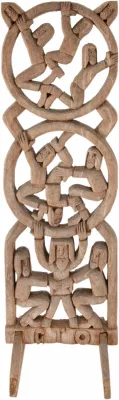

Geraldo Teles de Oliveira (Itapecerica MG 1913 - Divinópolis MG 2006)
Geraldo Teles de Oliveira, better known as GTO, was a renowned Brazilian sculptor and carver. Originating from a humble family, GTO performed several functions before dedicating himself to sculpture, as a rural worker, melter and night watchman. His first solo exhibition took place in 1967, at Galeria Guignard, in Belo Horizonte. From then on, it became part of important collective exhibitions, both in Brazil and abroad, including the Biennale Formes Humaines, at the Musée Rodin, in Paris, in 1974; the 13th São Paulo International Biennial - Special Room, in 1975; and the Venice Biennale, in Italy, in 1980.
The artist addressed regional themes, such as religious festivals and typical dances from the interior of Minas Gerais. His work was the theme of the 1978 book Mitopoética of 9 Brazilian artists, by Lélia Coelho Frota, from 1978, and also of films, such as the Tree of Dreams, by Carlos Augusto Calil, produced for the 42nd Venice Biennial. In 1995, the five years without new dreams of GTO was held in Belo Horizonte, in 1995. His production continued to be shown in important press conferences, such as Popular Art: Exhibition of Rediscovery (2000) and Pop Brasil: Popular Art and O Popular na Arte (2002). Sculptor Geraldo Teles de Oliveira, he originates from a poor family. Working as a night guard, the artist has visions, in which the sculptures he should make are shown to them. As the critic Roberto punctual notes, without ever having done any sculpture work, the artist begins, around 1965, to chop large pieces of wood.
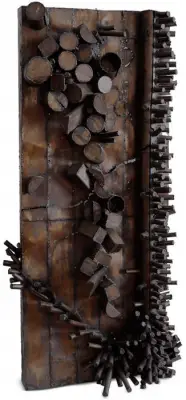
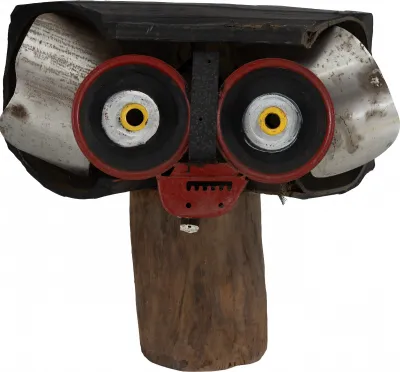
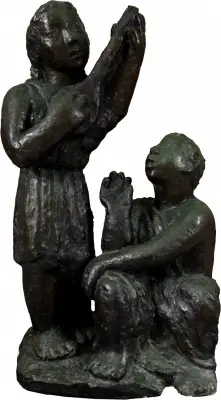
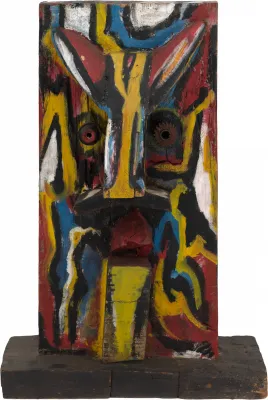
Constantly employs red cedar, maçaranduba-yellow and The Vinhático. In his works, part of the human figure, used schematically and repeatedly, in geometric structures, such as the rectangle and the circle. Frequently using the chisel and the knife, he excavates the wood with energy and precision. It creates surprising effects, exploring the full and empty and the rhythm conferred by the succession of figures in their works.
The characters often have popular traits and clothing and also resemble ex-votos. They are used to fill the entire interior of pieces such as magic wheels or mandalas, which the artist calls live wheels. Also according to Pontual, in his sculptural blocks, GTO associates the registration of popular sources with the emergence of archetypes of the collective unconscious.
In his sculptures, the artist addresses various themes, such as religious festivals and dances from the interior of Minas Gerais. GTO is the precursor of a style and a practice of wood sculpture that are now carried out by a whole series of artists who work in the Divinópolis region, in Minas Gerais. As a punctual note, its final production goes through inevitable simplifications, suffering an attenuation of the complexity of its symbolic record.
Criticism
"All GTO's attitude and work reveal typical magical involvement with reality, Exemplifying, in a very exact way, the mechanics of archaic behavior. Without ever having previously performed any piece of sculpture, he began, around 1965, to chop large blocks of wood toward them to achieve an inconsistent need for expression. Experiencing nocturnal visions that tormented him, especially while working as a guard at a hospital in Divinópolis; these visions were added daytime dreams, until, during one of them, he found himself sculpting, which he took as a supernatural order. impelling him to immediately seek wood and some rough instruments and start the task of intermediary-artist.
The most evident constant of his pieces - in which we curiously find similarity with African black sculpture, especially the Bamilekés, of the Republic of Cameroon - is the oneiric element, involving the accumulation of figures on figures or the syncopated movement of the crank mobile toys".
Roberto Pontual
Pontual, Roberto. Art/Brazil/Today: 50 years later. p. 179.
"The presence of the current is frequent, connecting men to each other, or to the central blocks of Madeira. At the door of their house, on Rua Rubim, in Divinópolis, we see his portrait in a round figure, of half body, carved and painted. He represented himself with long hair, which he uses, and beard, figuring out the oriental messianic type of Christ. Around his neck, a rope is seen, tied with a knot. This figure will perhaps be a replica of the also martyr Tiradentes, which he made for the mayor of São João del Rei. But he is unequivocally the self-portrait of GTO, and his identification to the house, placing him at the entrance of the same, which corroborates this intention. Loffler-delachaux attribute to the rope, and by extension to the current, the general symbolic content of connecting and connecting (...)"
Lélia Coelho Frota
FROTA, Lélia Coelho. Man: Temple in the center of himself, in the wheel of G. T. O. In: ---. Mythopoetics of 9 Brazilian artists: life, truth and work. p. 97.
"GTO gives his work this singular perspective, which is, at the same time, faith in the craft and in the ability to create 'beautiful' forms that reflect the astonishment in the world in which he lives. the dances, the religious festivals and all the sabbath of the interior of Minas, as well as allegories about events and figures that he heard about and about a great myth: the machine. It is the sculptor himself who claims that his pieces are the portrait of the things with which I dreamed of. He dreams of demons and wild beasts, war, the apocalypse, death; he cannot explain his nightmares but with images he carries. One of the essential qualities of his sculpture is sincerity. In his simplicity and naivety, he can place himself as one of the elect, one of those who allowed themselves to be possessed by the sacred fire; interpreter of the 'will of God', he transposes his will to the earthly planes, making it his highest inspiration."
Márcio Sampaio
SAMPAIO, Márcio. In: Global Winter Salon, 6. [catalog]. n. P.
Individual exhibitions
1967 - Belo Horizonte MG - Individual, at Galeria Guignard
1968 - Rio de Janeiro RJ - Individual, at the Copacabana Palace Gallery
1987 - Rio de Janeiro RJ - GTO: Twenty Years of Dreams, at the Historical Museum
1987 - Divinópolis MG - GTO: Twenty Years of Dreams, at the Historical Museum
Collective exhibitions
1968 - Belo Horizonte MG - The naive art
1969 - Belo Horizonte MG - 1st Contemporary Art Salon
1969 - São Paulo SP - 10th São Paulo International Biennial, at the Biennial Foundation
1970 - Belo Horizonte MG - 2nd Contemporary Art Salon - Acquisition Award
1970 - Belo Horizonte MG - The evolutionary process of art in Minas, at Palácio das Artes
1970 - São Paulo SP - Pre-Bienal de São Paulo, at the Bienal Foundation
1972 - São Paulo SP - Art/Brazil/Today: 50 years later, at the Collectio Gallery
1973 - Brussels (Belgium) - Brazil Export 73
1974 - Paris (France) - Bienale Formes Humaines, at the Rodin Museum
1974 - Paris (France) - Collective, at Galeria Iemanjá
1974 - Paris (France) - Collective, at Galeria Montparnasse
1975 - São Paulo SP - 13th São Paulo International Biennial, at Fundação Bienal
1977 - Belo Horizonte MG - 5th Global Winter Hall, at the Palácio das Artes Foundation
1977 - Brasília DF - 5th Global Winter Hall
1977 - Lagos (Nigeria) - 2nd World and African Festival of Black Art and Culture
1977 - Rio de Janeiro RJ - 5th Global Winter Hall, at the MNBA
1977 - São Paulo SP - 5th Global Hall Winter, at MASP
1978 - Belo Horizonte MG - 1st Plastic Arts Hall of the State Council of Culture, at Palácio das Artes
1978 - Venice (Italy) - 42nd Venice Biennale
1979 - Belo Horizonte MG - 6th Global Winter Salon, at the Clóvis Salgado Foundation. Minas Gerais Dance Company
1979 - São Paulo SP - Latin American Biennial Myths and Magic
1981 - Belo Horizonte MG - 8th Global Winter Salon, at Fundação Palácio das Artes
1981 - Rio de Janeiro RJ - 8th Global Winter Salon, at MAM/SP
1981 - São Paulo SP - 16th São Paulo International Biennial, at the Bienal Foundation
1981 - São Paulo SP - 8th Global Winter Hall, at the MAM/SP
1982 - São Paulo SP - A century of sculpture in Brazil, at MASP
1984 - Belo Horizonte MG - 1st Visual Arts Salon of the Clóvis Salgado Foundation, at Fundação Clóvis Salgado. Palácio das Artes
1985 - São Paulo SP - Art Brut, in the hall of the Cine Metrópole Gaumont
1986 - Rio de Janeiro RJ - Madeira Art, at the Folklore Museum
1987 - Belo Horizonte MG - 1st Madeira à Moda Mineira, at Galeria Trem de Minas
1988 - Belo Horizonte MG - 2nd Madeira à Moda Mineira, at Galeria Trem de Minas
1990 - Rio de Janeiro RJ - Exhibition sponsored by the company Vale do Rio Doce
Posthumous exhibitions
1993 - Rio de Janeiro RJ - Brazil: 100 years of modern art, in the MNBA
1995 - Belo Horizonte MG - The heirs of the night: fragments of the black imagination, in the center of Culture of Belo Horizonte
1995 - Belo Horizonte MG - Five years without new dreams of GTO, at Galeria Paulo Campos Guimarães
2001 - New York (United States) - Brazil: Body and Soul, at Solomon r. Guggenheim Museum
2001 - São Paulo SP - Expressão Popular, at Centro Cultural Light
2002 - São Paulo SP - Pop Brazil: Popular Art and Popular in Art, at CCBB
2004 - São Paulo SP - Form, color and expression: a collection of Brazilian art, at the São Paulo station
2004 - Rio de Janeiro RJ - Brazil: 100 years of modern art, at the MNBA
Source: Itaú Cultural