Georg Grimm (Kempten, Alemanha 1846 - Palermo, Itália 1887)
Painter, teacher, decorator.
Johann Georg Grimm attended the Munich Academy of Fine Arts between 1868 and 1870, where he probably studied with Karl von Piloty (1826 - 1886) and Franz Adam (1815 - 1886). After a journey through Italy, Greece, Turkey, Palestine and North Africa, he went to Brazil in 1878. He made frequent trips to the interior of Rio de Janeiro and Minas Gerais, producing studies of landscapes and coffee farms. From 1882 to 1884, he was acting professor of landscape, flowers and animals at the Academia Imperial de Belas Artes - Aiba [Imperial Academy of Fine Arts]. In mid-1884, he broke with the Aiba owing to growing disagreements with the board and other teachers, caused by his lack of faith in the institution's teaching methodology. He then gathered a group of artists, later known as the Grupo Grimm [Grimm Group], made up of Castagneto (1851 - 1900), Caron (1862 - 1892), Garcia y Vasquez (ca. 1859 - 1912), Francisco Ribeiro (ca. 1855 - ca. 1900), Antônio Parreiras (1860 - 1937), França Júnior (1838 - 1890) and Thomas Driendl (1849 - 1916), with whom he practiced open-air painting. Between 1885 and 1886, he traveled through towns in Rio de Janeiro and Minas Gerais, where he produced commissioned works. In 1887, he returned to Europe.
Critical Commentary
Johann Georg Grimm, the son of a carpenter, worked in his youth as a goatherd and in craft-related trades, among them house painting. He attended the Akademie der Bildenden Künste [Academy of Fine Arts] in Munich, between 1868 and 1870. According to the historian Carlos Maciel Levy, he may have been a student of the important Munich masters Karl von Piloty (1826 - 1886) and Franz Adam (1815 - 1886). In 1870, he served as a soldier in the Franco-Prussian War, when he befriended the fellow combatant and painter Thomas Driendl (1849 - 1916), who also moved to Rio de Janeiro in 1881. After a journey through Italy, Greece, Turkey, Palestine and North Africa, Grimm came to Brazil in 1878.
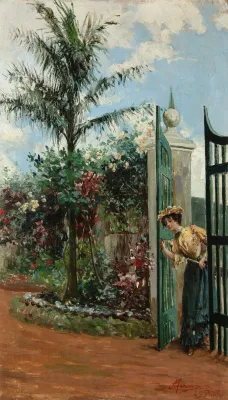
On arrival, he worked with the German decorator Friedrich Anton Steckel painting the walls of residences. In 1882, the Sociedade Propagadora das Belas Artes [Society for the Promotion of Fine Arts] organized for the first time a public exhibition outside the Academia Imperial de Belas Artes - Aiba, held at the Liceu de Artes e Ofícios in Rio de Janeiro. Grimm took part with more than 100 works - most of them painted outside Brazil -, which represented about a quarter of all the works shown. However, these paintings have been lost and very few are known today. According to Gonzaga Duque (1863 - 1911), a critic contemporary with the painter: "In two, three or five hours one made, in front of his canvases, a journey around the world. The nature of the countries where Jorge Grimm had been appeared to us radiant with light and color, before our idle eyes, accustomed to the pale, anemic, wretchedly sickly paints of most of our landscape painters". He traveled frequently to the interior of Rio de Janeiro and Minas Gerais, producing studies of landscapes and coffee farms with documentary aims. His painting shows a strong concern with luminosity and the observation of nature. Although Grimm's canvases depict an enormous amount of detail, the emphasis on description does not make his painting cold and lifeless.
Following his success at the exhibition, he was invited to teach at the Aiba as acting professor of landscape, flowers and animals, a post he held from 1882 to 1884. By declaring that his classes would be held outdoors and that the students should paint landscapes in front of nature, Grimm broke with academic teaching. Owing to growing disagreements with the board and other teachers, mainly because of his lack of faith in the institution's methodology, he left the Aiba. He moved to Niterói and from then on gathered a group of artists, known as the Grupo Grimm, with whom he painted outdoors. The group included some Aiba students, among them Castagneto (1851 - 1900), Caron (1862 - 1892), Garcia y Vasquez (ca. 1859 - 1912), Francisco Ribeiro (ca. 1855 - ca. 1900), Antônio Parreiras (1860 - 1937) and França Júnior (1838 - 1890), as well as his friend and compatriot Thomas Driendl, who occasionally replaced him.
Grimm's work as a teacher revolutionized the teaching of landscape painting, but his canvases, despite showing a deep understanding of the subject, are relatively conventional - as we see in the detailed and faithful manner of Vista do Rio de Janeiro Tomada da Rua do Senador Cassiano em Santa Teresa [View of Rio de Janeiro Taken from Rua do Senador Cassiano in Santa Teresa] (1883) - and do not represent a change as profound as that of his classes. This is noticeable even when avoiding comparisons with European Impressionist painters of the same period who also painted outdoors.
In 1882, with Thomas Driendl, he decorated the Liceu Literário Português in Rio de Janeiro, later destroyed by fire. In 1884, at the Exposição Geral de Belas Artes [General Fine Arts Exhibition], he was awarded, together with Driendl and Castagneto, the 1st gold medal. Other students of Grimm, such as Vasquez, Caron and França Júnior, also received prizes, which represented a great victory and the consecration of the Grupo Grimm. Three years later, already in poor health because of tuberculosis, after visiting Parreiras, he traveled to Italy, passing through Tunis and Sicily, and arrived in Palermo, where he died.
Critiques
"At the venerable Imperial Academy, Georg Grimm's class became the center of compensation for the frustrations generated by the immobility of the teaching processes adopted at the time. The German master professed the broadest admiration for nature and, now, under the tropical sun and luminosity, found the best environment to give himself over to his wandering, adventurous spirit. All places, near or far, became objects of interest for the teacher and his students. (...) the aim of Grimm and his students was not to study or make studies at the very places to be represented, but in fact to perceive and feel them in their natural integrity (...). Despite the powerful and beneficial influence he exerted, Grimm was an artist conditioned by well-defined limitations, and his paintings bear witness to the remnants of an overly rigid training little inclined to structural changes (...). Antônio Parreiras found in the absence of subjectivity in his master's paintings the motivation to state that Grimm was not an artist, it grieves me immensely to say it. He was, however, a great painter."
Carlos Roberto Maciel Levy
LEVY, Carlos Roberto Maciel. O Grupo Grimm: paisagismo brasileiro no século XIX. Rio de Janeiro: Pinakotheke, 1980.
"(...) Georg Grimm was perhaps the most successful of the German painters, and his influence on Brazilian painting is considerable. He was a great artistic personality with a large circle of talented students. The Bavarian artist began his teaching by rebelling against old conventions and traditions and moved his classes from the classroom to the open air. In the forests and mountains around Rio, he taught his students to contemplate nature in order to represent it well. (...) His merit, in the history of Brazilian art, was to have created a school from which important and well-known artists emerged."
Karl Heinrich Oberacker
LEVY, Carlos Roberto Maciel. O Grupo Grimm: paisagismo brasileiro no século XIX. Rio de Janeiro: Pinakotheke, 1980.
"Grimm does not work chiaroscuro like Henri-Nicolas Vinet, who places it at the service of modeling each component of the representation. He knows how to cast large shadows over areas of the picture, refine the white and create a symphonic effect with the half-tones and the variations of color tendency under a single dominant. In these pictures little of the sky can be seen. A mass of rocks climbing the canvas, like the dirt roads leading to the city, defines ascending surfaces, and the eye is forced to climb the landscape step by step, along faces of solid figures oriented in multiple directions."
Ana Maria de Moraes Belluzzo
BELLUZZO, Ana Maria de Moraes. O Brasil dos viajantes. São Paulo: Metalivros, 1994. v. 3: A construção da paisagem, p. 148-149.
"Grimm's landscapes seem impassive: he follows, with the curiosity of a geologist and the obstinacy of a hunting dog, the movement of a rock fault, the reverberation of the sun on each stone, the bare base of a granite hill and the green glimmer of a patch of vegetation beside a crystal-clear stream. At times, small human figures watch, lost, the spectacle of nature.
The painter's craft is all there, in this ability to achieve an apparently unemotional effect - to concentrate on seeing, to resolve itself in detail. Grimm certainly lacks a sure knowledge of form. He always seems ready to lose himself, fascinated, in pursuit of endless fragments, but when the pictures reach dimensions that allow him to make his voice resound freely, the landscape takes shape in monumental evidence, stripped of all rhetoric.
This is no small thing, especially in a field in which landscape painting had been, above all, illustration."
Luciano Migliaccio
MIGLIACCIO, Luciano. O século XIX. In: MOSTRA DO REDESCOBRIMENTO, 2000, São Paulo. Arte do século XIX. São Paulo: Fundação Bienal de São Paulo: Associação Brasil 500 anos Artes Visuais, 2000. p. 128.
Group Exhibitions
1882 - Rio de Janeiro RJ - Group show, at Sociedade Propagadora das Belas Artes, at Liceu de Artes e Ofícios
1884 - Rio de Janeiro RJ - 26ª Exposição Geral de Belas Artes [26th General Fine Arts Exhibition], at Aiba - gold medal
1885 - Rio de Janeiro RJ - Loja Laurent de Wilde: mostra inaugural [Laurent de Wilde Shop: Opening Exhibition], at Loja Laurent de Wilde
Posthumous Exhibitions
1948 - Rio de Janeiro RJ - Retrospectiva da Pintura no Brasil [Retrospective of Painting in Brazil], at MNBA
1953 - São Paulo SP - 2nd São Paulo International Biennial, at Pavilhão dos Estados
1977 - Rio de Janeiro RJ - Aspectos da Paisagem Brasileira: 1816-1916 [Aspects of the Brazilian Landscape: 1816-1916], at MNBA
1980 - Rio de Janeiro RJ - O Grupo Grimm: paisagismo brasileiro no século XIX [The Grimm Group: Brazilian Landscape Painting in the 19th Century], at Acervo Galeria de Arte
1980 - São Paulo SP - A Paisagem Brasileira: 1650-1976 [The Brazilian Landscape: 1650-1976], at Paço das Artes
1984 - São Paulo SP - Tradição e Ruptura: síntese de arte e cultura brasileiras [Tradition and Rupture: A Synthesis of Brazilian Art and Culture], at Fundação Bienal
1986 - São Paulo SP - Dezenovevinte: uma virada no século [Nineteen-Twenty: A Turn of the Century], at Pinacoteca do Estado
1989 - Fortaleza CE - Arte Brasileira dos Séculos XIX e XX nas Coleções Cearenses: pinturas e desenhos [Brazilian Art of the 19th and 20th Centuries in Ceará Collections: Paintings and Drawings], at Espaço Cultural da Unifor
1989 - Rio de Janeiro RJ - O Rio de Janeiro de Machado de Assis [Machado de Assis's Rio de Janeiro], at CCBB
1989 - São Paulo SP - Pintores Alemães no Brasil durante o Século XIX [German Painters in Brazil during the 19th Century], at Museu da Casa Brasileira
1992 - Rio de Janeiro RJ - Natureza: quatro séculos de arte no Brasil [Nature: Four Centuries of Art in Brazil], at CCBB
1993 - Rio de Janeiro RJ - Paisagens Brasileiras pelos Artistas Estrangeiros [Brazilian Landscapes by Foreign Artists], at Galeria de Arte Sesc Tijuca
1994 - São Paulo SP - Um Olhar Crítico sobre o Acervo do Século XIX [A Critical Look at the 19th-Century Collection], at Pinacoteca do Estado
1994 - São Paulo SP - O Brasil dos Viajantes [The Travelers' Brazil], at Masp
1995 - Lisbon (Portugal) - O Brasil dos Viajantes [The Travelers' Brazil], at Centro Cultural de Belém
1996 - London (England) - Brazil Through European Eyes, at Christie's
2000 - Porto Alegre RS - De Frans Post a Eliseu Visconti: acervo Museu Nacional de Belas Artes - RJ [From Frans Post to Eliseu Visconti: Museu Nacional de Belas Artes - RJ Collection], at Margs
2000 - São Paulo SP - Brasil + 500 Mostra do Redescobrimento [Brazil + 500 Rediscovery Exhibition], at Fundação Bienal
2000 - São Paulo SP - O Café [Coffee], at Banco Real
2001 - São Paulo SP - Trajetória da Luz na Arte Brasileira [Trajectory of Light in Brazilian Art], at Itaú Cultural
2002 - Rio de Janeiro RJ - Arte Brasileira na Coleção Fadel: da inquietação do moderno à autonomia da linguagem [Brazilian Art in the Fadel Collection: From the Restlessness of the Modern to the Autonomy of Language], at CCBB
2002 - São Paulo SP - Arte Brasileira na Coleção Fadel: da inquietação do moderno à autonomia da linguagem [Brazilian Art in the Fadel Collection: From the Restlessness of the Modern to the Autonomy of Language], at CCBB
2002 - São Paulo SP - Imagem e Identidade: um olhar sobre a história na coleção do Museu de Belas Artes [Image and Identity: A Look at History in the Museu de Belas Artes Collection], at Instituto Cultural Banco Santos
2003 - Brasília DF - Arte Brasileira na Coleção Fadel: da inquietação do moderno à autonomia da linguagem [Brazilian Art in the Fadel Collection: From the Restlessness of the Modern to the Autonomy of Language], at CCBB
Source: Itaú Cultural