Diego Rivera (1886 - 1957)
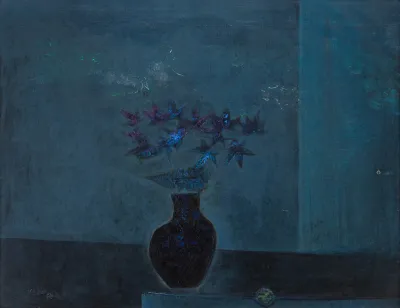
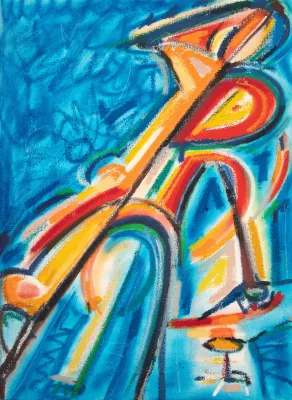
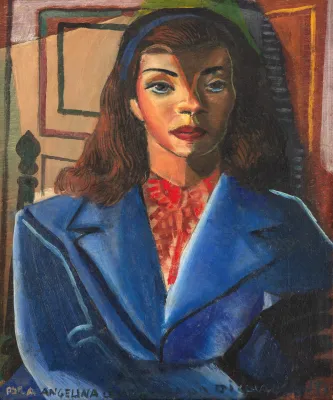
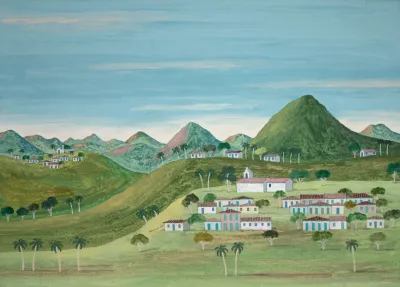
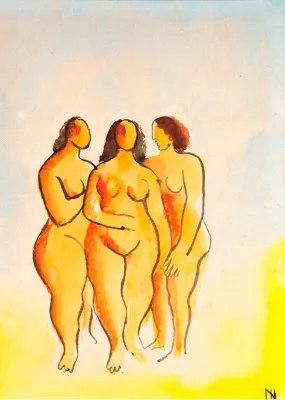
Diego María de la Concepción Juan Nepomuceno Estanislao de la Rivera y Barrientos Acosta y Rodríguez was born in 1886 in Guanajuato, Mexico. A naturally gifted artist, he began his formal art education at a young age, but his talent truly began to flourish when he went to Europe. Since childhood he had always wanted to be a painter, and everyone could see he had a talent for it. As a young adult, after studying painting in his teens, he attended the Academia de San Carlos in Mexico City and then left for Europe on a scholarship, staying there from 1907 to 1921. During his time in Europe, Rivera was exposed to avant-garde art. In Paris, he had a front-row seat to the development of the Cubist movement, and in 1914 he met Pablo Picasso, who expressed admiration for the young Mexican's work. Leaving Paris when the First World War broke out, he went to Spain, where he helped introduce Cubism in Madrid. He would travel around Europe until 1921, visiting various regions, including the south of France and Italy, and was influenced by the works of Cézanne and Renoir. This experience greatly enriched him artistically, as he came into contact with many painters of the time, such as Pablo Picasso, Salvador Dalí, Joan Miró and the Catalan architect Antoni Gaudí, who influenced his work. At this time he began working in a studio in Madrid, Barcelona. Returning to Mexico, Rivera soon found work with the new revolutionary government. The Secretary of Public Education, José Vasconcelos, believed in education through public art, and commissioned several paintings and murals in government buildings from Diego Rivera, as well as from his fellow painters David Alfaro Siqueiros and José Clemente Orozco. The beauty and artistic depth of the paintings by Rivera and his fellow muralists won international acclaim. With fame, Diego Rivera received commissions to paint in countries other than Mexico. He traveled to the Soviet Union in 1927 as part of a delegation of Mexican communists. He painted murals at the California School of Fine Arts, The American Stock Clube Luncheon Exchange and the Detroit Institute of Arts, and another was commissioned for Rockefeller Center in New York. However, it was never completed because of the controversy over Rivera's inclusion of an image of Vladimir Lenin in the work. Although his stay in the United States was short, he is considered a major influence on American art. Rivera was an atheist and faced serious problems because of it, suffering much prejudice. His mural Sueño de una tarde dominical en la Alameda Central [Dream of a Sunday Afternoon in the Alameda Central] depicted Ignacio Ramírez holding a sign that read: God does not exist. The work caused outrage, but Rivera refused to remove the inscription. The painting was not shown for nine years. After Rivera agreed to remove the inscription, he declared: To say “God does not exist”, I do not have to hide behind Don Ignacio Ramírez; I am an atheist and I consider religions a form of collective neurosis. Diego Rivera returned to Mexico in 1934, where he resumed his life as a politically active artist. He was instrumental in Leon Trotsky's move from the Soviet Union to Mexico: Trotsky himself lived with Rivera and Frida Kahlo for a time. At the Palace of Fine Arts, it was removed because it included images of Stalin and Mao Tse-tung. Also in 1934, he painted another version of El hombre en una encruzilhada [Man at the Crossroads] at the Palacio de Bellas Artes in Mexico. In 1936, Rivera was asked to help secure political asylum for Leon Trotsky, which he did with President Lázaro Cárdenas, obtaining it. In 1937, Leon and Natalia Trotsky were received at Frida's Blue House in Coyoacán. André and Jacqueline Breton arrived in Mexico in 1938 and stayed at the home of Lupe Marín. The Riveras, the Bretons and the Trotskys were friends and traveled together around Mexico. Because of his anarchist ideas, and for supporting a conservative presidential candidate, he broke with Leon Trotsky in 1939. In 1940, he was diagnosed with diabetes. He separated from and divorced Frida Kahlo. He was invited to exhibit at the Golden Gate Exposition in California. Siqueiros led an attack on Leon Trotsky in Frida's house. Trotsky was murdered by the Spaniard Ramón Mercader. Frida went to San Francisco and reconciled with Diego. They remarried, but lived in separate houses. From 1936 to 1940, Rivera devoted himself especially to painting landscapes and portraits. An essayist and a controversial figure, with André Breton he published the manifesto Pour un art révolutionnaire indépendant (1938). On the other hand, this great Mexican painter left his country a remarkable collection of indigenous figures, housed in his museum-house, called Anahuacalli. In 1943, he painted murals at the Instituto de Cardiología in Mexico City. He taught composition and painting at El Colegio Nacional. Despite their stormy relationship, Diego was devastated by Frida Kahlo's death in 1954. In 1955, he married Emma Hurtado. He donated to the people of Mexico Frida's Blue House, which became a museum, Anahuacalli, and the collection of pre-Hispanic pieces he had amassed over his lifetime. He suffered from cancer and went to the USSR for treatment. Diego Rivera died on November 24, 1957, in San Ángel, Mexico City, in his home studio, now known as the Museo Casa Estudio Diego Rivera y Frida Kahlo, and his remains were placed in the Rotunda of Illustrious Persons, contrary to his last wishes. In simplified, colorful forms, Diego Rivera beautifully recovered the pre-Columbian past, as well as the most significant moments in Mexican history: the land, the farmer and the worker, customs, and popular character. Diego Rivera's contribution to Mexican modern art was decisive in murals and easel paintings; he was a revolutionary painter who sought to bring art to the public, to the streets and buildings, in a precise and direct language full of social and realist content. Alongside his creative effort, Diego Rivera promoted education in his country, which holds a magnificent collection of the artist's work.
Testimonials
My homecoming produced an aesthetic joy that is impossible to describe. It was as if I were being born again, born into a new world... I was at the very center of the plastic world, where forms and colors existed in absolute purity. In everything I saw a potential masterpiece: the crowds, the markets, the festivals, the marching battalions, the workers in the shops and in the fields, in every glowing face, in every luminous child... My style was born as children are born, in a moment, except that this birth came after a torturous 35-year pregnancy. Diego Rivera Rivera, who... was to turn the history of Mexico into one of the great myths of our century, could not, in recalling his own life for me, restrain his colossal imagination. He had already turned certain events, especially from his early years, into legends. Gladys March
Interview with Diego Rivera by Elenita Poniatowska
What is the height of happiness for you? -Not having been born.
Not even Frida Kahlo's love justifies your existence, Diego? -No. Because I really did her so much harm that it would have been better not to have been born.
Your mother would not say the same thing, maestro. -I never loved my mother and I never got along with her. . .
You are like a man who begins his work with: I hate my mother. -Well, not that much. (Diego declares that he made Frida suffer, and yet I remember a passage by Frida herself: perhaps they expect to hear my cries about “how much suffering” it is to live with a man like Diego. ) But I do not think the banks of a river suffer from letting it flow. . . ) - Let's see, another little question.
Forgive me, maestro, I got distracted. What is the depth of unhappiness for you? - The depth of unhappiness ranges between constipation and having to attend a society gathering.
And yet you appear in the newspapers every other day. Aren't you a friend of the Three Hundred and Some More? Doesn't it matter to you? - No
But you like to portray them! -Yes. But I do not know them.
Not even those you portray? Like you? -To portray someone there is no interest in or need to know the model.
That is impossible! -I mean it. There are two ways of knowing. The worldly one, in which I do not know society, because I do not have the honor of frequenting it. And the biblical sense, in which I can say that I know, that I have known.
And what is the biblical sense? -No, no, no! Don't you know a little? It is the sense in which Noah knew his daughters to increase and multiply humanity. Besides, one does not need worldly knowledge to understand society and know everything about it from its origin to its present and near future, and to observe it carefully, deeply and passionately, and even to love it in the person of its finest female specimens. I think that is why I have been able to paint it. It does not matter that the love was not returned in most cases...
And who are the women you have loved? -The women I have loved? I was lucky enough to love the most wonderful woman I have ever known. She was poetry itself and genius itself. Unfortunately, I did not know how to love her alone, for I have always been incapable of loving only one woman. My friends say my heart is a multi-family building. For my part, I think the word love implies no numerical limitation of any kind, but rather embraces all of humanity.
But what I need are names, Señor Rivera, names. . . what are the names of the women you love? - If I had to give all the names I would have to apologize to all of them... and may our Mother of Guadalupe spare us such a thing! Secondly, I would earn a reputation as pretentious, pompous and cowardly, and I would close off for myself the exclusive paths I intend to explore in this filthy life.
But do you consider women only as women? Or do you believe in their intelligence and superiority? Do you believe in a matriarchy? -First of all, I am certain that woman is not of the same species as man. Humanity is woman. Men are a subspecies of animal, almost stupid, insensitive, unfit for love, created by women to place at the service of the intelligent and sensitive being they represent. A semi-intelligent animal that carries out the tasks required by the direction of women: man is to woman what the horse is to man, and nothing more.
Don't you mind being a horse, Diego? - A donkey, as long as she saddles me! (Well, Frida said: I will not speak of Diego as my husband because that would be ridiculous. ) Diego has never been, nor will he ever be, anyone's husband. Nor a lover, because he encompasses much more than sexual limitations, and if I spoke of him as my son, I would only be describing or painting my own emotion, almost my self-portrait, and not Diego). -I would give everything I have been able to enjoy, including the love of Frida Kahlo, the only truly great thing I have had, to have been spared the confusion and annoyance I had to endure in order to live. That does not mean I am a pessimist. I am something of an Epicurean and a hedonist, insofar as those tendencies fit within Marxism. It is clear, therefore, that the greatest pleasure is to exist within the marvelous universal organization of matter and to bear the inconvenience of inhabiting the most badly made world one can know, which is our beloved Earth.
So, if you could go back to birth, would you return to Earth? - That is a joke.
Where would you like to go? -Anywhere but Earth.
Don't you believe in God? -Definitely not. Because one cannot believe in a force that is implicit and present in every manifestation of energy or matter. One only believes when one does not understand. And the concept of gods is a miserable reduction to the scale of a world where every living being must kill in order to live, a reduction of the marvelous principle of life that animates everything, merely as desirable or undesirable, perhaps only because we do not understand it clearly.
But, maestro, don't religions matter to you? -I respect all religions. They interest me extraordinarily, on the same plane and for the same reasons that I respect all diseases and am extremely interested in curing them.
And what would be the cure for religious diseases? -The cure is the new socialist society in its full development, which will bring the death of the state and the general spread of the greatest possible knowledge of universal existence, when there are no repressions, authorities, ignorance, fear of death, or helplessness in preventing pain. When the forces of the universe are clear and understood, there will be no reason to invent gods to give us what we cannot obtain by our own strength. . . - But, maestro, something always eludes us, something we aspire to from the depths of our eternally incomplete being: that is God.
What is the historical event you most admire? -The October Revolution, which gave power to the Soviet proletariat and will thus give it to the proletariat of the world.
What social reform are you most eagerly awaiting? -The establishment of communism in the world and, consequently, the death of the state.
But, maestro, what does the Communist Party do for Mexico? -The Communist Party is the only one that defends the interests of the people, that is, of the productive majorities, manual and intellectual, against their exploiters, at home and abroad. In everything that has represented something favorable to the people of Mexico over the last 35 years, the party has been present and visible in action, which means that what the Communist Party does is exercise patriotism, or love for Mexico, expressed in actions favorable to the country. No other party can say the same, and one day the people of Mexico will belong to the Communist Party. Then human solidarity will be established in our homeland, and the greatest possible well-being within the real conditions of the world will follow as a consequence. - Elenita, are you making fun of your interviewees, or not?
Maestro, not much, not much,. . . may I ask you the next question? -Go ahead.
Which historical figure do you most admire? -I could not choose between Friedrich Engels, Karl Marx and Lenin.
For which faults do you feel the greatest indulgence? -For the biggest ones.
Could you give me a definition of your character? -Unfortunately, I am not a medium, or a psychoanalyst, or even a philosopher. As for my character, who knows, because I don't... I think...
And you don't try to find out? Yes, but without getting it. All my life I have tried to find out, without success. Introspection has been a complete failure for me.
And do you think there is anyone who knows you? -I think all the women who have had relations with me, even if only friendly or professional ones, for example you yourself, Elenita Poniatowska.
Do you believe in virtue? -Don Francisco de Quevedo said long ago: There is no virtue even in the dark. I extend physical reality to imaginative and psychological reality, and in that I agree completely with Don Francisco de Quevedo.
Which writer has impressed you most? -Rabelais.
Why? -This is not Marcel Proust's questionnaire, and I will not answer because it would be endless.
Who are your heroes and heroines in real life? -The list is very long, but I can name at least Madame Lovachewska, Marie Curie and Frida Kahlo. And going back to the top of the list, Queen Nefertiti.
Why Nefertiti? I admire Madame Lovachewska because her conception of the parallel universe did not find it ovoidal, as Euclid did, but always sought to know it. Without the Polish female brain, modern science would not have been possible. Whenever men reach a dead end in their scientific conclusions, a woman knocks down the wall that blocked man's way forward. So did Nefertiti, and later Lovachewska. None of today's science would have been possible within Euclid's concept, and when man could not move forward on the path begun by the Polish scholar, another great female brain provided the opportunity. Marie Curie's discoveries opened up enormous spaces where all present knowledge of matter now lies, especially regarding its most essential structure: the atom. I would not have known, as I now know and as all people will one day know, what the heroism of pain can be, joy in spite of agony, tenderness and boundless plastic genius in its most intimate and direct form, if I had not known Frida Kahlo. She is one of my heroes.