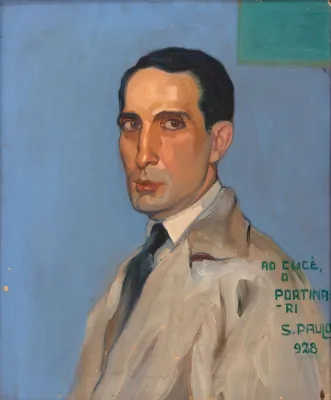

Cássio M'Boy (Mineiros do Tietê SP 1903 - São Paulo SP 1986)
Cássio M'Boy was a painter, sculptor, decorator, designer, costume designer and stained-glass artist. He began his studies in the drawing and anatomy classes of the German painter Georg Elpons (1865 - 1939) in São Paulo. In Rio de Janeiro, he attended classes at the Escola Nacional de Belas Artes (Enba) [National School of Fine Arts]. During the 1920s, he came into contact with the group of São Paulo modernists and began producing fabric prints, furniture designs and decoration projects. In that same period, he lived in Embu, São Paulo, where he carved images of saints.
In 1934, he took part in the 1st Salão Paulista de Belas Artes [São Paulo Fine Arts Salon], in the applied arts category. Three years later, he received an award at the Exposition Internationale des Arts et Techniques in Paris for the sculpture Fuga para o Egito [Flight into Egypt]. In 1938, he showed work at the Salão de Maio [May Salon], a period in which he also worked as a decorator.
He held his first solo exhibition in 1950 at the Museu de Arte de São Paulo Assis Chateaubriand (Masp). That same year, he took part in the Tokyo Salon in Japan and, in 1952, was part of the Brazilian delegation to the 26th Venice Biennale. He held two more solo exhibitions, in 1961 and 1970, at the Museu de Arte Moderna do Rio de Janeiro (MAM/RJ) and at the Paço das Artes in São Paulo, respectively.
After his death, the rugs he designed in the 1930s were included in the exhibitions Arte Construtiva no Brasil: Coleção Adolpho Leirner [Constructive Art in Brazil: Adolpho Leirner Collection], at MAM/SP in 1998 and at MAM/RJ in 1999; and O Art Déco Brasileiro: Coleção Fulvia e Adolpho Leirner [Brazilian Art Deco: Fulvia and Adolpho Leirner Collection], at the Pinacoteca do Estado de São Paulo (Pesp) in 2008.
Critical Commentary
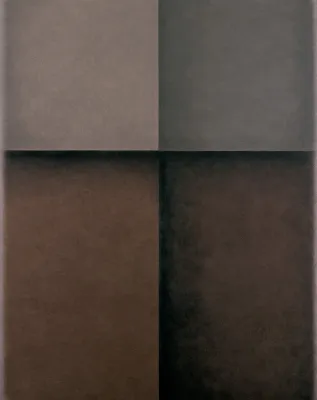
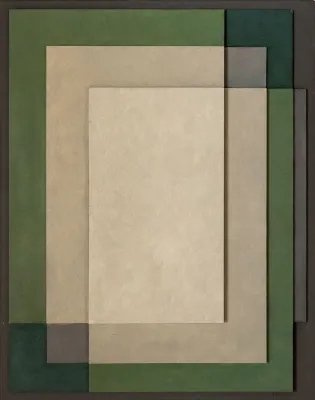
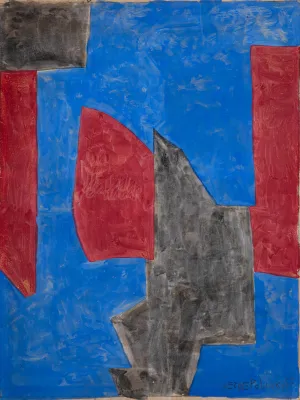
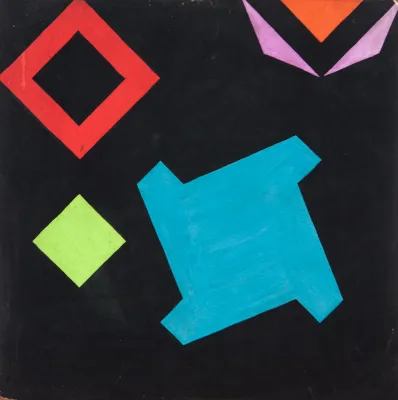
Cássio M'Boy's decorative work, creating designs for furniture, rugs and small sculptures, is guided above all by the Art Deco style. In the abstract-geometric rugs of the 1930s, the composition is built through the juxtaposition, in different directions, of semicircles and rectangles whose colors create a sense of volume and depth. In the small sculptures, as in Figura [Figure], 1930s, a continuous, elongated, elegant line defines a body that bends to tie a feather to its ankle.
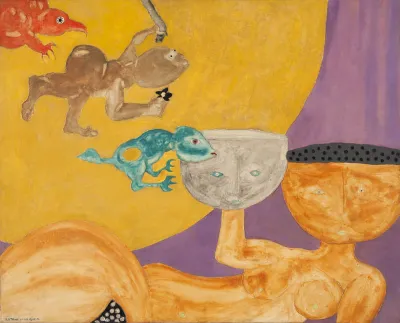
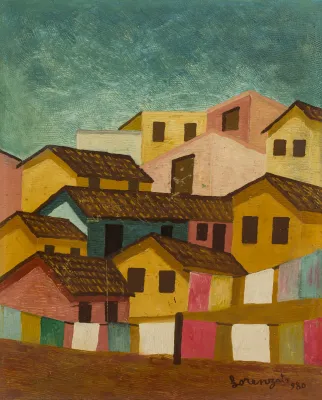
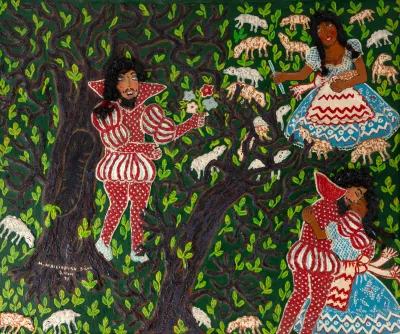
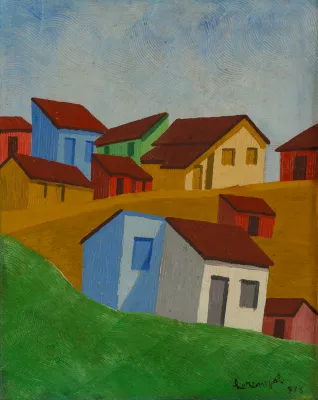
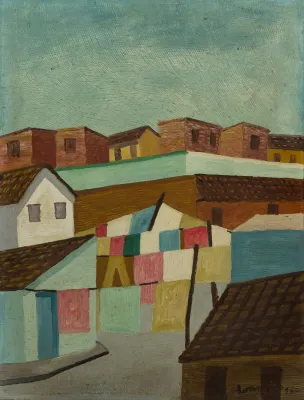
In the same period, he worked with religious themes, carving images of saints, and soon came to devote himself entirely to painting popular and religious themes. Apparently, M'Boy separates the formal solutions used in the "applied arts" from the visual procedures that organize the rest of his artistic production. The compositional logic of these works approaches so-called "naive" or "primitive" painting, even though the artist had formal training and deliberately sought this kind of visual solution. In this production, the image becomes less illusionistic.
M'Boy is known mainly for this phase of his work, being regarded as a painter of folk themes, to the point that Mário de Andrade (1893 - 1945) stated that M'Boy was the embodiment of folklore itself. According to the critic José Geraldo Vieira, this interpretation is due above all to the "very rustic domestic setting" and to the "crude processes" and "simple themes" he uses1.
Notes
1 PONTUAL, Roberto. Dicionário das artes plásticas no Brasil. Apresentação de Antônio Houaiss. Textos de Mário Barata et al. Rio de Janeiro: Civilização Brasileira, 1969, p.351.
Critiques
"People still insist on including Cássio M'Boy among the naive or primitive painters. This legend stems more from his very rustic domestic setting and the crude processes he uses on simple themes than from his own individual art (...). The truth is that Cássio M'Boy established himself as a painter of hagiographic and folk subjects, from which he never strayed in his studio of bucolic hibernation. Initially a costume designer and a sculptor with craftsman's experience, he soon acquired virtuosity in line, form, volume, color and composition. But the scenes, the human figures as well as the episodes, and in addition the animals, the flowers, the hills, the roads, the waterfalls - everything is drawn and colored with a populist and simple mentality".
José Geraldo Vieira
PONTUAL, Roberto. Dicionário das artes plásticas no Brasil. Apresentação de Antônio Houaiss. Textos de Mário Barata et al. Rio de Janeiro: Civilização Brasileira, 1969.
Solo Exhibitions
1950 - São Paulo SP - First solo exhibition, at Masp
1958 - São Paulo SP - Solo, at the Galeria da Folha de S. Paulo
1960 - São Paulo SP - Solo, at Galeria São Luiz
1961 - Rio de Janeiro RJ - Solo, at MAM/RJ
1970 - São Paulo SP - Solo, at Paço das Artes
1985 - São Paulo SP - A Pintura Caipira de Cássio M'Boy [The Caipira Painting of Cássio M'Boy], at Galeria Encontro das Artes
Group Exhibitions
1934 - São Paulo SP - Takes part, with two sculptures and a felt panel, in the Flávio de Carvalho exhibition closed by the police
1934 - São Paulo SP - 1º Salão Paulista de Belas Artes [1st São Paulo Fine Arts Salon], at Rua 11 de Agosto
1937 - Paris (France) - Exposição Internacional de Artes e Técnicas de Paris [Paris International Exhibition of Arts and Techniques] - gold medal
1938 - São Paulo SP - Salão de Maio [May Salon]
1952 - Venice (Italy) - 26ª Bienal de Veneza [26th Venice Biennale]
ca. 1952 - Tokyo (Japan) - Mostra Internacional de Pintura [International Painting Exhibition]
1960 - São Paulo SP - Coleção Leirner [Leirner Collection], at Galeria de Arte das Folhas
1985 - Rio de Janeiro RJ - 8º Salão Nacional de Artes Plásticas [8th National Salon of Visual Arts], at MAM/RJ
1985 - São Paulo SP - A Arte do Imaginário [The Art of the Imaginary], at Galeria Encontro das Artes
Posthumous Exhibitions
1996 - Osasco SP - Expo FIEO: doação Luiz Ernesto Kawall [Expo FIEO: Luiz Ernesto Kawall Donation], at Centro Universitário Fieo
1998 - São Paulo SP - Arte Construtiva no Brasil: Coleção Adolpho Leirner [Constructive Art in Brazil: Adolpho Leirner Collection], at MAM/SP
1999 - Rio de Janeiro RJ - Arte Construtiva no Brasil: Coleção Adolpho Leirner [Constructive Art in Brazil: Adolpho Leirner Collection], at MAM/RJ
2002 - São Paulo SP - Pop Brasil: a arte popular e o popular na arte [Pop Brazil: Popular Art and the Popular in Art], at CCBB
2002 - São Paulo SP - Santa Ingenuidade [Holy Naivety], at Unifieo
Source: Itaú Cultural