Arthur Timótheo da Costa (Rio de Janeiro RJ 1882 - idem 1922)
Arthur Timótheo da Costa was a painter, draftsman, set designer, wood carver and decorator. He began his studies at the Casa da Moeda (Mint), where he took the drawing course and came into contact with the process of engraving images, following the printing of coins and stamps. In 1894, encouraged by the institution's director, Enes de Souza, he enrolled, together with his brother João Timótheo da Costa, at the Escola Nacional de Belas Artes (Enba), attending the classes of Bérard, Zeferino da Costa, Rodolfo Amoedo and Henrique Bernardelli. Between 1895 and 1900, he learned stage design techniques informally with the Italian Oreste Coliva. He took part in several editions of the Exposição Geral de Belas Artes, winning the foreign travel award in 1907. The following year, he left for Paris, where he stayed for about two years. In 1911, he traveled to Italy as a member of the group of artists responsible for decorating the Brazilian Pavilion at the Turin International Exhibition. In 1919, he founded, with other artists, the Sociedade Brasileira de Belas Artes, in Rio de Janeiro, and in 1920 proposed the free participation of its member artists in the Exposições Gerais de Belas Artes. That same year, he and his brother decorated the Salão Nobre of the Fluminense Futebol Clube. In 1921, he took part in the Exposição Geral de Belas Artes for the last time. He died the following year, as a patient at the Hospício dos Alienados in Rio de Janeiro.
Critical Commentary
The painter Arthur Timótheo da Costa has a humble childhood. Very young, he becomes an apprentice at the Casa da Moeda in Rio de Janeiro, where he begins to take drawing lessons. There, the artist also comes into contact with the processes of engraving images by following the printing of stamps and coins. With the encouragement of the institution's director, Enes de Souza, Arthur Timótheo da Costa is sent in 1894, together with his brother João Timótheo da Costa (1879 - 1930), to the Escola Nacional de Belas Artes - Enba, where he studies with Bérard (1846 - 1910), Zeferino da Costa (1840 - 1915), Rodolfo Amoedo (1857 - 1941) and Henrique Bernardelli (1858 - 1936). Besides his formal studies at Enba, he learns stage design informally, working as an assistant to the Italian Oreste Coliva from 1895 to 1900.
In 1905, the artist makes his debut at the Exposição Geral de Belas Artes, showing two paintings, Diante do Modelo (Before the Model) and Repreensão (Reprimand), but without much success. He fares better in 1907, when he wins the foreign travel award, which leads him to move to Paris the following year. After his time in Paris, he travels through Italy and Spain. During his European stay, his painting changes considerably, to the point that the critic José Roberto Teixeira Leite states that the "Arthur Timótheo da Costa who returns from Paris after two years of absence is not the same one who had gone there so shortly before".1 The artist was approaching impressionist procedures: line ceases to structure the painting, forms are no longer restricted to the rigidity of the outline, and volumes come to be modeled by the brushstroke, which becomes looser and more marked.
After returning to Brazil in 1910, Arthur Timótheo da Costa makes one of the most exemplary paintings of his relationship with avant-garde painting: A Forja (The Forge, 1911). According to the sociologist Gilda de Mello e Souza, this work would have anticipated modern painting in Brazil, both in its subject, the hard toil of industrial labor, and in its treatment, which erases drawing and structures forms through visible, vigorous brushstrokes.2 In 1911, the artist goes to Italy, invited to decorate the Brazilian Pavilion at the Turin International Exhibition. He carries out this undertaking together with João Timótheo da Costa, Carlos Chambelland (1884 - 1950) and Rodolfo Chambelland (1879 - 1967). He does another decoration job in 1920, together with his brother João Timótheo da Costa, at the headquarters of the Fluminense Futebol Clube.
In Brazil, Arthur Timótheo da Costa exhibits regularly at the Exposições Gerais de Belas Artes, winning medals in 1913, 1919 and 1920. His work, in general, continues to depict traditional subjects of academic painting, above all landscape, but deepens the elements of an approach linked to impressionism. The brushstrokes become more marked and faster-moving. In his Auto-Retrato (Self-Portrait, 1919), the image is quite defined, but the brushwork models the whole body portrayed. The effects of depth are maintained, but they are not achieved through the traditional devices of light and shadow.
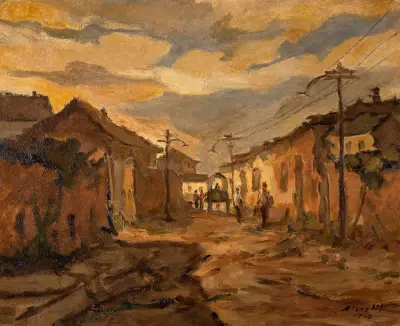
Timótheo da Costa's last landscapes radicalize modeling through the brushstroke and give up the outline. In works such as Cais Pharoux, Sol and Mercado Velho do Rio de Janeiro (1918), drawing disappears under the marks of paint. The brushstroke is more expressive, and at times the artist scratches the color that had been applied to the canvas. The dynamics of color are more prominent than the definition of the figures. Gradually, the artist stops painting. His mental illness worsens irremediably. Hospitalized, he dies on October 5, 1922.
Notes
1 LEITE, José Roberto Teixeira. Pintores negros do oitocentos. São Paulo: MWM-IFK, 1988.
2 SOUZA, Gilda de Mello e Souza. Pintura brasileira contemporânea: os precursores. O Baile das Quatro Artes. São Paulo: Livraria Duas Cidades, 1980. p. 223-247.
Critiques
"At the beginning of his artistic career, Arthur Timótheo da Costa worked for five years with the Italian set designer Oreste Coliva, developing a peculiar skill in executing theater sets. This characteristic, added to the charms of open-air painting revealed by impressionism and to care in technical treatment, is present in most of the artist's compositions. In Auto-Retrato, Timótheo takes great pains over the work, with striking and rigorous drawing and anatomically delineated details, as well as a spontaneous, thick impasto in the lit areas. The remarkable execution of this canvas reveals above all the painter's skill in the enigmatic and expressive play of light and shadow, achieved through a sober set of admirably combined colors".
Abbadia Caparelli and others
O MUSEU Nacional de Belas Artes. Prefácio de Alcidio Mafra de Souza. Editado por Alcidio Mafra de Souza. Textos de Abbadia Caparelli et al. São Paulo: Banco Safra, 1985.
"And the one cut out to be a great artist is his disciple, Mr. Arthur Timótheo da Costa, who day by day shows us his ardent talent and his broad skill as a composer. Antes d'Alleluia (painted in matte paint, by the same process with which Mr. Bernardelli painted the decorations of the Beneficência Portuguesa, and which was therefore called encalca) is a lively canvas, with many groupings, and unfortunately unfinished. What has been done, however, is enough to tell us of the worth of this young artist, extremely likable for his audacity and greatly skilled".
Gonzaga Duque
DUQUE, Gonzaga. Salão de 1907. In: ______. Contemporâneos: pintores e esculptores. Rio de Janeiro: Bendicto de Souza, 1929. p. 165.
"Of all the genres of painting, however, the one that attracted him most was the portrait. He had a rigorous way of painting and drawing; with a firm, sure hand, his works soon acquired that broad technique which so characterized him. Many were the admirable portraits his brushes sketched; among them, however, it is fair to single out that of the painter and sculptor Eduardo Sá, which the latter donated to the Museu Nacional de Belas Artes. The human figure was always Arthur Timótheo da Costa's dominant concern; he painted it with true passion, with unusual tenderness".
Francisco Acquarone
ACQUARONE, Francisco; VIEIRA, Adão de Queiroz. Primores da pintura no Brasil - I. 2.ed. [Rio de Janeiro]: [s.n.], 1942. [145] p.
"Arthur Timótheo da Costa belongs to that generation of painters situated in what is conventionally called the transition, that is, the turn of the century. This in fact implies a duality of procedures, already oscillating between academic norms and the new European trends that emerged with impressionism. Like the other artists of the time, Timótheo da Costa will try to break with the usual teachings of the Academy without, however, freeing himself completely from its influence. There are no examples, in Brazil at that time, of works successfully resolved in plastic terms within impressionist concepts. But, undoubtedly, even while keeping in certain works the dark, earthy palette of the 19th century and the effects of chiaroscuro, Timótheo da Costa will already reveal some understanding of the moderns who were his contemporaries. His work is no longer a mere pictorial transcription of the apparent world. The subject now maintains an affective relationship with the object-environment, building the reality of painting through the sensation with which he perceives the world: making color an awareness of that perception. The value of color is now a constitutive unit of the very space of painting".
Paulo Venâncio Filho
BIENAL BRASIL SÉCULO XX (1994: SÃO PAULO, SP), AGUILAR, Nelson (org.). Bienal Brasil Século XX: catálogo. Apresentação Edemar Cid Ferreira; texto José Roberto Teixeira Leite, Annateresa Fabris, Tadeu Chiarelli, Maria Alice Milliet, Walter Zanini, Agnaldo Farias; curadoria Nelson Aguilar, José Roberto Teixeira Leite, Annateresa Fabris, Tadeu Chiarelli, Maria Alice Milliet, Walter Zanini, Cacilda Teixeira da Costa, Agnaldo Farias. São Paulo: Fundação Bienal de São Paulo, 1994. p. 63.
Solo Exhibitions
1912 - Rio de Janeiro RJ - Solo, at Associação dos Empregados do Comércio
Group Exhibitions
1905 - Rio de Janeiro RJ - 12th General Fine Arts Exhibition, at Enba
1906 - Rio de Janeiro RJ - 13th General Fine Arts Exhibition, at Enba - first-class honorable mention
1907 - Rio de Janeiro RJ - 14th General Fine Arts Exhibition, at Enba - foreign travel award
1911 - São Paulo SP - First Brazilian Fine Arts Exhibition, at Liceu de Artes e Ofícios
1911 - Turin (Italy) - Turin International Exhibition
1912 - Rio de Janeiro RJ - 19th General Fine Arts Exhibition, at Enba
1913 - Rio de Janeiro RJ - 20th General Fine Arts Exhibition, at Enba - small silver medal
1914 - Rio de Janeiro RJ - 21st General Fine Arts Exhibition, at Enba
1918 - Rio de Janeiro RJ - 25th General Fine Arts Exhibition, at Enba
1919 - Rio de Janeiro RJ - 26th General Fine Arts Exhibition, at Enba - large silver medal
1919 - Rio de Janeiro RJ - Rio de Janeiro Exhibition of Printmaking and Etching
1920 - Rio de Janeiro RJ - 27th General Fine Arts Exhibition, at Enba - large gold medal
1921 - Rio de Janeiro RJ - 28th General Fine Arts Exhibition, at Enba
Posthumous Exhibitions
1923 - Rio de Janeiro RJ - 30th General Fine Arts Exhibition, at Enba
1940 - São Paulo SP - Retrospective Exhibition: Works by the Great Masters of Painting and Their Disciples
1950 - Rio de Janeiro RJ - A Century of Brazilian Painting: 1850-1950, at MNBA
1976 - São Paulo SP - The Portrait in the Pinacoteca Collection, at Pinacoteca do Estado
1980 - São Paulo SP - The Brazilian Landscape: 1650-1976, at Paço das Artes
1981 - Rio de Janeiro RJ - Universe of Carnival: Images and Reflections, at Acervo Galeria de Arte
1984 - São Paulo SP - Tradition and Rupture: A Synthesis of Brazilian Art and Culture, at Fundação Bienal
1986 - São Paulo SP - Dezenovevinte: A Turn of the Century, at Pinacoteca do Estado
1987 - São Paulo SP - Brazil Painted by Brazilian and Foreign Masters: 18th - 20th Centuries, at Masp
1989 - Rio de Janeiro RJ - The Rio de Janeiro of Machado de Assis, at CCBB
1993 - São Paulo SP - Black Painters of the 19th Century, at Pinacoteca do Estado
1994 - São Paulo SP - Bienal Brasil Século XX, at Fundação Bienal
1994 - São Paulo SP - A Critical Look at the 19th-Century Collection, at Pinacoteca do Estado
1998 - Rio de Janeiro RJ - Negotiated Images: Portraits of the Brazilian Elite, at CCBB
1998 - Rio de Janeiro RJ - Seascapes in Great São Paulo Collections, at Museu Naval e Oceanográfico
2000 - Porto Alegre RS - From Frans Post to Eliseu Visconti: Museu Nacional de Belas Artes Collection - RJ, at Margs
2000 - Rio de Janeiro RJ - Brasil + 500 Mostra do Redescobrimento. Black in Body and Soul, at Fundação Casa França-Brasil
2000 - São Paulo SP - Brasil + 500 Mostra do Redescobrimento, at Fundação Bienal
2001 - São Paulo SP - The Trajectory of Light in Brazilian Art, at Itaú Cultural
2002 - Brasília DF - Barão do Rio Branco: His Work and His Time, at Ministério das Relações Exteriores. Palácio do Itamaraty
2002 - Rio de Janeiro RJ - Brazilian Art in the Fadel Collection: From the Restlessness of the Modern to the Autonomy of Language, at CCBB
2002 - São Paulo SP - Brazilian Art in the Fadel Collection: From the Restlessness of the Modern to the Autonomy of Language, at CCBB
2003 - Brasília DF - Brazilian Art in the Fadel Collection: From the Restlessness of the Modern to the Autonomy of Language, at CCBB
2004 - São Paulo SP - The Price of Seduction: From Corset to Silicone, at Itaú Cultural
2012 - São Paulo SP - The Two Brothers João and Arthur Timótheo da Costa: Brazilian Pre-Modernists, Museu Afro Brasil
Source: Itaú Cultural