Arthur Bispo do Rosário (Japaratuba SE 1911 - Rio de Janeiro RJ 1989)
Arthur Bispo do Rosário was a visual artist. In 1925, he moved to Rio de Janeiro, where he worked in the Brazilian Navy and at the Light electricity company. In 1938, after a mystical delusion, he presented himself at a monastery, which sent him to the Hospital dos Alienados in Praia Vermelha. Diagnosed as a paranoid schizophrenic, he was committed to the Colônia Juliano Moreira, in the Jacarepaguá district of Rio de Janeiro. Between 1940 and 1960, he alternated periods of internment with work in private homes in Rio. In the early 1960s, he worked at the Amiu Pediatric Clinic, where he came to live in a small attic room. During this period, he began his artistic production, creating miniatures of warships and automobiles and various embroideries with rudimentary materials.
In 1964, he returned to the Colônia Juliano Moreira, where he remained until his death. He produced around a thousand pieces using everyday objects, such as embroidered clothes and sheets. In 1980, his work was revealed to the wider public through a report by Samuel Wainer Filho for TV Globo's program Fantástico. Two years later, the art critic Frederico Morais included his creations in the exhibition À Margem da Vida [On the Margin of Life] at the Museu de Arte Moderna do Rio de Janeiro (MAM/RJ). His life has been the subject of films, books — such as Arthur Bispo do Rosário: o Senhor do Labirinto [The Lord of the Labyrinth], by Luciana Hidalgo — and plays.
In 1989, the Associação dos Artistas da Colônia Juliano Moreira was founded to preserve his work, which was listed as heritage in 1992 by the Instituto Estadual do Patrimônio Artístico e Cultural (Inepac). His production is housed at the Museu Bispo do Rosário, formerly called the Museu Nise da Silveira, located in the former Colônia Juliano Moreira.
Critical Commentary
Arthur Bispo do Rosário's past is practically unknown. All that is known is that he was Black, a sailor, a boxer, a bus washer and a bodyguard. On the eve of Christmas 1938, after a mystical delusion, he was committed to the Hospital Nacional dos Alienados in Praia Vermelha, Rio de Janeiro. Diagnosed as a paranoid schizophrenic, he was transferred the following year to the Colônia Juliano Moreira in Jacarepaguá. Through many stays and departures, he lived more than 40 years at the institution, where he produced most of his work.
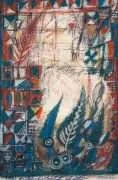
Bispo's works range from juxtapositions of objects to embroideries. In the former, he generally uses everyday utensils from the Colônia, such as aluminum mugs, buttons, spoons, wood from fruit crates, plastic bottles and shoes, as well as materials bought by him or by friends. For the embroideries he uses whatever fabrics are available, such as sheets or clothes, and obtains the thread by unraveling his blue inmate's uniform. With his works, he prepares a kind of inventory of the world for the Day of Judgment. On that day he would present himself to God, wearing a special mantle, as the representative of men and of all existing things. The embroidered mantle bears the names of people he knew, so that he would not forget to intercede with God on their behalf. Bispo also makes banners, ceremonial uniforms, beauty-pageant sashes and card files, among other things, on which he embroiders drawings, names of people and places, and phrases referring to newspaper stories or biblical episodes, gathering them into a kind of cartography. For him, creating these pieces is a task imposed by voices he said he heard.
In the early 1980s, with the questions raised by contemporary art, by antipsychiatry and by new theories of madness, Bispo's works began to be valued and integrated into the art circuit. In 1980, a report by TV Globo's Fantástico on the situation at the Colônia Juliano Moreira showed his works, gathered in the small room where he lived. That same year, the psychoanalyst and photographer Hugo Denizart (1946) made the film O Prisioneiro da Passagem - Arthur Bispo do Rosário [The Prisoner of Passage]. The exposure brought artistic recognition of the works, which led to his participation in 1982 in the exhibition À Margem da Vida, at the Museu de Arte Moderna do Rio de Janeiro - MAM/RJ, with works by prisoners, juvenile offenders, the elderly and inmates of the Colônia. Later, his first solo exhibition was held, also at MAM/RJ. The art critic Frederico Morais wrote about his work, linking it to avant-garde art, pop art, Nouveau Réalisme and especially to the work of Marcel Duchamp (1887 - 1968).
In 1995, with a vast selection of pieces, Bispo represented Brazil at the Venice Biennale and gained international recognition. His work became one of the references for generations of Brazilian artists of the 1980s and 1990s.
Notes
1 According to the records of Light, where he worked between 1933 and 1937, he was born on March 16, 1911. The records of the Brazilian Navy, where he served between 1925 and 1933, give May 14, 1909.
Critiques
"Much has already been written about the 'artistic production' carried out in the confinement of asylums and psychiatric hospitals, or that of outsiders, on the margins of the visual arts circuit and the system of Culture, without, however, granting it a role in Art History, because this production slides toward other meanings. The effort has been to assign them a category - art brut, unusual art, singuliers de l'art - since they reveal creativity in its pure state, without any systematization or discipline, (...). However, the interest of Bispo's work lies in his production as a whole together with his working method, which amounts to a romantic metaphor of being an artist: inside his cell, he unraveled his inmate uniforms to obtain faded blue threads with which he embroidered his cartography, and he mummified the objects of his daily life. The artist strips himself bare, divests himself in order to give existence to the work, signaling the transience of the body as opposed to the permanence of the work".
Ivo Mesquita
MESQUITA, Ivo. Arthur Bispo do Rosário. GALERIA: revista de arte, São Paulo, n. 17, p. 122, 1989.
"The assemblages gather objects that are generally industrial, mass-produced, linked to consumption and mass culture. On each panel, a row of objects: aluminum mugs, buttons, plastic bottles with shredded paper, hardware, soaps, spoons, shoes, rubber boots, electrical and electronic material, ritual objects (macumba). Sometimes the objects placed on the same support differ from one another, but the textures and materials are similar. Seen together, these accumulations recall a bazaar or a hardware store. They are like display cases and, not by chance, Bispo called them 'shop windows'. (...)
He also gathered on makeshift supports objects of bare wood, sometimes with a thin coat of whitewash, which recall Schwitters's Merzbilder. Isolated objects, Duchampian I would say, still hard to decipher, with a strong symbolic charge, or simply enchanting, like these small boxes in which cut-out, multicolored papers are like musical notes".
Frederico Morais
MORAIS, Frederico. A reconstrução do universo segundo Arthur Bispo do Rosário. In: ARTHUR Bispo do Rosário: registros de minha passagem pela terra. Belo Horizonte: Museu de Arte, 1990. p. 21, 24.
"The extreme originality of these creators' work is the result of several factors: the near absence of academic training, detachment from the spirit of the times, withdrawal from social life, etc. In this ontological solitude lies the certainty of Fernando Diniz when he turns old sheets into art, or the determination of Bispo do Rosário in gathering banal objects at the Colônia Juliano Moreira - one of the final depositories of human beings along the path of psychiatric internment - and transforming them into surprising installations. (...) A being who had no studio nor any encouragement from his surroundings built a body of work driven from within, of extreme contemporaneity, breaking with and calling into question the very means by which art is made".
Luiz Carlos Mello
MELLO, Luiz Carlos. Flores do abismo. In: MOSTRA DO REDESCOBRIMENTO, 2000, SÃO PAULO. Imagens do inconsciente. São Paulo: Fundação Bienal de São Paulo: Associação Brasil 500 anos Artes Visuais, 2000. p. 43.
"Whether it is a mantle or not may seem an unimportant question. Nevertheless, the term 'mantle' conceals the nature of the social archetype on which Bispo do Rosário worked. This work is born from the imitation of a garment of the nobility: part of the attire of a king, or of a general of the royal army. Only the jacket matters, since it concentrates the ostentatious symbolic elements of power and nobility, such as epaulettes, embroidery and decorations. (...) what we have here is the artist's appropriation of an object-symbol that in his eyes conveys wealth, beauty, nobility, (...).
Seen from this angle, this work by Bispo do Rosário is, as artistic expression, a surprising manifestation for its originality and semantic power".
Ferreira Gullar
GULLAR, Ferreira. Relâmpagos: dizer o ver. São Paulo: Cosac & Naify, 2003.
Testimonials
"HUGO: How did you end up here in this hospital?
BISPO: On December 22 I went down there, to São Clemente, Botafogo, at the back of one of those houses, when I was recognized by the family. The next day, then, I presented myself at the São Bento Monastery, on the 24th. On the 24th I came here to live, right? Sent by the friars.
HUGO: By the friars?
BISPO: Yes, they recognized me. I said: I have come to judge the living and the dead. They understood and sent me to the asylum. Because even before, back on Ilha do Governador (...) I was already saying that I was coming to the asylum to judge the living and the dead. That's for those who can see, who know. A doctor, for instance, who is a psychiatrist; when I arrived at Praia Vermelha, after two days I was called before a medical board. Dr. Odilon Galotti. There was a medical board to question me, and all of them understood that I had come to represent his holiness. Within that holiness, they allowed me a strongroom. The strongroom belongs to Christ, and so I came to live in the strongroom, to make miniatures, because they understood my vision.
(...)
HUGO: This transformation you are going through. . .
BISPO: My presentation to the world. I should be ready in about six or five months (...) with action, radiance, from head to toe, to present myself to the world. Within this representation here.
HUGO: And what will this representation be like?
BISPO: I'm going to stop and present the radiance for the representation of the world. And those who should present me are the people concerned here at the Colônia who, according to the dwelling of Christ, say: I, from the asylum, must present my transformation to the directors. Nothing more.
HUGO: To the directors?
BISPO: Yes, to the directors, don't they stay here? Only they can present me. This here was made for them. Only for them. Nothing more.
(...) Like these miniatures I made, it allows my transformation.
HUGO: The miniatures allow your transformation?
BISPO: That's right.
HUGO: How do they allow it?
BISPO: Isn't there the representation? I'm going to present myself bodily. My bodily action is this brightness I've put on.
HUGO: And these miniatures are representations.
BISPO: It's material that exists in the land of men.
HUGO: It's a representation of everything that exists on earth?
BISPO: Yes, they are works that exist.
HUGO: And you're going to turn into Jesus Christ, how does that work?
BISPO: I'm not going to turn into him, man, you're talking to him. It's plain to see. But for those who can see; for those who can't, it's no use".
Arthur Bispo do Rosário interviewed by Hugo Denizart
HIDALGO, Luciana. "Os anjos vão abrindo a formosa fina pluma espuma esponja por onde sai o verbo estrondo". In: _______. Arthur Bispo do Rosário: o senhor do labirinto. Rio de Janeiro: Rocco, 1996. p. 136, 137, 139.
Group Exhibitions
1982 - Rio de Janeiro RJ - On the Margin of Life, at MAM/RJ
Posthumous Exhibitions
1989 - Rio de Janeiro RJ - Records of My Passage on Earth, at EAV/Parque Lage
1990 - Belo Horizonte MG - Records of My Passage on Earth, at Museu de Arte da Pampulha
1990 - Porto Alegre RS - Records of My Passage on Earth, at Museu de Arte do Rio Grande do Sul Ado Malagoli
1990 - São Paulo SP - Records of My Passage on Earth, at MAC/USP
1991 - Stockholm (Sweden) - Viva Brasil Viva, at Kulturhuset, Konstavdelningen och Liljevalchs Konsthall - special room
1992 - Rio de Janeiro RJ - Recycle, at Fundação Nacional de Arte. Centro de Artes
1992 - Rio de Janeiro RJ - Transforming and Recreating Leftovers: Trash Made Clean, at Paço Imperial
1993 - Rio de Janeiro RJ - Arthur Bispo do Rosario: Inventory of the Universe, at MAM/RJ
1994 - Rio de Janeiro RJ - Bispo do Rosário, at Galeria Ibeu Copacabana
1994 - Rio de Janeiro RJ - Bispo do Rosário, at Galeria Ibeu Madureira
1995 - Venice (Italy) - 46th Venice Biennale
1996 - Rio de Janeiro RJ - The Navigator, at MNBA
1997 - Mexico City (Mexico) - Así Está la Cosa: instalación y arte objeto en América Latina, at Centro Cultural Arte Contemporáneo
1998 - Brasília DF - I Need These Words. Writing, at CEF
1999 - São Paulo SP - Everyday Life/Art. Object 1990s, at Itaú Cultural
1999 - São Paulo SP - Why Duchamp?, at Paço das Artes
1999 - São Paulo SP - Transcendences: Boxes of Being, at Casa das Rosas
1999 - Vitória ES - I Came, at Universidade Federal. Galeria de Arte Espaço Universitário
2000 - Rio de Janeiro RJ - Brasil + 500 Mostra do Redescobrimento. Images of the Unconscious, at Paço Imperial
2000 - Rio de Janeiro RJ - Brazilianness, at Centro Cultural Light
2000 - São Paulo SP - Brasil + 500 Mostra do Redescobrimento. Images of the Unconscious, at Fundação Bienal
2001 - New York (United States) - Brazil: Body and Soul, at Solomon R. Guggenheim Museum
2002 - São Paulo SP - Open Opera: Celebration, at Casa das Rosas
2003 - Paris (France) - La Clé des Champs et Arthur Bispo do Rosario, at Galerie Nationale du Jeu de Paume
2003 - Rio de Janeiro RJ - Art in Motion, at Espaço BNDES
2003 - Rio de Janeiro RJ - Flags of Brazil, at Museu da República
2003 - São Paulo SP - Order and Vertigo, at CCBB
2004 - São Paulo SP - Brasileiro, Brasileiros, at Museu Afro-Brasil
Source: Itaú Cultural