Antônio Ferrigno (Salerno, Italy 1863 - Idem 1940)
Antônio Ferrigno was a painter and teacher. Born in Maiori, in the province of Salerno. He studied painting with Giacomo de Chirico (1844–1883) in Naples. At the age of 19, he received a scholarship and enrolled at the Accademia di Belle Arti di Napoli, where he attended, between 1883 and 1885, the Sculpture Course with Stanislao List (1824–1908) and the course of natural painting with Theophilo Patini (1840–1906). Between 1884 and 1886, he also attended the classes of Domenico Morelli (1826–1901). At that time, he became interested in landscape painting and took views of Naples. He opened a small painting studio with Luigi Paolillo (1864–1934).
In 1893, he moved to Brazil and took up residence in São Paulo, where he met his friend and painter Rosalbino Santoro (1858 – s.d.), who lived in the city since 1887. He lived with Pedro Alexandrino (1856–1942) and Almeida Júnior (1850–1899), and became friends with the patron Freitas Valle (1870–1958). He quickly achieved notoriety as a painter and began to receive several orders from farmers. The series of 12 canvases on the cultivation of coffee, produced in 1900 for the Count of Serra Negra, and the six large canvases that portray moments of the coffee plantation, held in 1903 at Fazenda Santa Gertrudes, in the current municipality of Santa Gertrudes, Sao Paulo. In 1905, before returning to Italy, he held an individual exhibition with 64 works — mostly landscapes and marines —, which was greatly successful, with almost all the works sold.
Back to Salerno, he maintained an active artistic life, participating in the main shows in Italy. In 1913, he obtained the Chair of Drawing Teacher at the Technical School of Salerno. The following year, he participated in the Salon des Indépendents in Paris. In 1927, he was part of the Salernitana Exhibition, held an individual exhibition in Salerno and presented marines, coastal landscapes and gardens in Naples. In 1933, in commemoration of his 50 years of artistic activity, a special exhibition was held in Salerno.
Critical Comment
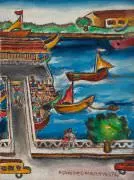
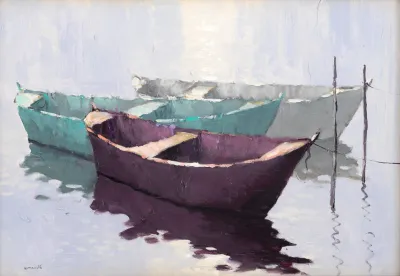
Antonio Ferrigno is an important painter of Scuola di Maiori, as it is The group of artists also formed by Pietro Scoppetta (1863 - 1920) and Gaetano Capone (1845 - 1920) were known. With other painters from the Salerno region, he is part of a group of artists who are called Il Costaioli, due to the constant presence of the landscapes of the Amalfi Coast between the works. Rarely dates his paintings, which makes it difficult to identify the phases of his painting. According to Massimo Bignardi, a researcher of Ferrigno's work, his production can be divided into three groups: the paintings executed until 1900, which have a relationship with what is new in the local artistic environment and bring a technical affinity with impressionism; the paintings with social concern, existing both in their European and Brazilian production; and the landscape painting of the big farms, orders from rich owners who brought him fortune. For Bigignardi, in the 1890s, Ferrigno's painting undergoes a significant transformation. A milestone of this transformation is the canvas Le Lavandaie [As Lavandasas], from 1890. For the author, "the artist's colors then become fluid, luminous". 1905, reproduces landscapes from São Paulo, from the interior and from the coast, as well as genre scenes that portray popular characters. At first it is enchanted by the coast. The sea was already attracting him to Italy: he was interested in exploring the effects of light on the water. In Brazil, it paints bays with small houses, boats, beaches, many of them populated by fishermen, children and ladies strolling, such as those that appear on a walk in the stones - Guarujá. Several of these scenes from the coast - which portray beaches in Santos, São Vicente, Guarujá and Caraguatatuba - are part of their 1905 individual exhibition. Carmo, Tamanduateí River, Várzea do Tamanduateí with Convento do Carmo, Barra Funda Station and the Tietê River sand harbor. Rua 25 de Março is portrayed several times. One of the canvases, presented to Pedro Alexandrino (1856 - 1942), is now part of the collection of the Pinacoteca do Estado de São Paulo - PESP.
According to researcher Ruth Tarasantchi,2 Ferrigno He usually performs a sketch of the landscape in the place, and finishes the paintings in the studio with the addition of different elements, thus combining observation and imagination. Although they are pictorial representations and cannot be immediately considered records of an era, such paintings allow us to see interesting aspects of the configuration of the landscape and of the São Paulo customs of the beginning of the 20th century. Among these canvas are the paintings that portray laundresses in the river, with their colorful clothes mirroring the water in luminous stains. In these works, which resume the theme previously explored in Italy, such as Ladeira Porto Geral and Lavadeiras do Rio Tamanduateí, the artist expresses his technical refinement with creative freedom. To portray anonymous, popular characters in their daily work, like the old man who repairs his instrument in tuning the violin, or in a moment of rest, as in a mulatto quitandeira, belonging to the Pesp collection. Bought by the state government in 1903, the screen shows a black slave saleswoman napping on a hot summer afternoon.
Having portrayed the farms of proud owners who want to fix them on canvas, she becomes known as the painter of the coffee. The series held at Fazenda Victória, in Botucatu, is commissioned by the Count of Serra Negra, who, when noting that a crisis in coffee growing as a result of the overproduction, has the idea of carrying out a campaign to advertise Brazilian coffee in Europe. The paintings are presented in Paris in 1900, and then in several European capitals, in exhibitions for the promotion of Café Paulista. Another well-known series The painter performs at Fazenda Santa Gertrudes, located in the current municipality of Santa Gertrudes. The six large canvases - flowering, harvesting, washing, terreiro, coffee and coffee bagging for the season - which today belong to the São Paulo Museum of the University of São Paulo - MP/USP are sent by the Brazilian government to the Universal Exhibition of Saint Louis in 1903 to Representing Brazil and then exposed in São Paulo, achieving significant critical and public success.
Back to Italy, it progressively starts painting with less detail, adding elements of memory and fantasy. In the 1920s and 1930s, he painted several gardens, by Ravello, Vietri and Salerno, canvas of strong and bright colors, in which he explores the different shades of green, light and design. Screens such as Alameda da Villa Rufolo have affinities with impressionism in the way of applying colors.
Notes
1 Massimo Bignardi apud TARASANTCHI, Ruth. 100 years later. In: Antonio Ferrigno: 100 years later. São Paulo: Pinacoteca do Estado: Sociarte, 2005. p. 22.
2 TARASANTCHI, Ruth. 100 years later. In: Antonio Ferrigno: 100 years later. São Paulo: Pinacoteca do Estado: Sociarte, 2005. p. 23.
Collective exhibitions
1902 - São Paulo SP - Exhibition of Fine Arts Industrial
1903 - São Paulo SP - Rosalbino Santoro and Antônio Ferrigno
1914 - Paris (France) - Salon des Independents
Posthetic exhibitions
1978 - São Paulo SP - Highlight of the month, at the Pinacoteca do State
1979 - São Paulo SP - The landscape in the collection of the Pinacoteca, in the Pinacoteca do Estado
1980 - São Paulo SP - The Brazilian landscape: 1650-1976, in the Paço das Artes
1982 - São Paulo SP - Italian painters in Brazil, at MAM/SP
1983 - São Paulo SP - The Italian look at São Paulo, at the Pinacoteca do Estado
1986 - São Paulo SP - Nineteenth: a Turn in the Century, at the Pinacoteca do Estado
1988 - São Paulo SP - Brasiliana: The Man and the Land, at the Pinacoteca do Estado
1993 - São Paulo SP - The Italian look over São Paulo, at the Pinacoteca do State
1994 - São Paulo SP -A critical look at the 19th century collection, at the state's Pinacoteca
1998 - São Paulo SP - São Paulo iconography in private collections, at the Brazilian House Museum
2000 - São Paulo SP - O Café, at Banco Real
2001 - São Paulo SP - Brazilian Art Museum: 40 years old, at the Brazilian Art Museum
2003 - São Paulo SP - painters on the coast of São Paulo, at Sociarte
2005 - São Paulo SP - Antonio Ferrigno: 100 years later, at Pinacoteca do Estado
2008 - São Paulo SP 2010 - São Paulo SP - 6th SP-Arte, at Fundação Bienal
2011 - São Paulo SP - Art in Brazil: a history at the Pinacoteca de São Paulo, at the Pinacoteca do Estado
Source: Itaú cultural