Aloysio Zaluar (Rio de Janeiro RJ 1937)
Aloysio Zaluar is a painter, engraver and filmmaker. He studied painting at the National School of Fine Arts between 1956 and 1961, and learned engraving from Goeldi and Darel Valença Lins. In 1964, he held his first solo show at the Santa Rosa Gallery, in Rio de Janeiro. He participated in several editions of the National Salon of Modern Art, in Rio de Janeiro, between 1958 and 1967. In 1965, he was one of the founders of the School of Fine Arts of Santa Maria, in Rio Grande do Sul. in which he participated, the following stand out: Contemporary Art Brasil-Senegal, at MAM/RJ, in 1975; Panorama of Brazilian graphic arts, at MAM/SP, in 1977; Latin American Biennial of São Paulo, in Ibirapuera Park, in 1978; football universe, at MAM/RJ and at the Arte Galeria collection, in Rio de Janeiro, in 1982; and retrospective, at CCBB, in Rio de Janeiro, in 1993. He also acts as the author of the film O Clóvis Vem Aí, made in 1977.
Critical Comment
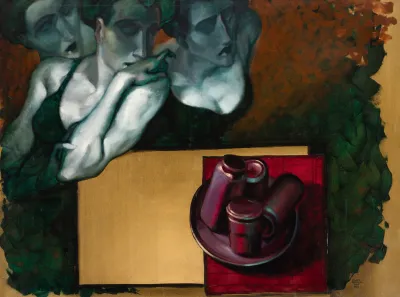
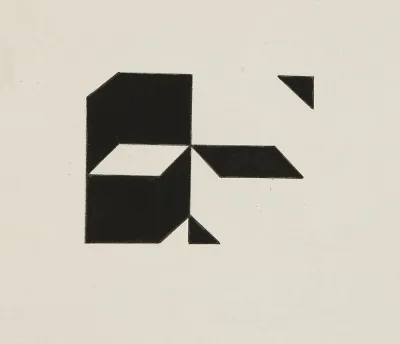
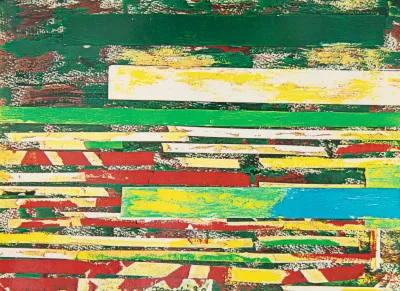
Close followed the movement of the call "Contemporary Art", through the international presence of informal abstractionism; until the outbreak of a new form of aesthetic and political predominance; North American pop art. As a student at the National School of Fine Arts (1956-61), the artist has come across the strategic, cultural occupation models, such as the "modern" goals of the seductive policy of new consumable products.
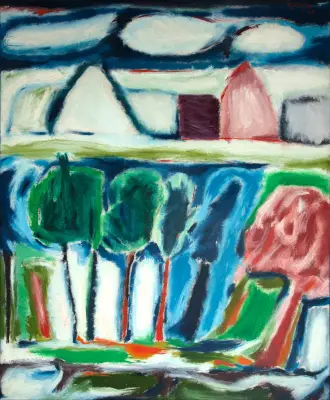
Following the feverish pace of progress, as a heavily pessimistic expressionist artist, he fought at the National Hall of Modern Art from 1956 to 1968. Career of "salon artist", announcing Macunaíma: "Little health and many painters, the evils of Brazil are!".
In the 1970s, as a friend and interlocutor of several vanguard artists, he witnessed the difficult The trajectory of these creators, until the embarrassing academicization of the present day and the unexpected abandonment of the concept of vanguard and modernism - with the environmental collapse caused by the impotence of the ideal of progress. Pessimist but humorous, in 1975, launched the Manifesto: Das Lupems Udigrudi (Pedra de Guaratiba - 1975) and the psychosocial character, Al Zalu, of the potentate of Azurara.
From 1976 onwards, the artist, through the peripheral shadows of the West Zone of Rio de Janeiro, announced in his paintings, pamphlets and reports, his special reading of the Ciranda da Violência urban, through the call on top of the fantastic masked carnival: "Clovis is coming!" Working, uninterruptedly, with his ideas, his stories and his visual production, the artist finds it strange, to see himself rejected, when his known proposals are put up for sale, in the institutional market, in the name of creatures without imagination and without any ethics.
His last work brought together numerous ideas: Rio Percussion, the sound of form, gathering capoeira and several collective aesthetic possibilities. The location was the Laurinda Santos Lobo Cultural Center, in May 1999. There, his trapozga - an interactive instrument or sound sculpture was always presented there. In addition to numerous wheels of capoerira, chorinho, jongo, poetry, etc. A multi-disciplinary event featuring videos, movies, photographs and a retorspective exhibition by Aloysio Zaluar, with montages of mechanically reproduced images, reports, texts and 4 ideas from the artist, registered in a notary's office and in the memory of friends.
Source: Itaú Cultural and Art Bonobo