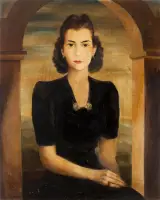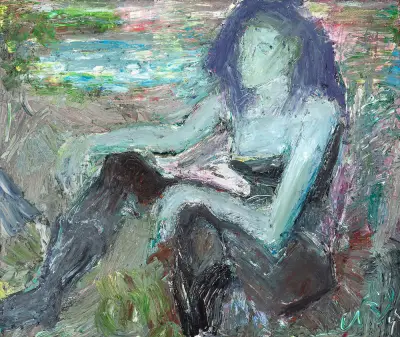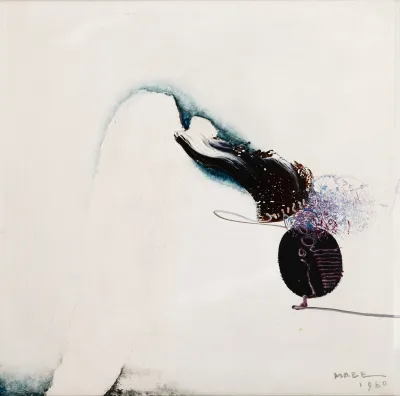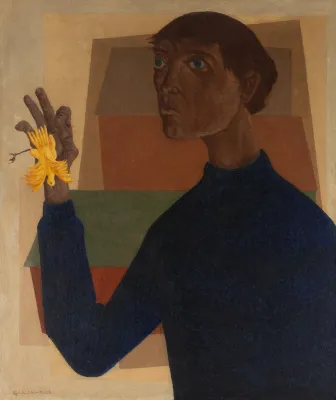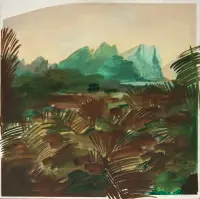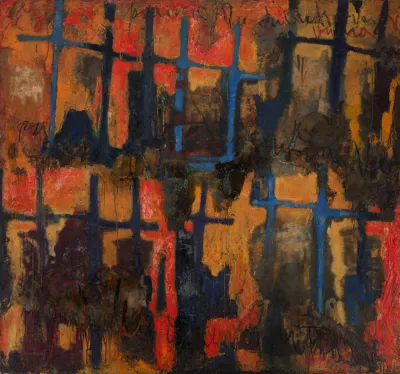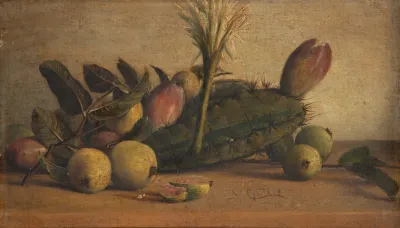

Abigail de Andrade (Vassouras RJ 1864 - Paris, France 1890)
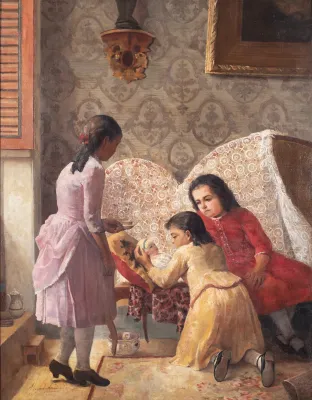
Abigail de Andrade was a painter and draftsman. He began his drawing studies at the Lyceum of Arts and Crafts in Rio de Janeiro in 1882, a year after the decree that allowed female attendance at school. She was a student of the cartoonist Angelo Agostini and the photographer and painter Insley Pacheco. Abigail painted scenes from Rio's daily life, landscapes, portraits, self-portraits and still lifes, in addition to making drawings. He participated in the exhibition of the Liceu de Artes e Ofícios in 1882, receiving praise from Agostini on the pages of the Illustrated Magazine. In 1884, she was the first woman to win a 1st grade gold medal at the 26th General Exhibition of Fine Arts of the Imperial Academy of Fine Arts (Aiba), an event that revealed artists such as Almeida Júnior, Rodolfo Amoedo and Belmiro de Almeida. In 1886, he exhibited at Casa Vicitas and at Casa Costrejean, in Rio de Janeiro.
Critical Gonzaga Duque made a complimentary comment about him in the book A Brazilian Art, published in 1888, suggesting that it be sent abroad to improve your studies. After his involvement with Angelo Agostini, he accompanied him to Paris to escape the scandal caused by the relationship, with whom he had a daughter, also the painter Angelina Agostini. His name, almost absent from the history of art books and dictionaries of fine arts in Brazil, is mentioned by the painter and art historian Theodoro Braga, who records the few published studies on Abigail de Andrade in his book Artistas Painters do Brasil, from 1942.
Critical Comment
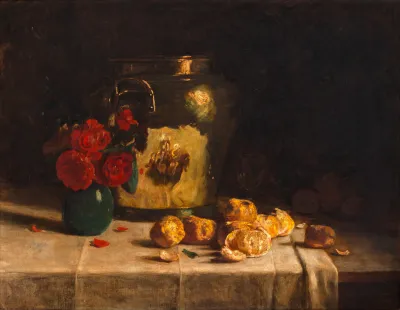
According to the analysis of researcher Ana Paula Simioni, the recognition of Abigail de Andrade as the first woman to receive an award at the 26th General Exhibition of Fine Arts, in 1884, represents the beginning of an institutional visibility for women artists in Brazil at the end of the 19th century. Prevented from officially attending the Imperial Academy of Fine Arts - AIBA, a fact that only became possible in 1892, women have little space for artistic learning in this period. Its options are restricted to private lessons or free courses at AIBA, with the exception of live model classes, deemed unsuitable for female modesty. Celebrated by the critic Gonzaga Duque as a true professional among amateur artists, Abigail de Andrade makes at the end of the 19th century a painting considered "modern", which values the themes then considered innovative, genre scenes that involve popular everyday life. His works reveal an attention to the impression of the moment, such as the Tela Cesto de Compras, s.d., awarded in the general exhibition. In this composition, at first sight, a traditional still life, Ana Paula Simioni observes the interest in portraying a snapshot of the domestic daily life, highlighted by the detail of the half-open drawer, by the disorderly arranged objects and by the money scattered on the table. Despite the meticulous composition, in which the objects are painted with the traditional techniques of the modeled in dark light and in their local color, the search for capturing the moment, which is reflected more in the choice of the arrangement of the elements than on their invoice, can be related to the fact that the artist often use of photographs - many of them taken by Insley Pacheco, his teacher - as a starting point for his canvas.
Criticism
"Mrs. D. Abigail broke the ties of the prejudices and made painting his profession, not like others who, about the same paternal care, learn only the collegial artisan, pelintra, pretentious, hypocritical, execravel of making dolls on skin and aquerella Paizagens d´apres cartons; not to say that he knows how to draw and paint setins of fans, not to gather the gift of playing the piano and embroidering the retroz of martyrisar brushes, but by indole, by will, by dedication. Mrs. Amadora has a finer spirit, more deeply sensitive to the impressions of nature and knows, either by herself or intelligently guided, to apply her talent to a noble profession that will, if not now, at least in a short time, reinstate her The life of happiness. (...) The portraits and the quirks that there have been exposed are true victory for an amateur, but in these works there is a very feminine, very timid pulse, and above all an exaggeration, in fact forgiving, of enjoying the subject well by suffocating The first impression received as if obliged were the conventions of teaching".
Gonzaga Duque
Duque, Gonzaga. Brazilian Art: Painting and Carving. Rio de Janeiro: S. Ed. , 1888.
Individual exhibitions
1886 - Rio de Janeiro RJ - Individual, at Casa Vicitas
1886 - Rio de Janeiro RJ - Individual, at Casa Costrejean
Collective exhibitions
1882 - Rio de Janeiro RJ - Collective, at the Liceu de Artes e Ofícios
1884 - Rio de Janeiro RJ - 26th General Exhibition of Fine Arts, at AIBA - 1st Medal of gold
Posthumous exhibitions
1989 - Rio de Janeiro RJ - Rio de Janeiro by Machado de Assis, at CCBB
2004 - São Paulo SP - women painters, at the Pinacoteca do State
Source: Itaú Cultural