Rubem Grilo (Pouso Alegre MG 1946)
Recorder, illustrator, teacher, curator.
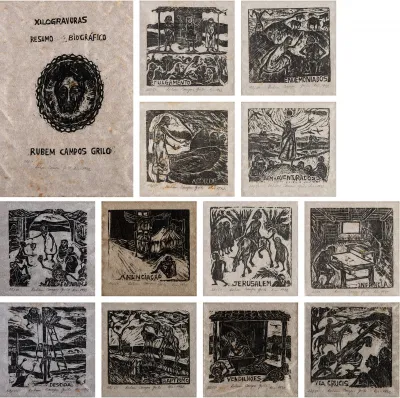
In 1963, Rubem Campos Grilo Transfers to Itaguaí, Rio de Janeiro, and, at the age of 23, completes the Agronomy course at the Federal Rural University of Rio de Janeiro - UFRRJ. In 1970, he studied woodcuts with José Altino (1946), at the Escolinha de Arte do Brasil, in Rio de Janeiro. The following year, he started to attend the iconography section of the National Library and contacts the engravings of Oswaldo Goeldi (1895 - 1961), Lívio Abramo (1903 - 1992), Marcelo Grassmann (1925), among others. During this period, he began a woodcut course at the School of Fine Arts at UFRJ and is guided by Adir Botelho (1932). In visits to the studio of Iberê Camargo (1914 - 1994), he receives lessons in metal engraving and, at the School of Visual Arts at Parque Lage - EAV/Parque Lage, studies lithograph with Antonio Grosso (1935). At the beginning of the 1970s, it illustrates newspapers such as Opinião, Movimento, Versus, Pasquim, Jornal do Brasil. In Folha de S. Paulo, he creates illustrations for the fascicles of the Portrait of Brazil collection. In 1985, he published the book Grilo: Xilogravuras, by Circo Editorial. In 1990, it was awarded by Xylon International, Switzerland. In 1998, he participated, with a special room, in the 24th International Biennial of São Paulo and, in the following year, is General Curator of the Rio Engravura Show. He has published works in specialized magazines such as Graphis and Who's Who in Art Graphic (Switzerland), Idea (Japan), Print (United States).
Critical Comment
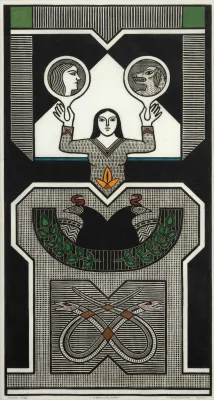
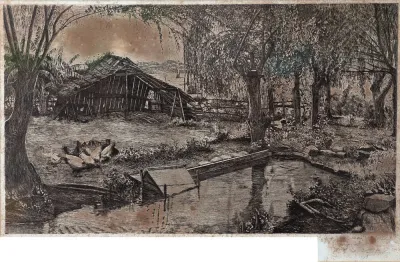
In the decades of 1970 and 1980, the woodcut appears for Rubem Grilo not as a merely aesthetic, formal choice, but as a technique of popular reach that allows him to act politically. In line with this ideal is the option to illustrate periodicals and work with themes of Brazilian daily life such as the military dictatorship, bureaucracy, social security, the constituent, the political system, etc. In this thematic choice, Grilo seeks to elaborate a direct communication, in which political criticism is accentuated by the approximation between text and image, as in bureaucracy, 1979, Labor Relations, 1980, Civil Society, 1983, Coup Militar, 1984. tenuous and contrasted transfigures and recreates vigorous forms to occupy all the spaces of the plane, without allowing any vanishing point that deflects the eye of the image reader.
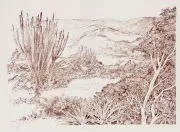
In the 1990s, after the times of military repression, Rubem Grilo leaves to illustrate periodicals. In the new authorial production, social criticism remains, but the attention turns to graphic simplicity. The ironic ambiguity of the Obra Minor series translates the concern with the details, present in objects represented on a reduced scale, measuring a few centimeters. In this series, Cricket provokes questions by shifting the functionality of objects. In a clock, 7 x 5.5 cm, 1994, for example, it replaces the circular order of numbers with a spiral. In this operation, it changes the logic of the object and starts to act as a supposed scientist to propose reflections on the measurement of time and its importance in everyday life.
Criticism
"A fact: Brazilian contemporary woodcut recovers, through of cricket, its greatest dimension in the tradition established by the work of Oswaldo Goeldi. This dimension - that of the masterful work - made today a growing evidence when the work of Rubem Grilo is appreciated, results from a process of creation in which the productive intensity managed to establish the difficult but possible balance between Invention and intelligibility The creation, in the engraving of Rubem Grilo, is a time of construction/imaging deconstruction in which the continual compose/discompose/recompose of the work establishes the basic premise of mastery: the eternal learning. Do the work to learn from the work, says Grilo, standing in the perplexity of the eternal apprentice in the face of the mystery of creation. This perplexity, far from being attenuated, only tends to intensify, in the growing complexity of a work that has achieved, in its specific tension, to preserve the commitment to the invention without Hermeticism."
George Kornis
KORNIS, George. Presentation of the book Cricket Xylographs. In: Graphic image. Rio de Janeiro: School of Visual Arts of Parque Lage, 1995. p. 152.
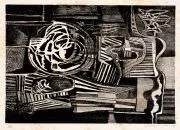
"It is in another space, between investment and dissolution, that Rubem Grilo's work will now be projected. The dispersion is a way of maintaining the personal relationship of time, the flow of action, but simultaneously deconcentrate it on the images, eliminating the seduction of the virtuoso and the excess of investment in the same work. It is in this territory that the cricket woodcut would have to find its new poetics. It is between two ends of its graphic action - the very detailed image or the Simple images - that Rubem Grilo reconfirms Riva Castleman's statement that there were few stylistic changes in the images of black lines, so that its medieval character represented a timeless element and without conscious artistic intention. 'I remake a gesture that has already been exhausted Millions and millions of times', says Rubem Grilo. (...) Sometimes Rubem Grilo seems to work as if words were missing for a universe and it was necessary to make it present in an image. Thinking would be a cut in the matrix".
Paulo Herkenhoff
HERKENHOFF, Paulo. Rubem Grilo: Caminhos da Reason. In: GRILO, Rubem. Banco do Brasil, 1996. P. 5-9.
"Not producing portraits or caricatures, cricket brings types, characters that operate graphically juxtaposed on the scene, which, in turn, is juxtaposed to the narration textual. In the juxtapositions of their scenes, the figures and objects intensify the narration by performing enumeration or accumulation: emphatic, the figures are graphically blown out by disproportion in the drawing and in the lights that make them massive and fragile, because cracked by incisive lines and flogged by displacement forces. The exacerbation of the destructive forces contradicts the compactness of the figures that, being static the scenes, show themselves exploded in themselves. They reinforce these effects lines that, outside the figures, draw fast movements, as in the comic book, whose mark on the work of cricket is also proven in the use of balloons. fierce, humor is that of a chewy laughter, which he waves, repelling, with which cricket speaks before his spectators. Woodcutting brings nothing experimental, because it digs, in the incision, the subjective deepening. In it, the external novelty, that of the experimental engraving, flees from it, let the mixed technique, understood as static from the subject's perspective, immobilizes all technicism: therefore, woodcutting, as simple, traditional, is nothing more than an instrument docile of an absolute subjectivity. For Rubem Grilo, Antonio Henrique Amaral or Anna Carolina, the discredit of woodcutting, whether in the market or of technical prejudice, can privilege subjectivity. In cricket, it is accelerated maximally as an incessant search for the self for the self. The cricket subject always emerges differently, because more and more cricket: the subject's centering and the engraving circumference are forever located; It is impertinent, therefore, the thought of Nicholas of Cusa, for whom the center and circumference are everywhere and nowhere. As in Antonio Henrique Amaral, in Rubem Grilo the difficult question of the exit of political engraving is proposed: the former does so for painting, in which the allegory ends up rotting; This, by the fixation of a center that accelerates as the identity of the self."
Leon Kossovitch and Mayra Laudanna
Kossovitch, Leon; Laudanna, Mayra. About the politician. In: Engraving: Brazilian art of the 20th century. Presentation Ricardo Ribenboim; Text Leon Kossovitch, Mayra Laudanna, Ricardo Resende São Paulo: Itaú Cultural: Cosac & Naify, 2000. p. 13.
Testimonies
"The great achievement of art was to become aware of its intrinsic issues, of things that only concern it. But, on the other hand, it is difficult to reduce all art to shapes, colors, lines. Because, by expressing oneself, certain people convey their life experience. I think it goes through a matter of authenticity, of being true to yourself and fulfilling yourself according to your particular needs. I am conditioned to a type of culture and, at the same time, I try to grow within it. What I have done so far is to answer this question. Have a highly critical look at my process but at the same time know that the path has to be where I feel my floor. (...)
Some of my works approach expressionism. When expressionism is said, the reference is German expressionism, the great room where this language became universally known.
If you think of expressionism not only as a representation of exacerbated, anguished images, but above all as a poetics of the self, an individual poetics in which The artist strays from the collective, becomes, in action and in thought, a person, the consciousness of the self - I would say, then, that my work has to do with expressionism. But, on the other hand, I don't force myself to be expressionist as an aesthetic option. (...)
The press was the beginning of maturity. The work begins only when you discover a reason in it. It's not when you make a drawing, it's when that drawing becomes a meaningful thing. From the 1970s onwards, I collaborated with the alternative press, which was a vehicle of opposition to Brazilian military governments. This trench somehow deepened the urgency over the work. I published from 1973 to 1975 in the weekly Opinion, from 1975 to 1979 in the newspaper Movimento. From 1980 to 1982 I published it on Folha de S.Paulo, in a notebook called Folhetim. And I made small collaborations for Jornal do Brasil, O Globo, O Pasquim, versus, in short, various types of press. The last collaboration was a collection of fascicles called Portraits of Brazil, a balance of what the country experienced during the military period.
And during all this time I maintained, as a point of honor, the habit of making woodcuts exactly to distinguish it in an appropriate way by the press. Progressively, my work became more time consuming, more complex."
Rubem Grilo
Senac Nacional 1999
Cricket, Rubem. Engraving, language and life. Rio de Janeiro: Senac, 1999. P. 113-118.
Individual exhibitions
1972 - Rio de Janeiro RJ - First individual, at Marina Lima Gifts
1973 - Rio de Janeiro RJ - Individual, at Galeria Atelier
1981 - Rio de Janeiro RJ - Individual, at EAV/Parque Lage
1983 - Rio de Janeiro RJ - Individual, at the Art Gallery Banerj
1983 - São Paulo SP - Individual, at Sesc Pompéia
1984 - Paris (France) - Individual, in the Latin-Americain space
1984 - Vitória ES - Rubem Grilo: woodcuts, at UFES. Art and Research Gallery
1985 - Curitiba PR - Individual, at Casa da Engravura Solar do Barão
1985 - Joinville SC - Individual, at the Joinville Museum of Art
1985 - Porto Alegre RS - Individual, at Margs
1985 - Rio de Janeiro RJ - Individual, at Funarte. Sérgio Milliet Gallery
1986 - Brasília DF - Individual, at Galeria Oswaldo Goeldi
1986 - Campinas SP - Individual, at Galeria Aquarela
1986 - Cuiabá MT - Individual, at the Federal University of Mato thick. Language Institute
1986 - São Paulo SP - Individual, at the Suzanna Sassoun Gallery
1989 - Assunção (Paraguay) - Individual, at the Center for Brazilian Studies
1992 - São Paulo SP - Arte Minor, MASP
1993 - Brasília DF - Individual, at Espaço Cultural 508 Sul
1995 - Rio de Janeiro RJ - Rubem Grilo: woodcuts, at EAV/Parque Lage
1995 - Rio de Janeiro RJ - Rubem Grilo: woodcuts, at UERJ. Center for Education and Humanities
1996 - Rio de Janeiro RJ - Minor Art: Woodcuts, at CCBB
1997 - Belo Horizonte MG - Individual, at the Guignard Gallery
1997 - Vitória ES - Individual, at UFES. Gallery of Art and Research
1998 - Rio de Janeiro RJ - Pensar Graphics, at Paço Imperial
1998 - Salvador BA - Individual, at MAM/BA
1999 - Florianópolis SC - Individual, at Masc
2000 - Nova Hamburgo RS - Individual, at Centro Universitário Feevale
2000 - Pelotas RS - Individual, at the Leopoldo Gottuzzo Art Museum
2000 - Porto Alegre RS - Minor Art: woodcuts, at the Casa de Cultura Mario Quintana. Galeria Sotéro Cosme
2001 - Fortaleza CE - Minor Art: woodcuts, at MAUC
2004 - Passo Fundo RS - Rubem Grilo: Paulo Dalacorte Collection, at the Ruth Museum of Visual Arts Schneider
2004 - Recife PE - Minor Art, at UFPE. Institute of Contemporary Art. Benfica Cultural Center
2004 - Rio de Janeiro RJ - Individual, at Anita Schwartz Galeria
Collective exhibitions
1972 - Capri (Italy) - 2nd Triennale Internazionale Della Xilografia Contemporânea - Acquisition Award
1972 - Rio de Janeiro RJ - 21st National Salon of Modern Art, at MEC
1972 - Rio de Janeiro RJ - 4th Summer Hall, at MAM/RJ
1973 - Niterói RJ - 2nd Visual Arts Exhibition of the State of Rio de Janeiro
1973 - Rio de Janeiro RJ - 22nd National Salon of Modern Art
1973 - Rio de Janeiro RJ - 5th Salon of Summer, at MAM/RJ
1974 - Rio de Janeiro RJ - Grafikos, at Livraria Carlitos
1976 - Rio de Janeiro RJ - Graphic Art in the Press, at ABI
1976 - São Paulo SP - Exhibition With illustrators of the newspaper Movimento, at Aliança Français
1982 - Curitiba PR - 5th Annual Engraving Exhibition City of Curitiba, at Casa da Engravura Solar do Barão
1982 - Rio de Janeiro RJ - 5th National Salon of Plastic Arts, in the MAM/RJ - Acquisition Award
1982 - Rio de Janeiro RJ - 6th Carioca Art Salon, at the Carioca Metro Station
1982 - Rio de Janeiro RJ - Universo do Futebol, at MAM/RJ
1983 - Curitiba PR - Engraving Hall - 1st Prize
1983 - Mexico - 31 Brazilian graphic artists
1983 - Colombia - 31 Brazilian graphic artists
1983 - Montevideo (Uruguay) - 1st Bienal de Grabado Iberoamericano, at the Museo de Arte Contemporânea - Special Prize for Travel abroad
1983 - Rio de Janeiro RJ - 6th National Salon of Plastic Arts, at MAM/RJ
1983 - Rio de Janeiro RJ - 7th Carioca Art Salon, at the Carioca subway station
1983 - São Paulo SP - Exhibition on Human Rights, at CCSP
1983 - Taipei (Taiwan) - 1st International Biennial Print Exhibition, Taipei Fine Arts Museum
1984 - Brno (Checoslovakia, current Czech Republic) - 11th Biennal of Graphic Design
1984 - Curitiba PR - 6th Engraving Exhibition City of Curitiba the woodcut in the history of Brazilian art, at Casa Romário Martins - awarded
1984 - Fortaleza CE - 7th National Salon of Visual Arts
1984 - Rio de Janeiro RJ - 7th National Salon of Plastic Arts, at MAM/RJ - awarded
1984 - Rio de Janeiro RJ - The face and the work, at the gallery of IBEU Copacabana
1984 - Rio de Janeiro RJ - The xillograph universe, at Funarte. National Center for Folklore and Popular Culture
1984 - Rio de Janeiro RJ - The woodcut in the history of Brazilian art, at Funarte. Sérgio Milliet Gallery
1984 - Rio de Janeiro RJ - 8th Carioca Salon of Art, at the Rio de Janeiro Metro Station
1984 - São Paulo SP - 15th Panorama of Current Brazilian Art, at MAM/SP
1985 - Rio de Janeiro RJ - National Salon of Plastic Arts, at MAM/RJ
1985 - Rio de Janeiro RJ - Art Construction: 21 contemporary artists, at the Rio Business Center Gallery
1985 - Rio de Janeiro RJ - 8th National Salon of Plastic Arts, at MAM/RJ
1985 - São Paulo SP - 18th São Paulo International Biennial, at the Biennial Foundation
1986 - Bogotá (Colombia) - 5th American Biennial of Arts Graphics
1986 - Bogotá (Colombia) - Nuevos Nombres: 4 Brasileños artists, at Banco de la República. Luis Ángel Arango Library
1987 - Berlin (Germany) - Intergrafik: Internationale Biennale der Grafik - 3rd Prize
1987 - Brasília DF - Missions 300 years: A The artist's vision, at the National Theater Cláudio Santoro
1987 - Campinas SP - 1st International Engraving Biennial, at MACC
1987 - Porto Alegre RS - Missions 300 years: the artist's vision, in the UFRGS. Cultural Center
1987 - Rio de Janeiro RJ - Missions 300 years: The artist's vision, at EAV/Parque Lage
1987 - São Paulo SP - Missions 300 years: the artist's vision, at MASP
1987 - Taipei (Taiwan) - 3rd International Biennial Print Exhibition, at the Taipei Fine Arts Museum
1988 - Brno (Czechoslovakia, current Czech Republic) - 13th Biennal of Graphic Design
1988 - Curitiba PR - 8th Exhibition of the Engraving City of Curitiba. Adir Botelho and Rubem Grilo, at the Paraná Art Museum
1988 - Porto Alegre RS - Missions 300 years: the artist's vision
1988 - Rio de Janeiro RJ - Missions 300 years: the vision of the Artist, at EAV/Parque Lage
1988 - São Paulo SP - Missions 300 years: The artist's vision, at MASP
1989 - Belo Horizonte MG - 21st UFMG Winter Festival
1989 - Havana (Cuba) - 3rd Havana Biennial
1989 - Ljubljana (Yugoslavia - Current Slovenia) - 18th International Engraving Biennial, at the modern gallery Ljubljana
1989 - Rio de Janeiro RJ - Brazilian engraving: 4 themes, at EAV/Parque Lage
1990 - Amadora (Portugal) - 2nd Engraving Biennial
1990 - Berlin (Germany) - Intergrafik: Internationale Triennale Grafik
1990 - Biella (Italy) - Premio Internazionale Biella per l'Incisione
1990 - Caracas (Venezuela) - Encuentro de Grabado Latinoamericano
1990 - Rio de Janeiro RJ - Indigenous traps, at Funarte
1990 - São Paulo SP - Indigenous traps MASP
1990 - Tuzla (Yugoslavia, current Bosnia and Herzegovina) - 6th International Biennial Exhibition of Portrait, Drawings and Graphics
1990 - Winterthur (Switzerland) - 11th Xylon: International Triennial Exhibition of Artists Relief Printing - 2nd Prize 1991 - São José do Rio Pardo SP - Popular Imaginary, at the Rio Pardense Museum
1992 - Curitiba PR - 10th Exhibition of the Engraving City of Curitiba. América, at the Engraving Museum (Curitiba, PR)
1992 - Rio de Janeiro RJ - Art Engraving in Brazil: Proposal for a mapping, at CCBB
1993 - Biella (Italy) - 12th Prize Internazionale Biella per l'Incisione
1993 - Helsinki (Finland) - International Print Triennial, at Alvar Aalto Museum
1993 - João Pessoa PB - Woodcut: From Cordel to Galeria, at Funesc
1993 - Lisbon (Portugal) - Brazilian matrices and engravings: Guita collection and José Mindlin, at the Calouste Gulbenkian Foundation. José de Azeredo Perdigão Modern Art Center
1994 - Belgrade (Yugoslavia - current Serbia and Montenegro) - 3rd print Biennal Belgrade
1994 - Mexico City (Mexico) - 9th Ibero-American Art Biennial
1994 - São Paulo SP - Woodcut: from cordel to the gallery, in the subway
1995 - Belo Horizonte MG - Derived image: a look at the unfolding of the engraving Today, at MAP
1995 - Biella (Italy) - Premio Internazionale Biella per l'Incisione
1996 - Mexico City (Mexico) - 10th Ibero-American Biennial of Art
1996 - Winterthur (Switzerland) - 13th Xylon: International Triennial Exhibition of Artists Relief Printing
1997 - Barra Mansa RJ - Contemporary Traits: Homage to Brazilian engraving, at the Centro Universitário de Barra Mansa
1997 - Krakow (Poland) - International Print Triennial
1997 - Curitiba PR - The Contemporary Art of Engraving, at the Metropolitan Museum of Art in Curitiba
1997 - Irving (United States) - Contemporary Brazilian Prints, at the University of Dallas. Haggar Art Gallery
1997 - Ljubljana (Slovenia) - 22nd International Biennial of Graphic Art
1997 - Odessa (United States) - Contemporary Brazilian Prints, At the Gallery at the University of Texas of the Permian Basin
1997 - Plan (United States) - Contemporary Brazilian Prints, at the Collin County Community College. Spring Creek Art Gallery
1997 - Wichita Falls (United States) - Contemporary Brazilian Prints, at the Midwestern State University Art Gallery
1998 - Abilene (United States) - Contemporary Brazilian Prints, at Abilene Christian University Shore Art Gallery
1998 - Baton Rouge (United States) - Contemporary Brazilian Prints, Louisiana State University
1998 - Mexico City (Mexico) - 11th Iberoamerican Art Biennale at the Museo del Palacio de Bellas Artes
1998 - Rio de Janeiro RJ - The image of the sound of Caetano Veloso, at Paço Imperial
1998 - Rio de Janeiro RJ - Theory of Values, at MAM/RJ
1998 - Rio de Janeiro RJ - The image of the sound of Caetano Veloso (1998 : Rio de Janeiro, RJ) - Paço Imperial (Rio de Janeiro, RJ)
1998 - São Paulo SP - 24th São Paulo International Biennial, at the Bienal Foundation
1998 - São Paulo SP - The Collectors - Guita and José Mindlin: Matrixes and engravings, at the SESI Art Gallery
1998 - São Paulo SP - Theory of Values, at MAM/SP
1999 - Niterói RJ - Exhibition Rio Engravura. Banerj Collection, at the Ingá Museum
1999 - Rio de Janeiro RJ Curatorship - Exhibition Rio Engravura. Guita and José Mindlin Collection, at the Centro Cultural Correios
2000 - Buenos Aires (Argentina) - 1st Bienal Argentina de Gráfica Latino-Americana, at the Museu Nacional del Grabado
2000 - Hanover (Germany) - Expo 2000 Hannover
2000 - São Paulo SP - Investigations. The Brazilian engraving, at Itaú Cultural
2001 - Brasília DF - Investigations. The Brazilian engraving, at Galeria Itaú Cultural
2001 - Penápolis SP - Investigations. The Brazilian engraving, at Galeria Itaú Cultural
2001 - São Paulo SP - Brazilian Culture 1, at Casa das Rosas
2002 - Brasília DF - Fragments to its magnet, in the contemporary cultural space Venâncio
2002 - Passo Fundo RS - Engravings: Paulo Dalacorte Collection, at the Ruth Schneider Visual Arts Museum
2002 - Porto Alegre RS - Engravings: Paulo Dalacorte Collection, at the Museu do Trabalho
2002 - Rio de Janeiro RJ - Caminhos do Contemporary 1952-2002, at Paço Imperial
2003 - Rio de Janeiro RJ - Art in Motion, at Espaço BNDES
2003 - Rio de Janeiro RJ - Grande Orlândia: artists below the line of Ecuador
2003 - São Paulo SP - Art and Society: a controversial relationship, at Itaú Cultural
2003 - São Paulo SP - MAC USP 40 years: Contemporary Interfaces, at MAC/USP
Source: Itaú Cultural