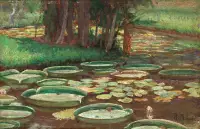

Rodolfo Amoedo (Salvador BA 1857 - Rio de Janeiro RJ 1941)
Rodolfo Amoedo was a painter, draftsman, teacher and Brazilian decorator. He worked as a teacher at the National School of Fine Arts in Rio de Janeiro, being recognized for his deep mastery of artistic techniques. He moved to Rio de Janeiro in 1868. In 1873, he began his studies at the Lyceum of Arts and Crafts, where he had as masters Victor Meirelles (1832–1903) and Antônio de Souza Lobo (1840–1909). The following year, he enrolled at the Imperial Academy of Fine Arts (Aiba), taking classes with Agostinho da Motta (1824–1878), Victor Meirelles, Zeferino da Costa (1840–1915) and Chaves Pinheiro. (1822–1884).
In 1879, he traveled to Paris as a pensioner for Aiba and studied at the Académie Julian and the École Nationale Supérieure des Beaux-Arts by Alexandre Cabanel (1823–1889) and Pierre Puvis de Chavannes (1824–1898). He returned to Brazil in 1887 and held his first solo exhibition in Rio de Janeiro, in 1888. That same year, he was appointed honorary teacher of historical painting at AIBA, where he had as students Baptista da Costa (1865–1926), Eliseu Visconti (1866–1944), Candido Portinari (1903–1962), Eugênio Latour (1874–1942) and Rodolfo Chambelland (1879–1967), among others.
He took over the position of deputy director of the institution in 1893 and, in 1931, he was appointed full professor honoris causa. He carried out decoration work in important buildings, such as the Itamaraty Palace, the National Library, the Federal Supreme Court and the Military Supreme Court, in Rio de Janeiro; the Ipiranga Museum — currently São Paulo Museum of the University of São Paulo (MP/USP), in São Paulo; and the José de Alencar Theater, in Fortaleza. After his death, part of his work was donated to the National Museum of Fine Arts (MNBA) in Rio de Janeiro. National of Fine Arts - ENBA, at the end of the 19th century. Despite having an essentially traditionalist view of painting, the artist was one of the introducers of artistic currents that updated academic art, bringing to the country a bourgeois realism less idealized in themes and treatment than in neoclassical and romantic currents predominant in Brazil. until then. However, he is seen as an ambiguous artist, who at the same time renews and makes the uncompromising defense of the old standards. Critic and historian Tadeu Chiarelli says that "amoedo appears undecided between the heir of local academicism and that of introducer of bourgeois realism (...) Interestingly, the artist manages to transform his initial realism into the only possible and uncompromising heir of traditional art in the country, the only effective sentry against the advances of the vanguards coming from Europe".1
The artist has a controversial origin. Some say they are born in Salvador, others say they are from Rio de Janeiro. It is true that he lives part of his childhood in Bahia, possibly from 6 to 11 years old. According to historian Quirino Campofiorito (1902 - 1993), Amoedo's parents are theater artists.2 He lives without luxury, in the midst of financial difficulties. He moved to Rio de Janeiro in 1868. He is admitted to Colégio Pedro II and remains there for some time. Lack of money prevents you from completing the course. After that, the artist works as an assistant to the painter-literist Albino Gonçalves. Only at the age of 16, he goes back to school. He enters the Liceu de Artes e Ofícios and has classes with Costa Miranda (1818 - s.d.), Victor Meirelles (1832 - 1903) and Antônio de Souza Lobo (1840 - 1909), who becomes his protector.
Thanks to the support of this teacher, Amoedo becomes a student at the Imperial Academy of Fine Arts - AIBA, where he continues to study with Victor Meirelles, in addition to taking classes with Zeferino da Costa (1840 - 1915), Augustine da Motta (1824 - 1878) (which influence him a lot) and Chaves Pinheiro (1822 - 1884). In 1878 he received the Aiba Exterior Travel Award for his canvas Abel's Sacrifice. In 1879, he left for Paris and following the advice of Almeida Júnior (1850 - 1899) he enrolled at Académie Julian. The following year, he joined the École National des Beaux-Arts, where he attends classes by Alexandre Cabanel (1823 - 1889), Paul Baudry (1828 - 1886) and Pierre Puvis de Chavannes (1824 - 1898). With them, he learns to use discreet colors and to paint based on a meticulous, objectivist drawing. Both characteristics will be present in his work. During this period, Amoedo paints traditional themes from the academy, seeking to remove his idealistic load. He performs important indigenist paintings such as Marabá (1882) and Último Tamoio (1883). It is a golden moment of your creativity. He makes portraits, as in sulking (1882); female nude, as in the back of a woman (1881) and in the controversial study of women (1884); and biblical scenes, such as the departure of Jacob (1884) and Jesus in Kafarnaum (1885).
In 1887, he returned to Rio de Janeiro, where he is appointed professor of painting at Aiba. The influence of the French academic environment is noted both in its aesthetic and pedagogical conceptions. His work moves away from the triumphant tone of the academy's official painting, looking for a more discreet, objective treatment that distances him from mythicized themes. His disagreements with Aiba's teaching methods are expressed in 1888, when together with the brothers Henrique Bernardelli (1858 - 1936) and Rodolfo Bernardelli (1852 - 1931), Souza Lobo and Zeferino Costa, Funda. The free studio, a parallel space for teaching and art work, where artists seek to draw attention to the lag in academic teaching. They propose a curricular modernization, having as a model the Académie Julian.
In 1889, with the Proclamation of the Republic, the group is recognized and won the board of the National School of Fine Arts - ENBA, formerly AIBA. In the new political regime, Amoedo becomes vice-director of the school, working with great dedication. Both in painting and in teaching there is a growing concern with technical issues, of the métier leaving the themes in the background. Amoedo is concerned with the correction of the design and the smoothness of the color, obeying the traditional norms of composition. As a teacher, he teaches with the same rigidity. Indicates where colors should be distributed in the palette and is rigid with pictorial technique issues. A good part of the artists trained by the ENBA pass through their hands, such as Baptista da Costa (1865 - 1926), Eliseu Visconti (1866 - 1944), Candido Portinari (1903 - 1962), Eugênio Latour (1874 - 1942), João Timótheo da Costa (1879 - 1930), Rodolfo Chambelland (1879 - 1967), Carlos Chambelland (1884 - 1950) and Alfredo Galvão (1900 - s.d.).
Amoedo holds the position of deputy director of ENBA in 1893 and in 1896. In 1906, he had a disagreement with the director, Rodolfo Bernardelli, and leaves for Europe, moving away from school until 1918, the year in which he re-assesss the teacher's seat occupying it until his retirement, in 1934. In 1909, he paints the ceiling of the supreme session room. Federal Court; A year later, he makes panels for the rare books section of the National Library and, in 1916, decorates the Municipal Theater. The artist died on May 31, 1941, at the age of 83. At the moment, he is recognized as one of the great names of Brazilian academic art. A year after his death, the artist's widow donates part of her collection to the National Museum of Fine Arts - MNBA. In the limits of academic realism, few artists were so sensitive to the capture of bourgeois subjectivity, especially in portraits and genre scenes.
Notes
1 CHIARELLI, Tadeu. Rodolfo Amoedo. In: ____________. Brazilian international art. São Paulo: Lemos, 1999. p. 154.
2 Campofiorito, Quirino. History of Brazilian painting in the 19th century. Rio de Janeiro: Pinakotheke, 1983. p. 188.
Criticism
"There is even a curious phenomenon worthy of being marked in the life of Rodolfo Amoedo, for which it is difficult to find an explanation outside of this inability to assimilate the evolutionary forms that were emerging around him. All the canvases that established him, in the general and unanimous concept, as a master in Brazilian painting, and even today (1944) represent him as such in the galleries of the National Museum of Fine Arts, they were works carried out at the time of a student, as a pensioner of the Academy, in Europe. Since returning, consecrated by critics, admired by everyone and rewarded with a prestigious teaching, nothing else has produced comparable to the mandate paintings of France (...) The creative impulse of your admirable brush seems to have been stopped by a mysterious force and it is painful to have to compare his later painting with that of the early heyday phase."
Frederico Barata
BARATA, Frederico. the travel prize. In: ______. Eliseu Visconti and his time. Rio de Janeiro: Zelio Valverde, 1944. p. 45-46.
"The brilliant and moving initial work of Professor Amoedo suffered, after the narration of fillets, a deviation that would be very impressive if we had not already asked about his studies and predilections of its nature. This deviation, collaborated by complex causes, has led it to a less emotional art as inspiration, but, without a doubt, strong, serious and perfect as a technique. Researcher by nature and by professional probity concerned with the invoice, on which the durability of the works depends, his Times have been a devotion to painting material, already rehearsing dusty processes of antiquity, already following innovations that modern science vulgarizes."
Gonzaga Duque
duke, Gonzaga. Rodolpho Amoêdo: The Master, we should add. In: ______. Contemporaries: painters and sculptors. Rio de Janeiro: Benedicto de Souza, 1929. p. 11-18.
"Enthusiast of the human figure, the work of Rodolfo Amoedo is almost entirely dedicated to it. It is rare to see a landscape of its own, other than small studies, without the presence of a figure. dedicated himself to the study of the nude and the portrait".
Edson Motta and the MNBA team
MOTTA, Edson. Rodolfo Amoedo. In: FUNARTE (Rio de Janeiro). National Museum of Fine Arts. Rio de Janeiro: Alcídio Mafra de Souza Edition, 1979. p. 76 (Brazilian Museums, 1).
"In the teaching Rodolfo Amoedo innovated, abandoning the copy of paintings and prints, suppressing the concern of the 'beautiful ideal', already timidly tempted by Victor Meirelles. He went on to 'verismo', that is, to the interpretation of the living model as presented, with plastic qualities or without them. Queimadas stated certain notions that I never forgot, such as 'black should only be used in half-painted lights' or 'will make the landscape easily who master the human figure completely'. He taught the most usual painting processes at the time: pastel, watercolor, tempera, encaustic, oil, fresco, being the first teacher to do so throughout the centenary life of the academy and the school. Benevolence the 'free student', perhaps because in the academy they were called 'amateurs'. But this class of students allowed the formation of notable artists. They were students who worked for a living and studied for an irresistible vocation. Candido Portinari and Oswaldo Teixeira are the most notorious examples."
Alfredo Galvão
Galvão, Alfredo. Wladimir Alves de. Aspects of Brazilian Art. Rio de Janeiro: Funarte, 1981. p. 53.
"If in the 1884 salon, Amoedo appears undecided between the role of heir of local academicism And the one who introduces bourgeois realism in the country, over the years, can be seen curiously that the artist managed to transform his initial realism into the only possible and uncompromising heir of traditional art in Brazil, the only effective sentinel against the advancement of the vanguards coming from Europe. These vanguards that surreptitiously threatened to corrupt the values hitherto immutable of the school, introjecting themselves - even if superficially, as in the painting of Manoel Santiago - in the production of their best students and in the production of some of their teachers.
Rodolfo Amoedo realized with sagacity that, without the approval of the Imperial Court, the ideally romantic painting had come to an end in Brazil. In the early years of the Republic, the clear need had ended in the empire to forge the myths of nationality, both in literature and in the visual arts. On the other hand, sacred themes have fallen into disuse, giving way to a more bourgeois taste, represented in the visual arts by painting portraits and landscapes.
It is with portraits that the painter will stand out. In his paintings, he will know how to combine the objective capture of the real, a balanced dose of idealization, perceptible in the emphasis on the linearity of his compositions, the adjustment of the color, the supremacy of the contour, procedures that show the plastic character of his works. (...)
The death of Amoedo announces the beginning of the end of 19th century art; An art based on the cult of good design begins to be definitively buried, the objective (but not naturalistic) capture of the form, to the rigor of the composition".
Tadeu Chiarelli
CHIARELLI, Tadeu. Rodolfo Amoedo. In: ______. Brazilian international art. São Paulo: Lemos, 1999. p. 154-156.
"Amoedo had also understood the lesson of Cabanel, who It had impressed Victor Meirelles and Pedro Américo in previous decades. His interpretation, however, seems almost an intentional parody of the two masters. The Indianist theme gave way to the much more urban and real world of the cocottes, with a daring seen as a challenge by the Pharisees guardians of the moral of the Imperial Academy.
(...) The painting of Amoedo, however, It is distinguished by the attention to technical novelties which make it a point of reference for the renewal of the academy: on the one hand, the studies of optics by Bruck and Helmholtz; on the other hand, the rediscovery of old procedures such as encaustic or egg painting".
Luciano Migliaccio
Migliaccio, Luciano. The 19th Century. In: Rediscovery Show, 2000, São Paulo 19th Century Art. São Paulo: Fundação Bienal de São Paulo: Associação Brasil 500 years Visual Arts, 2000. p. 146.
Studies in Paris
Statue of Rodolpho in Rio de Janeiro. From 1879 to 1887 he lived and studied in Paris. Initially, he attended the Julian Academy and in 1880 he managed to enroll in the École des Beaux-Arts. by renowned painters such as Alexandre Cabanel, Paul Baudry and Puvis de Chavannes, he participated in the Salon de Paris (1882, 1883 and 1884) and began to develop his great themes around mythology (the narration of of the Bible (Jesus in Capernaum, the departure of Jacob) and of Brazilian literature, in which he stood out for the production of large canvases focused on Indianism (the last Tamoio, Marabá)1.
Back to Brazil
Back to Rio de Janeiro, still in 1888 he was appointed honorary teacher at the Academy, started teaching at the Polytechnic School of Rio de Janeiro and held his first solo exhibition. He was awarded several times at the General Exhibition of Fine Arts, highlighting the gold medal at the exhibition commemorating the centenary of the opening of the ports (RJ, 1908), and the medal of honor at the 1917 general exhibition.
Classes, important works and outstanding students
He was a teacher at the National School of Fine Arts (ENBA), where he encouraged his students to research the most diverse painting processes: tempera, encaustic, watercolor, etc. He was also deputy director of ENBA, temporarily occupying the position of director on several occasions. He created the panels for the Federal Supreme Court in 1909, for the National Library and for the Municipal Theater of Rio de Janeiro in 1916. In 1934. Among his numerous students, it is worth mentioning Batista da Costa, Rodolfo Chambelland, the brothers Arthur Timóteo da Costa and João Timóteo da Costa, Lucílio de Albuquerque, Eliseu Visconti and Candido Portinari.
Cerves
Pinacoteca collection of the state of São Paulo/Brazil - São Paulo SP
National Museum of Fine Arts, MNBA - Rio de Janeiro RJ
Mariano Procópio Museum - Judge From Fora MG
Museum of the School of Fine Arts Dom João VI - Rio de Janeiro RJ
São Paulo Museum of Art - MASP - São Paulo SP
Collective exhibitions
1876 - Rio de Janeiro RJ - 24th General Exhibition of Fine Arts, in Aiba
1879 - Rio de Janeiro RJ - 25th General Exhibition of Fine Arts, in Aiba
1882 - Paris (France) - Salon de Paris
1883 - Paris (France) - Salon de Paris
1884 - Paris (France) - Salon de Paris
1884 - Rio de Janeiro RJ - 26th General Exhibition of Fine Arts, at AIBA
1887 - Paris (France) - Salon de Paris
1890 - Rio de Janeiro RJ - General Exhibition of Fine Arts, at Enba
1893 - Chicago (United States) - Chicago International Exhibition - Medal Honor
1894 - Rio de Janeiro RJ - 1st General Exhibition of Fine Arts, at Enba
1895 - Rio de Janeiro RJ - 2nd General Exhibition of Fine Arts, at Enba
1896 - Rio de Janeiro RJ - 3rd General Exhibition of Fine Arts, at Enba
1897 - Rio de Janeiro RJ - 4th General Exhibition of Fine Arts, at Enba
1898 - Rio de Janeiro RJ - 5th General Exhibition of Fine Arts ENBA
1899 - Rio de Janeiro RJ - General Exhibition of Fine Arts, at Enba
1900 - Rio de Janeiro RJ - 7th General Exhibition of Fine Arts, at Enba
1901 - Rio de Janeiro RJ - 8th General Exhibition of Fine Arts, at ENBA
1902 - Rio de Janeiro RJ - 9th General Exhibition of Fine Arts, at Enba
1903 - Rio de Janeiro RJ - 10th General Exhibition of Fine Arts ENBA
1904 - Rio de Janeiro RJ - 11th General Exhibition of Fine Arts, at ENBA
1908 - Rio de Janeiro RJ - 15th General Exhibition of Fine Arts, at ENBA - Grand Prix
1910 - Rio de Janeiro RJ - 17th General Exhibition of Fine Arts, at Enba
1911 - Rio de Janeiro RJ - 18th General Exhibition of Fine Arts, at Enba
1912 - Rio de Janeiro RJ - 19th General Exhibition of Fine Arts, at Enba
1912 - São Paulo SP - Second Brazilian Exhibition of Fine Arts, at the Liceu de Artes e Ofícios
1915 - Rio de Janeiro RJ - 22nd General Exhibition of Fine Arts, at Enba
1916 - Rio de Janeiro RJ - 23rd General Exhibition of Fine Arts, at Enba
1917 - Rio de Janeiro RJ - 24th General Exhibition of Fine Arts, at ENBA - Medal of Honor
1919 - Rio de Janeiro RJ - 26th General Exhibition of Fine Arts, at ENBA
1920 - Rio de Janeiro RJ - 27th General Exhibition of Fine Arts, at Enba
1921 - Rio de Janeiro RJ - 28th General Exhibition of Belas Artes, at Enba
1927 - Rio de Janeiro RJ - 34th General Exhibition of Fine Arts, at ENBA
1928 - Rio de Janeiro RJ - 35th General Exhibition of Fine Arts, at Enba
1929 - Rio de Janeiro RJ - 36th General Exhibition of Fine Arts, at Enba
1930 - Rio de Janeiro RJ - 37th General Exhibition of Fine Arts, at Enba
1940 - São Paulo SP - Retrospective Exhibition: Works of the Great Masters of Painting and His Disciples
Posthumous exhibitions
1943 - Rio de Janeiro RJ - Collective of Religious Painting, at MNBA
1946 - São Paulo SP - 12th São Paulo Salon of Fine Arts, At Galeria Prestes Maia
1948 - Rio de Janeiro RJ - Retrospective of painting in Brazil, at MNBA
1950 - Rio de Janeiro RJ - A century of Brazilian painting: 1850-1950, in the MNBA
1957 - Rio de Janeiro RJ -  Centenary of the birth of Rodolfo Amoedo, in MNBA
1977 - Rio de Janeiro RJ - Aspects of the Brazilian landscape: 1816-1916, at MNBA
1980 - São Paulo SP - The Brazilian landscape: 1650-1976, at Paço das Artes
1984 - São Paulo SP - Tradition and rupture: synthesis of art and culture Brazilian women, at the Bienal Foundation
1986 - São Paulo SP - Nineteenth: a turn in the century, at the Pinacoteca do Estado
1991 - São Paulo SP - Desire in the Academy: 1847-1916, at the Pinacoteca do Estado
1994 - São Paulo SP - Bienal Brasil Século 20th, at the Bienal Foundation
1994 - São Paulo SP - A critical look at the collection of the 19th century, at the Pinacoteca do Estado
1999 - Rio de Janeiro RJ - Brazil rediscovered, at Paço Imperial
2000 - Porto Alegre RS - from Frans Post to Eliseu Visconti: Collection National Museum of Fine Arts - RJ, at Margs
2000 - São Paulo SP - Brazil + 500 rediscovery show. 19th century art, at the Bienal Foundation
2001 - Rio de Janeiro RJ - Brazilian Watercolor, at the Light Cultural Center
2001 - São Paulo SP - 30 masters of painting in Brazil, at MASP
2001 - Paulo SP - Trajectory of light in Brazilian art, at Itaú Cultural
2002 - Brasília DF - Barão do Rio Branco: his work and his time, in the Ministry of Foreign Affairs. Palácio do Itamaraty
2002 - Niterói RJ - Brazilian art on paper: 19th and 20th centuries, at Solar do Jambeiro
2002 - São Paulo SP - Image and identity: a look at the history in the collection of the Museum of Fine Arts, in the Instituto Cultural Banco Santos
2004 - São Paulo SP - The price of seduction: from corset to silicone, at Itaú Cultural
Source: Itaú Cultural, wikipedia