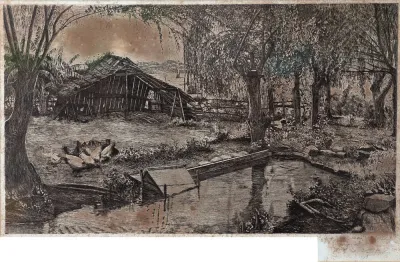
Pedro Weingartner (Porto Alegre RS 1853 - Idem 1929)
Pedro Weingartner was a painter, engraver, lithographer, designer and teacher. The son of German immigrants, he began his professional career as a traveling salesman and then as a lithographer. In 1879, he traveled on his own to Hamburg, Germany, where he studied at the Lyceum of Arts and Crafts. He later went to Karlsruhe and joined the School of Fine Arts of Baden, where he was a student of Ferdinand Keller (1842–1922), Theodor Poeckh (1839–1921) and Ernst. Hildebrandt.
In the early 1880s, he moved to Paris, where he studied with Tony Robert-Fleury (1837–1911) and William-Adolphe Bouguereau. (1825–1905), with whom he remained for three years. Bouguereau asked Emperor Dom Pedro II (1825–1891) for a grant so that Weingartner could continue his studies in Europe. In 1886, he took up residence in Rome, where he remained for a long period. He made constant trips to Brazil and participated in several exhibitions. In 1888, he held an individual show in Rio de Janeiro, with landscapes and genre scenes, much praised by Brazilian critics. Rio de Janeiro. He made several trips to the south of the country, exploring regional themes that became recurring in his work. He traveled again to Italy between 1896 and 1902, and then between 1911 and 1920, keeping frequent trips to Brazil. He also started to dedicate himself to the technique of strong water, of which he was one of the forerunners in the country.
Critical Comment
Son of German immigrants, Weingartner begins his artistic training in his family's lithograph workshop. In 1879, in order to improve himself, he traveled on his own to Hamburg, where he studied at the Lyceum of Arts and Crafts. Then he goes to Karlsruhe and studies at the Baden School of Fine Arts, where he has as teachers Ferdinand Keller (1842 - 1922), Theodor Poeckh (1839 - 1921) and Ernst Hildebrandt. With the transfer of the latter to Berlin, he accompanies the master and joins the Academy of Fine Arts. For art historian Quirino Campofiorito (1902 - 1993), the contact with these artists marks Weingartner's production, mainly in relation to the concern with details, and gives his compositions a meticulous treatment that brings them closer to the photographic image.
In the early 1880s, he studied in Paris with Tony Robert-Fleury (1837 - 1911) and William-Adolphe Bouguereau (1825 - 1905). He later proceeds to reside in Rome, with the subsidy of Emperor Dom Pedro II (1825 - 1891). The artist constantly travels to Brazil, and exhibits in Rio de Janeiro, São Paulo and Porto Alegre. In 1888, in an individual show in the country, he presents several scenes of genre and landscapes painted in Italy, obtaining much success. - Enba. During this period, he makes several trips to the south of the country, where he begins to explore regional motifs, a theme that becomes constant in his production, such as in Chega Tarde, s.d., Desterro, s.d., landscape of Rio Grande do Sul, 1900 or Ceifa, s.d. For art historian Luciano Migliaccio, the artist founds a new regionalism in Brazilian painting, presenting the lives of immigrants from the south of the country with sensitivity. The artist also performs engravings in strongwater and lithographs with a refined technical skill.
Source: Itaú Cultural