Nicolas Antoine Taunay (Paris, France 1755 - Idem 1830)
Pintor, illustrator, professor.
Starts painting studies in 1768, in Paris, Ateliers by François Bernard Lépicié, Nicolas Guy Brenet and Francisco Casanova. At 17, he dedicates himself to landscape painting. As of 1777, he exhibits at the event called Jeunesse and at the Salon de la Correspondance, both unofficial. In 1784, it is accepted as an aggregate in the Royal Academy of Painting and Sculpture. This title makes it possible to participate in the official events, as well as its nomination for a three-year pension at the Academy of the Mancini Palace, in Rome. In Italy he has contact with the painter Jacques-Louis David (1748 - 1825), who at the time paints the oath of the Horaces. He returns to France in 1787 and exhibits in Parisian salons. In 1793, with the troubled environment and the extinction of monarchical institutions, as an unfolding of the French Revolution, he retired from Paris, where he returned in 1796 to integrate the newly created Institute of France. In 1805, he portrays the campaigns of Napoleon (1769 - 1821) in Germany. With the end of the Napoleonic Empire, he comes to Brazil as a member of the French Artistic Mission. He arrived in Rio de Janeiro in 1816 and became a pensioner for D. João VI (1767 - 1826) and a member of the Royal School of Sciences, Arts and Crafts, future Imperial Academy of Fine Arts - AIBA, where he occupies the chair of landscape painting. In 1821, after disagreements arising from the appointment of Henrique José da Silva (1772 - 1834) to the school administration, he returned to France.
Critical Comment
Despite the short stay of the French painter Nicolas Taunay in Brazil (1816-1821), his production of paintings with Brazilian themes1 is of extreme importance for the history of the country's art in the 19th century, especially with regard to the development of landscape painting among us. When he arrived in Rio de Janeiro, in 1816, as a member of the French Artistic Mission - led by Joachim Lebreton (1760 - 1819), whose objective is to create the first Academy of Arts in the country -, Taunay, at age 61, is already an artist with extensive experience. and renowned in France.
Son of Pierre Antoine Henri Taunay, painter of the royal manufacture of Sèvres, joined the studio of François Lépicié at the age of 13. He later studies historical painting with Nicolas Brenet and Batalha with Francesco Casanova. In the absence of this last master, he dedicates himself to the direct study of nature, painting the surroundings of Paris or undertaking nature study trips to neighboring countries. In 1777, he began his career as an artist, participating in unofficial exhibitions, such as the so-called Jeunesse or the Salon de la Correspondance. His work began to be noticed and, in 1784, he received the title of aggregate of the Royal Academy of Painting and Sculpture with the work Orlando Furioso, which allows him to participate in the official halls. That year he left for Rome, where he remained until 1787 as a pensioner at the Mancini Palace, headquarters of the French Academy in Italy. In the Italian city, he has contact with the painter Jacques-Louis David (1748 - 1825), who at the time carries out the work The Oath of Horaces. He paints pictures inspired by the Italian landscape and its glorious past. He returns to Paris and even during the fall of the monarchy and the revolution continues to practice gender, historical and landscape painting and participate in the halls. During the period of terror, he took refuge with his children and his wife in Montmorency, in the house that belonged to the Enlightenment philosopher Jean Jacques Rousseau (1712 - 1778), whom he personally met and admired throughout his life. In 1795 he was appointed a member of the Institute of France. In 1798 the exterior painting of a military hospital (1798), on the victorious campaign of Napoleon Bonaparte in Italy, is acquired by the government for the Musée du Louvre [Louvre]. Reinstated to the new regime, Nicolas Taunay becomes one of the favorite painters of the future emperor. During the Napoleonic Empire, he executes decorations for the royal residence and mainly historical and war frames with the deeds of Napoleon I and his army, being invited to accompany the German campaign as a painter. Historical setbacks, with the fall of Napoleon, put Taunay back in danger. At the moment, he is invited to participate in the group of Lebreton.2
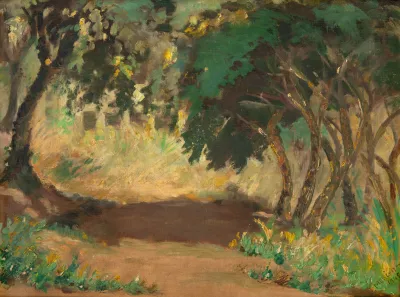
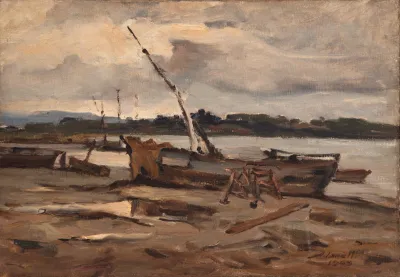
In Rio de Janeiro, Taunay is hired as a pension painter from the kingdom and teacher of the landscape painting chair at the Royal School of Sciences, Arts and Crafts, future Imperial Academy of Fine Arts - AIBA. While this is not effectively instituted, it carries out portraits of the heirs of the throne at the request of the Queen and landscapes of Rio de Janeiro. Largo da Carioca and Morro de Santo Antônio are, it seems, the first Brazilian-themed paintings made by the artist, in 1816. It strives to be faithful to the new landscape, but guided by its pictorial repertoire. Ordained landscapes arise, in which man finds himself in contemplative harmony with nature. The almost always constant presence of oxen on their canvas evokes the pastoral landscape and the idyllic view of the nature of Arcadia.
On the other hand, atmospheric light endows the characteristic landscapes of Rio de Janeiro (sugar bread, Glória outer, forest of Tijuca etc) of mysterious aura. Taunay does not surrender to the lancinating clarity of the tropics. In the emblematic painting Cascatinha da Tijuca, the artist self-represents himself at sunrise in the exercise of his craft. But there are no conflicts, the contemplative view remains. Even in genre paintings such as Dom João VI and D. Carlota Joaquina strolling at Quinta da Boa Vista, in which the royal family represents, the placid natural landscape prevails to the detriment of the narrated scene. As the artist and historian Carlos Zilio noted, his detailed and orderly construction works reveal the difficulties of reconciling European culture and an unknown nature. In his attempt to give an account of this new nature, Taunay sometimes submits it to European representation schemes.
In the face of the directions taken by the Royal School of Sciences, Arts and Crafts, Nicolas Taunay decides to return to France in 1821, indicating his son Félix Taunay (1795 - 1881) to replace him in the landscape painting classes. Another of his children, the designer Adrien Taunay (1803 - 1828), remains in Brazil, dying in an accident as a designer of the Langsdorff expedition. In France, he resumes his historical themes and his successful career, dying in 1830.4
Notes
1 It is assumed that the French artist has produced 25 to 40 Brazilian-themed canvases. However, only 16 have been identified so far.
2 On this there is two information: first that Taunay himself would have offered, in a letter from 1816, his services as a painter of the court and preceptor to Dom João VI, already installed in Rio de Janeiro. As the invitation came to meet the king's desires to establish an academy in the new capital of the kingdom, the artist was naturally integrated into the mission of Lebreton. Secondly, Lebreton himself, also persecuted by the new regime, would have directly invited Taunay. The ideal of Rousseau's natural life and existence.
4 Nicolas Taunay's fame at the time can be measured by the Charles X Distribuant des Récompenses aux Artistes painting, à la fin du salon de 1824 [Carlos X distributing awards to artists at the end of the 1824 hall], authored by François-Joseph Heim (1797-1865), held between 1825 and 1827, belonging to the Musée du Louvre in Paris. In it Taunay appears represented alongside, among others, Jean-Auguste-Dominique Ingres (1780-1867). of light harms the set. In them there are no great effects of shadow; the contemplation of Brazilian nature changed its color and inspired one of the best phases of the career of landscapers, since, indeed, from its views in Rio de Janeiro, some are incomparable realism.
I wanted to fix effects, so difficult to translate, from tropical light and often managed to solve the arduous problem".
Afonso d'Escragnolle Taunay
TAUNAY, Affonso de E. The Artistic Mission of 1816. Brasília: University of Brasília, 1983, p. 195-197
"(...) the prestige of Louis David grew and with him the dominance of Neoclassicism Nicolas Antoine Taunay was reluctant to blindly follow the new trend, but he couldn't help but give it to him. Some attention not to incur the displeasure of lovers of David's dominant painting. Interested in the landscape, however, he also had to apply himself to the figure, as the neoclassical aesthetics considered the landscape genre inferior and only praised the composition of a figure, the painting 'greater', and particularly the one dedicated to the themes of antiquity for which the models were invariably the Greco-Roman sculpture. As a competitor to the Salon, Taunay reached official grand prizes."
Quirino Campofiorito
Campofiorito, Quirino. History of Brazilian painting in the 19th century. Rio de Janeiro: Pinakotheke, 1983, p. 54.
"Taunay is not interested in representing the landscape, but in interpreting it by the effects of a luminous contrast. It should be noted that the coastal landscape of Rio de Janeiro often meets the expectations of traveling artists, having at sea outlined at the limits of the bay an image of the lacustrine placidity, which allows serene contemplation and associates it with the meaning of Arcadian poetry. They rarely relate to the storm of the uncontrolled sea.
Taunay took a better place at the Tijuca Forest Retreat, where he lives with his family, remembering again the fate of Rousseau. He has the Tijuca forests as his private garden and revives the memory of pastoral painting. Dusk, light is the poetic element that draws the bridge between life and painting".
Ana Maria de Moraes Belluzzo
BELLUZZO, Ana Maria de Moraes. The Brazil of Travelers. São Paulo: Metalivros, 1994. v. 3, p. 123-124
"The function of Nicolas Antoine Taunay as a landscaper was different, but no less important for the construction of the image of Brazil. (...) In addition to betting on the characteristic aspects of the Brazilian environment - the presence of Black slaves, of the friars, the peculiar architecture of the Portuguese great house -, Taunay also used a new and shrewd meaning for the tradition of the pastoral landscape inspired by Claude Lorraine. idyll, to the countryside rambling, which is done with only a slight touch of the local color, that characteristic of buildings and vegetation. Taunay's stay in Brazil was limited to only six years, but its presence was fruitful in consequences for Brazilian art. Children - Charles, Félix Émile, Hyppolite, Théodore and Aimé-Adrien -, four of whom remained in Brazil after their father's departure, he transferred to the Tijuca forest the memory of his house in Montmorency, Mont Louis, Where Jean-Jacques Rousseau had lived, whom the painter had met in person. of nature. Tiny, immersed in the majestic landscape, the artist almost acquires the appearance of a hero, concentrated as he is in portraying a palm tree with the humble instruments of his craft. At his side, two slaves contemplate the work admired; Others, further down, lead a donkey. The value of education through observation could hardly be better expressed, as well as the emotion before the voice of nature. This will be the inspiration of his son Félix-Émile, when elaborating his version of the Brazilian landscape.
But it cannot be forgotten that Taunay is also the author of urban landscapes that can be considered almost parts of a panorama. The two landscapes seen from Morro de Santo Antônio, at the National Museum of Fine Arts (MNBA), display two city frames endowed with the objectivity of the lucid camera. The friars, the figures in the foreground, increase the sense of reality of the image, adding to it local color, that mixture of urban and rural, of baroque religiosity and modernity that should still be visible in colonial Rio de Janeiro". Migliaccio
Migliaccio, Luciano. The 19th Century. In: Exhibition of Rediscovery, 2000, São Paulo. 2000. P. 52-53.
"Taunay's vision is one of the most interesting among the numerous traveling painters who have passed through our country. His paintings impress not only for the quality of the execution and the refinement of the technique, but also demonstrate the wide experience of his métier that allowed the artist to produce a result that could be called 'mature surprise' by confronting his solid formation with the discovery of the new landscape and the unexpected themes that the nature of Brazil imposes on it. It is fascinating to see him still try to adapt to the new landscape of Rio de Janeiro the classic compositions he used to repeat in Europe, with details worthy of a miniaturist, and even including more cows and herds in the Brazilian landscape than any other foreign artist before or after him. (...) Still, the absolute precision in the description of vegetation and architecture shows the effort of the old artist who also intends to be faithful to the new landscape, even if he overlaps classic patterns".
Pedro Corrêa do Lago
Lago, Pedro Corrêa Do. Taunay and his time In: Exhibition of Rediscovery, 2000, São Paulo The distant look São Paulo: Fundação Bienal de São Paulo: Associação Brasil 500 years Visual Arts, 2000. p. 115.
Collective exhibitions
1777 - Paris (France) - Shows Jeunesse, at Praça Dauphine
1778 - Paris (France) - shows Jeunesse, Square Dauphine
1782 - Paris (France) - Salon de la Correspondence
1787 - Paris (France) - Paris Salon
1789 - Paris (France) - Paris Salon
1791 - Paris (France) - Paris Salon
1793 - Paris (France) - General Commune of the Arts
1796 - Paris (France) - Paris Salon
1798 - Paris (France) - Paris Salon
1802 - Paris (France) - Exhibition, at the Central Museum of Art in Paris
1804 - Paris (France) - Paris Salon - Great Gold Medal
1806 - Paris (France) - Paris Biennial
1808 - Paris (France) - Paris Salon
1808 - Paris (France) - Salon de la Correspondence
1822 - Paris (France) - Paris Salon
Posthetic exhibitions
1953 - São Paulo - 2nd São Paulo International Biennial, State Pavilion
1976 - Washington D.C. (United States) - European View of America, National Gallery of Art
1977 - Paris (France) - European View of America, Galeries Nationales du Grand Palais
1977 - Rio de Janeiro RJ - Aspects of the Brazilian landscape: 1816-1916, National Museum of Belas Arts
1980 - Rio de Janeiro RJ - Nicolas Antoine Taunay: 1755-1830, National Museum of Fine Arts
1984 - São Paulo SP - Tradition and rupture: synthesis of Brazilian art and culture, foundation Bienal
1989 - Paris (France) - La Révolution Française et l'Europe, Grand Palais
1989 - Rio de Janeiro RJ - Rio de Janeiro: From Machado de Assis to the great painters, Centro Cultural Banco do Brazil
1990 - Rio de Janeiro RJ - French Artistic Mission and Traveling Painters: France - Brazil in the 19th Century, Fundação Casa França-Brazil
1992 - Rio de Janeiro RJ - Nature: Four Centuries of Art in Brazil, Centro Cultural Banco do Brasil
1992 - Zurich (Switzerland) - Brasilien: Entdeckung und Selbstentdeckung, Kunsthaus Zürich
1993 - Rio de Janeiro RJ - Brazilian landscapes by foreign artists, Arte Sesc Tijuca
1994 - Rio de Janeiro RJ - The Traveling Painters, National Museum of Fine Arts
1994 - São Paulo SP - The Brazil of Travelers, São Paulo Museum of Art
1995 - Lisbon (Portugal) - Travelers' Brazil, Belém Cultural Center
1996 - London (England) - Brazil through European Eyes, Christie's
1997 - Mexico City (Mexico) - Así está la cosa: Instalación y Arte Objecta en America Latina, Centro Cultural Arte Contemporáneo
1998 - São Paulo SP - The picturesque landscape in Brazil, Museu da Chácara do Céu
1999 - Rio de Janeiro RJ - O Brazil rediscovered, Paço Imperial
2000 - Porto Alegre RS - From Frans Post to Eliseu Visconti: Collection National Museum of Fine Arts - RJ, Rio Grande do Sul Art Museum Ado Malagoli
2000 - Rio de January RJ - The Carioca Landscape, Museum of Modern Art
2000 - Rio de Janeiro RJ - Views of Rio in the Geyer Collection, Banco do Brasil Cultural Center
2000 - São Paulo SP - Brazil + 500 Rediscovery Exhibition. The distant look and art of the 19th century, Bienal Foundation
2000 - São Paulo SP - Brasiliana Collection, Pinacoteca do Estado
2001 - São Paulo SP - Trajectory of light in Brazilian art, Itaú Cultural
2002 - São Paulo SP - Image and identity: a look at the history in the collection of the Museum of Fine Arts, Instituto Cultural Banco Santos
2004 - Rio de Janeiro RJ - French Artistic Mission and the Origins of the Collection of the National Museum of Fine Arts, National Museum of Fine Arts
2005 - Fortaleza CE - Brazilian Art: in the public and private collections of Ceará, Unifor Cultural Space
2007 - São Paulo SP - French Artistic Mission National Museum of Fine Arts Collection, Pinacoteca do Estado
2008 - Rio de Janeiro RJ - Nicolas Antoine Taunay in Brazil: a reading of the tropics, National Museum of Fine Arts
2008 - São Paulo SP - Brazil Brazilian, Centro Cultural Banco do Brasil
2008 - São Paulo SP - Nicolas Antoine Taunay in Brazil: a reading of the Tropics, Pinacoteca do Estado
2009 - Rio de Janeiro RJ - Brasil Brasileiro, Centro Cultural Banco do Brasil
2010 - São Paulo SP - 6th SP-Arte, Bienal Foundation
2011 - São Paulo SP - Art in Brazil: a history at the Pinacoteca de São Paulo, Pinacoteca do Estado
Source: Itaú Cultural