
Madeleine Colaço (1907 - 2001)
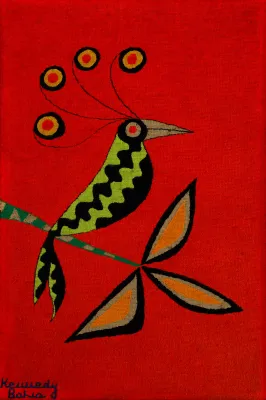
Madeleine Ribeiro Colaço was a plastic artist and specialized in tapestry. Born in 1907 in Tangier, Morocco, she moved to Paris at age 12, where she studied at Neully's Saint Marie College, completing her studies in London. He returned to Tangier around 1925, where he became an apprentice in the art of tapestry at the Kasbah Palace School. On subsequent trips to England and France, he studied collections of tapestries in museums.
In 1928, he moved to Lisbon, where he learned the traditional technique of the point of Arraiolos, developed since the 16th century. In 1940, he moved to Brazil, initially settled in Petrópolis, Rio de Janeiro, where he developed the technique known as "Brazilian Point", registered at the Center International de la Tapisserie Ancienne et Moderne, in Lausanne, Switzerland. In the same decade, he founded the Thomaz Colaço School, a center for vocational education focused on literacy and training of artisans, which operated until 1978.
He held his first solo exhibition in 1953, at the Ministry of Education and Culture, in Rio de Janeiro. He showed his works both in Brazil and abroad between the 1960s and 1990s, including biennial exhibitions at the Jacques Ardies gallery, in São Paulo, from 1986 to 2000. In 1987, he received from the Brazilian government the commendation of the Order of Rio Branco. Madeleine died in 2001, in Rio de Janeiro.
Analysis
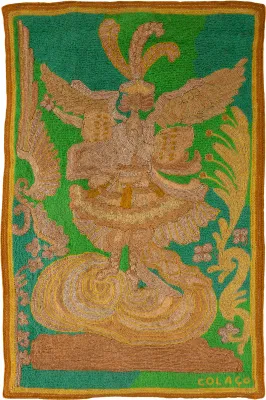
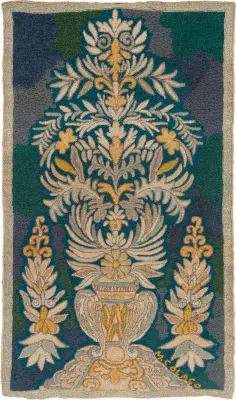
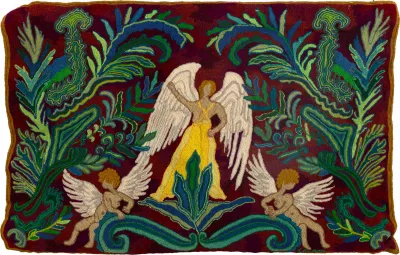
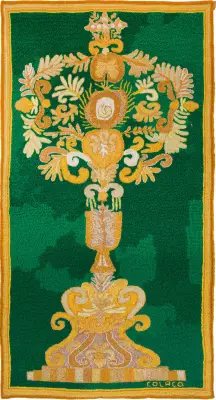
The work of Madeleine Ribeiro Colaço represents a significant milestone in the history of tapestry in Brazil, not only for its innovative technique, but also for way in which she incorporated cultural and natural aspects of the country into her art. From the 1940s onwards, the artist began to experience Brazilian culture, and this had a profound impact on the evolution of her work. Brazil, with its diversity of colors, rhythms and natural elements, provided a fertile field for Madeleine to develop a unique and creative style. most notable innovations from Colaço. By associating the cadence of samba with the technique of embroidery, the artist introduced a new rhythm in the tapestry, which became the essence of her creation. Madeleine describes this discovery with a touching simplicity, by stating that she realized, when listening to a samba, that the act of embroidering could have a rhythm of its own, a cadence. This fusion of samba with the tapestry creates a visual language that is not only innovative, but deeply connected to Brazilian culture.
The collaço technique is a combination of tradition and freedom. Although he learned the point of Arraiolos in Portugal, it introduced variations that made his approach more fluid and expressive. While the traditional Arraiolos point requires a specific direction for the needle, Colaço breaks with this stiffness, allowing itself a "free and creative way of working with the needle". This process also reflects the unpredictable and spontaneous characteristic of Brazilian nature and life, where the unexpected and the vibrant are always present.
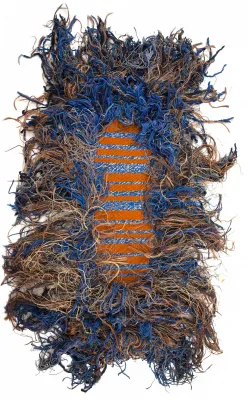
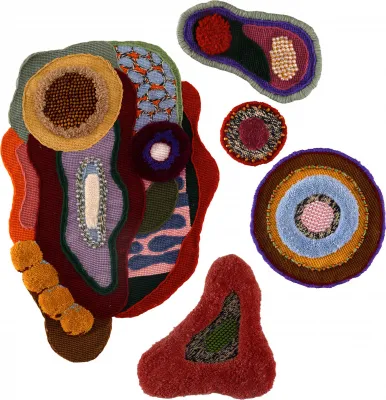
In terms of composition, Madeleine did not use preparatory cards, which distinguished her from other upholsterers. traditional. She preferred to draw directly on the canvas, which allowed for a more direct and personal interaction with her work. His choice of materials also reflected this experimental and daring approach. Using wool, cotton, acrylic and metallic threads, she created tapestries that challenged both aesthetic and technical conventions.
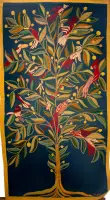
The reasons for Madeleine Colaço's tapestries are equally representative of the diversity and richness of Brazilian culture. It is mainly inspired by the country's fauna and flora, but also resorts to elements of colonial architecture and popular festivals, often incorporating the geometric patterns of Portuguese tiles and the ornamentation of churches and colonial houses. These influences are not merely decorative, but become a visual language that sometimes resembles the painting of Alfredo Volpi, another great name in Brazilian art.
The fusion between technique, culture and innovation in the work of Madeleine Colaço has established a new phase. in the tapestry in Brazil, transforming it into a form of art that, at the same time, dialogues with traditions and the contemporary reality of the country. His "embroidered sambas" continue to enchant and influence new generations of artists and admirers of textile art, consolidating his position as one of the most important figures in Brazilian art of the 20th century.
Exhibitions
1974 - 1st Brazilian Tapestry Show
1972 - Art/Brazil/Today: 50 years later
1982 - 5th Northwest Visual Arts Salon
1987 - 20th Chapel ART Show
1988 - 21st Chapel Art Show
1980 - Meeting of National Tapecers of the State of São Paulo
1991 - Large collective exhibition of naive art
1994 - great art exhibition Brazilian Naif
2006 - Rarities
2005 - Naif Art
2015 - Art Naif
2003 - Naif Art
2008 - Arte Naif
2003 - Naif Art
2006 - Naif Art
2000 - Naif Art
2002 - Art Naif 2002
2011 - Naïve Art 2011
Source: Itaú Cultural