Jorge de Lima (União dos Palmares AL 1893 - Rio de Janeiro RJ 1953)
Painter, draftsman, illustrator, sculptor, poet, novelist and teacher.
Jorge Mateus de Lima completed his medical degree in Rio de Janeiro in 1914. During his studies, he wrote and published poems in small newspapers, both inside and outside the schools he attended. In 1921, he was elected Prince of the Poets of Alagoas. While teaching natural history and later Brazilian literature at schools in Maceió, he became involved in politics, serving as a state deputy and city councilor. He began in the visual arts by illustrating the book O Mundo do Menino Impossível [The World of the Impossible Boy] in 1927. In 1931, he moved to Rio de Janeiro, where he practiced medicine in his own office, which also served as a studio and a meeting place for artists and intellectuals. In 1939, he furthered his painting by attending the studio of the painter Sylvia Meyer (1889 - 1955). That same year, he painted his first canvas, Quadro com Mulher [Painting with Woman] or Mulher Sonhando [Woman Dreaming]. At the same time, he continued to devote himself to literature, publishing, among others, Poemas Escolhidos [Selected Poems], 1932; the surrealist novel O Anjo [The Angel], 1934; Tempo e Eternidade [Time and Eternity], 1935, dedicated to Ismael Nery (1900 - 1934); Quatro Poemas Negros [Four Black Poems], 1937; A Túnica Inconsútil [The Seamless Tunic], 1938; A Pintura em Pânico [Painting in Panic], an album of photomontages with a preface by Murilo Mendes (1901 - 1975), 1943; and Invenção de Orfeu [Invention of Orpheus], 1952. In 1940, he was honored with the Grand Prize for Poetry from the Academia Brasileira de Letras - ABL. After his death, his poem O Grande Circo Místico [The Great Mystical Circus] gave its name to a dance production by Naum Alves de Souza (1942 - 2016) and to an album with songs by Edu Lobo (1943) and Chico Buarque (1944), in 1983.
Critical Commentary
Jorge de Lima graduated from the Faculdade de Medicina do Rio de Janeiro in 1914. He lived in Maceió from 1915 until 1930, when he moved permanently to Rio de Janeiro. He became a very well-known writer and, in parallel, developed a significant body of painting. Around 1927, he began painting on his own and later refined his skills in the studio of the painter Sylvia Meyer (1889 - 1955). He kept up this activity until 1953, the year of his death.
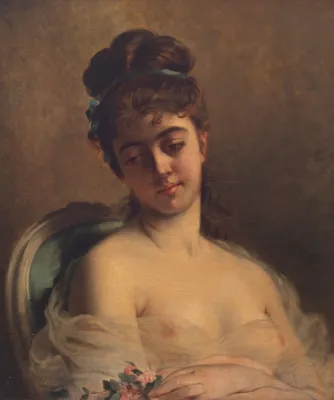
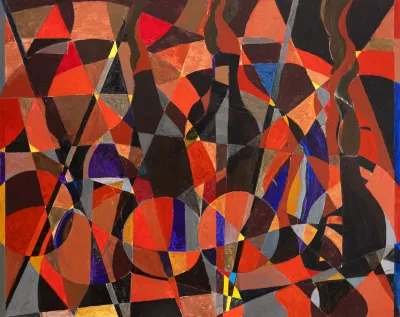
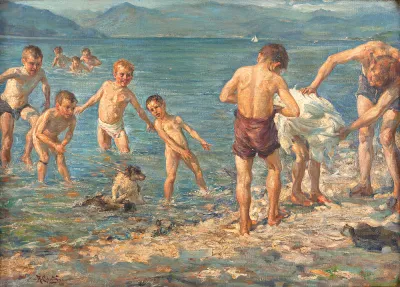
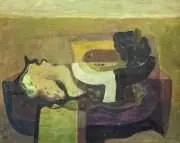
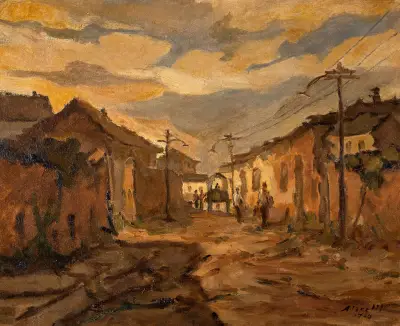
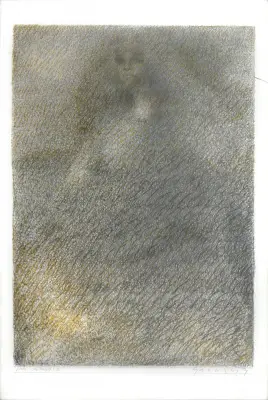
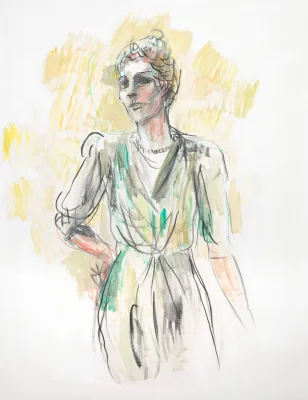
As the scholar Ana Maria Paulino points out, Jorge de Lima did not settle on a single style. The religious themes found in his poetry are also present in his painting, in works that engage with Expressionism and especially with the work of Candido Portinari (1903 - 1962). Another constant is the figure of woman, portrayed above all as a contemplative character. Several of his works also come close to Surrealism, mainly through their dreamlike atmosphere.
Jorge de Lima also devoted himself to photomontage. This activity was first presented by Mário de Andrade (1893 - 1945) in the text Fantasias de um Poeta [A Poet's Fantasies], published in 1939 in the newspaper O Estado de S. Paulo. In 1943, the artist published the book A Pintura em Pânico [Painting in Panic], which gathers several of his collages. In the book's preface, the critic and poet Murilo Mendes (1901 - 1975) relates his work to contemporary art movements such as Surrealism, and to the work of Max Ernst (1891 - 1976) and Salvador Dalí (1904 - 1989), among others.
For the art historian Tadeu Chiarelli, the artist's photomontages are very close to Ernst's: they consist of strange scenes taking place in continuous spaces. The images, however, are handled within the strictures of representation. According to Ana Maria Paulino, Jorge de Lima was probably interested in the metaphysical painting of Giorgio de Chirico (1888 - 1978) and in the writings of Sigmund Freud (1856 - 1939) and Carl G. Jung (1875 - 1961) on the unconscious. He channeled this knowledge into his collages, presenting fantastic, hybrid and mysterious beings, such as a sumptuously dressed female figure with an animal's head, or a cross between woman, mannequin and piece of furniture. In another work, he superimposes two female figures, inverting them like playing cards. One wears a diving helmet and the other has long hair falling to the floor. The resulting association suggests a kind of hourglass evoking the passage of time. In other works, the artist creates an oppressive atmosphere, with images such as birds flying in enclosed spaces.
For Paulino, Jorge de Lima uses a process similar to collage in his poems, creating visual scenes in which elements, characters and objects interact, producing a certain strangeness that stirs the reader's sensibility.
Critiques
"Choosing man as the most frequent subject of his painting, Jorge de Lima was fully aware of the creative and transformative function of art. He stated that his human figures 'are in no way integrated into any photographic appearance of reality, nor have any concern for objectivity', since they are 'seen from a poetic angle' and present reality in another light. This awareness, combined with his desire to create in the visual field, made him a painter. Many of his works bear the mark of Surrealism, Expressionism and metaphysical painting. (...). His painting, like his poetry, he said, took a path independent of himself, following its own autonomous courses".
Enock Sacramento
ARTE e medicina. Apresentação de Alois Metzler. Textos de Enock Sacramento, Alberto Beuttenmuller, Márcio Sampaio e Ziraldo. São Paulo: Sadalla Galeria de Arte, 1990.
"By making a number of photomontages visibly influenced by the Surrealists, Jorge de Lima became the pioneer of this practice in Brazil. Although this work was only published in book form in 1943 - A pintura em pânico, Rio de Janeiro: Ed. Revista Acadêmica -, the author had already made it known in newspapers and magazines since the late 1930s.
O Cruzeiro, in a July 1938 issue, featured five 'photographs', as the author himself called them in the interview accompanying the images, in which he names Max Ernst (1891-1976) as the creator of the genre, explains how he makes them himself and compares them to a poem, identifying them as another form of poetic expression (...).
In July 1939, in Dom Casmurro, Jorge de Lima again presented his new experiments, but this time they were découpages - made by the same process as photomontage, but using engravings as material (...)".
Gênese Andrade
TERESA REVISTA DE LITERATURA BRASILEIRA. São Paulo: Editora 34, nº 3, 2002. p. 84-85
Solo Exhibitions
1946 - Rio de Janeiro RJ - Solo exhibition, at ABI
1951 - Recife PE - Solo, at Gabinete Português de Leitura
Group Exhibitions
1942 - São Paulo SP - 7th Salon of the Sindicato dos Artistas Plásticos, at Galeria Prestes Maia
1944 - Rio de Janeiro RJ - 50th National Fine Arts Salon - Modern Division
1944 - Rio de Janeiro RJ - 51st National Fine Arts Salon - Modern Division
1947 - Rio de Janeiro RJ - 52nd National Fine Arts Salon - Modern Division - honorable mention
1948 - Rio de Janeiro RJ - Visual Arts Salon of the Sociedade Brasileira de Belas Artes - honorable mention
1949 - Rio de Janeiro RJ - 54th National Fine Arts Salon - Modern Division - honorable mention
1951 - São Paulo SP - 1st São Paulo International Biennial, at Pavilhão do Trianon
1953 - Rio de Janeiro RJ - 2nd National Salon of Modern Art
Posthumous Exhibitions
1962 - Recife PE - Retrospective at Galeria Rozemblit, presented by Vicente do Rego Monteiro
1981 - Maceió AL - Artistas Brasileiros da Primeira Metade do Século XX [Brazilian Artists of the First Half of the 20th Century], at Instituto Histórico e Geográfico
1983 - Premiere of the dance production O Grande Circo Místico [The Great Mystical Circus], based on Jorge de Lima's poem of the same name, with a script by Naum Alves de Souza and choreography by Carlos Trincheiras, by Ballet Guaíra
1983 - Rio de Janeiro RJ - Recording of the album O Grande Circo Místico, with music by Edu Lobo and lyrics by Chico Buarque based on Jorge de Lima's poem
1985 - São Paulo SP - 18th São Paulo International Biennial, at Fundação Bienal
1990 - São Paulo SP - Arte e Medicina [Art and Medicine], at Sadalla Galeria de Arte
1993 - São Paulo SP - 100 Obras-Primas da Coleção Mário de Andrade: pintura e escultura [100 Masterpieces from the Mário de Andrade Collection: Painting and Sculpture], at IEB/USP
1998 - Rio de Janeiro RJ - 16th National Visual Arts Salon, at MAM/RJ
2002 - Porto Alegre RS - Apropriações e Coleções [Appropriations and Collections], at Santander Cultural
Source: Itaú Cultural