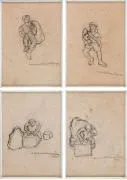
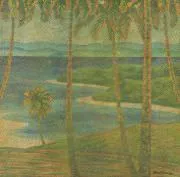
Hércules Florence (Nice, França 1804 - Campinas SP 1879)
Draftsman, painter, photographer, typographer, lithographer, teacher, inventor.
Antoine Hercule Romuald Florence arrived in Brazil in 1824. He worked in commerce and at a printing firm before joining the Langsdorff Expedition as a draftsman, between 1825 and 1829, during which he devised a method for transcribing birdsong called zoophonia. He settled in Vila de São Carlos (now Campinas), where in 1833 he invented a photographic process, which he named photographie [photography]. He was responsible for several other inventions, among them polygraphie [polygraphy], a system for printing all the primary colors simultaneously. In 1842, he launched O Paulista - the first newspaper in the interior of the province of São Paulo - and, in 1858, printed at his lithographic press Aurora Campineira, the first newspaper in Campinas. His multiple talents attracted the attention of Emperor Dom Pedro II (1825 - 1891), who visited him in Campinas in 1876. He wrote several books, most notably Viagem Fluvial do Tietê ao Amazonas [River Journey from the Tietê to the Amazon], published in 1875.
Critical Commentary
Little is known about Hercule Florence's life before his arrival in Rio de Janeiro in 1824, as a crew member of a French ship. The son of a military doctor and a French noblewoman, he showed an early interest in drawing, science and the famous expeditions of European travelers to the New World. It is not certain whether he learned to draw on his own. In Rio de Janeiro he worked at the fashion shop of the Frenchman Mr. Dillon and then at Mr. Plancher's bookshop. In response to an advertisement, in September 1825 he left with the Langsdorff Expedition (1821 - 1829) - a scientific journey conceived by the Russian consul Baron Langsdorff (1773 - 1852) - as second draftsman. The group went to Santos by ship and headed for the Amazon through the interior of the country. From 1826 to 1829 it traveled through the present-day states of São Paulo, Mato Grosso, Mato Grosso do Sul, Rondônia, Amazonas and Pará. Florence produced a series of drawings and watercolors depicting the fauna, flora, landscape and population of the places visited, which, together with the works of the German artist Rugendas (1802 - 1858) and the French draftsman Adrien Taunay (1803 - 1828), constitute the only visual documentation of this adventure, which cost the consul himself his sanity.
The works Florence produced, kept at the Academy of Sciences in Moscow, reveal his objective and meticulous eye in the task of representing nature. Historian Ana Maria Belluzzo believes that, in search of a homogeneous and impersonal linear line, the artist may have used the camera lucida to produce his drawings. Meticulous, the artist noted the observation conditions of each record made: date and place of collection, dimensions of the documented specimen, the proportions between the size of the referent and of the reference, whether the images were made from dried plants or stuffed animals, etc. His analytical vision grasps the object as a whole and in its details. Plants and animals are shown from various points of view, inside and out, with emphasis on the characteristics of each genus. In the ethnographic portraits, he presents the figures from the front and in profile, striving to reproduce their particularities (for example, skin color, body painting, ornaments and clothing). Hercule Florence clearly seeks to individualize physiognomies and affirm ethnic diversity, without resorting to standardization. In the landscapes, in addition to the topography of each region, he is interested in recording the luminosity of the sky and clouds.
Back in Rio de Janeiro in 1829, he left his daily notes on the expedition with Félix Taunay (1795 - 1881), brother of Adrien, who drowned in 1828 in the Guaporé River. The manuscript entitled Esboço da Viagem Feita pelo Snr. Langsdorff ao Interior do Brasil desde Setembro de 1825 até Março de 1829 [Sketch of the Journey Made by Mr. Langsdorff into the Interior of Brazil from September 1825 to March 1829] was translated and published by Alfredo d'Escragnolle Taunay, with the author's consent, more than 40 years later, between 1875 and 1876.
Only in 1849 did Hercule Florence return to his notes and begin writing the complete diary of the scientific journey. This diary, now in the possession of his descendants, was published in 1977 under the title Viagem Fluvial do Tietê ao Amazonas pelas Províncias Brasileiras de São Paulo, Mato Grosso e Grão-Pará (1825 - 1829) [River Journey from the Tietê to the Amazon through the Brazilian Provinces of São Paulo, Mato Grosso and Grão-Pará].
With the end of his work as second draftsman, from 1830 the artist settled in Vila de São Carlos, now Campinas, in São Paulo, where he started a family and became a farmer, without, however, setting aside art and scientific questions. He continued to record the landscape and the transformations the region underwent over the 19th century. He documented the expansion of sugarcane and coffee farming, slave labor on the sugar mills, the burning and clearing of forests for planting and, to a lesser extent, the city of São Paulo. One of the few drawings of the interior of the old Igreja da Sé (n.d.) in São Paulo is by Florence. For this production he is recognized as one of the pioneers of São Paulo iconography.
Hercule Florence was also a precursor in another field: that of chemical processes for reproducing images. Seeking to simplify the procedures common at the time (limited to different types of printmaking, such as lithography and woodcut), in 1830 he invented what he called polygraphie [polygraphy], a color printing method similar to today's mimeograph. From 1832, he began investigating the possibilities of fixing the image produced by the camera obscura by means of an element that changes color under the action of light. With the help of the apothecary Joaquim Corrêa de Mello, he carried out photochemical experiments that gave rise to images named photographie [photography] in 1833. In other words, at almost the same time as Joseph Nicéphore Niépce (1765 - 1833) and Louis Jacques Mandé Daguerre (1781 - 1851), in France, and William Henry Fox Talbot (1800 - 1877), in England, and under very different scientific conditions, Florence produced photographic copies of drawings in Campinas.1 Of the examples produced, what remains today are the photographic prints of the "Diploma da Maçonaria" [Freemasonry Diploma] (c. 1833) and of pharmacy labels (n.d.). In recognition of his iconographic work, he was named a Corresponding Member of the Instituto Histórico, Geográfico e Etnográfico do Brasil in 1877. He died in Campinas two years later.
Notes
1 In general, the official date of the birth of photography falls in the year 1839. At that time, the daguerreotype - an early process for obtaining photographic images invented by the French physicist and painter Louis Jacques Mandé Daguerre - was declared public domain by the French government. On learning of this, Hercule Florence declared: "Photography is the marvel of the century. I too had already established its foundations, foreseen this art in its fullness. I achieved it before Daguerre's process, but I worked in exile. I printed by means of the sun seven years before photography was spoken of. I had already given it this name; nevertheless, all honors to Daguerre." Apud: MONTEIRO, Salvador (org.), KAZ, Leonel (org.). Expedição Langsdorff ao Brasil, 1821-1829: Rugendas, Taunay, Florence. Rio de Janeiro: Alumbramento: Livroarte, 1998. p. 360.
Critiques
"(...) Florence made several drawings to document the places the expedition passed through and the human types it encountered, especially after the death of another draftsman linked to it, Adrien Taunay. (...) In 1825, in São Paulo, although struggling with scarce means and a lack of suitable materials, he produced remarkable works, among them a portrait of his future father-in-law, the great physician and greatest patriot, Álvaro Machado, and other portraits of the then Baron of Congonhas do Campo, of Dr. Nicolau Pereira de Campos, etc."
Roberto Pontual
PONTUAL, Roberto. Dicionário das artes plásticas no Brasil. Rio de Janeiro: Civilização Brasileira, 1969.
Posthumous Exhibitions
1946 - São Paulo SP - 12º Salão Paulista de Belas Artes [12th São Paulo Fine Arts Salon], at Galeria Prestes Maia
1978 - São Paulo SP - Mostra de desenho e aquarela, Viagem Fluvial do Tietê ao Amazonas [Drawing and Watercolor Exhibition, River Journey from the Tietê to the Amazon], at Masp
1980 - São Paulo SP - Fotografia Arte e Uso [Photography Art and Use], at Masp
1980 - São Paulo SP - Exposição Itália-Brasil - Relações entre os Séculos XVI e XX [Italy-Brazil Exhibition - Relations between the 16th and 20th Centuries]
1984 - São Paulo SP - Tradição e Ruptura: síntese de arte e cultura brasileiras [Tradition and Rupture: A Synthesis of Brazilian Art and Culture], at Fundação Bienal
1988 - Rio de Janeiro RJ - Expedição Langsdorff [Langsdorff Expedition], at Paço Imperial
1988 - São Paulo SP - Expedição Langsdorff [Langsdorff Expedition], at MAC/USP
1989 - Campinas SP - Hércules Florence - A Fixação de uma Imagem [Hércules Florence - The Fixing of an Image], at MIS/Campinas
1990 - Rio de Janeiro RJ - Missão Artística Francesa e Pintores Viajantes: França - Brasil no século XIX [French Artistic Mission and Traveling Painters: France - Brazil in the 19th Century], at Fundação Casa França-Brasil
1992 - Rio de Janeiro RJ - Natureza: quatro séculos de arte no Brasil [Nature: Four Centuries of Art in Brazil], at CCBB
1992 - São Paulo SP - Índios no Brasil [Indigenous Peoples in Brazil], at Fundação Bienal
1992 - Zurich (Switzerland) - Brasilien: Entdeckung und Selbstentdeckung [Brazil: Discovery and Self-Discovery], at Kunsthaus Zürich
1994 - São Paulo SP - Um Olhar Crítico sobre o Acervo do Século XIX [A Critical Look at the 19th-Century Collection], at Pinacoteca do Estado
1995 - São Paulo SP - O Brasil de Hoje no Espelho do Século XIX: artistas alemães e brasileiros refazem a Expedição Langsdorff [Today's Brazil in the Mirror of the 19th Century: German and Brazilian Artists Retrace the Langsdorff Expedition], at Masp
1996 - Rio de Janeiro RJ - O Brasil de Hoje no Espelho do Século XIX: artistas alemães e brasileiros refazem a Expedição Langsdorff [Today's Brazil in the Mirror of the 19th Century: German and Brazilian Artists Retrace the Langsdorff Expedition], at Fundação Casa França-Brasil
1997 - Rio de Janeiro RJ - Exposição A Coleção do Imperador. Fotografia Brasileira e Estrangeira no Século XIX [The Emperor's Collection Exhibition. Brazilian and Foreign Photography in the 19th Century], at CCBB
2000 - Rome (Italy) - Viajantes e Naturalistas Italianos: imagens do Brasil nos séculos XVIII e XIX [Italian Travelers and Naturalists: Images of Brazil in the 18th and 19th Centuries], at Palazzo Santacroce
Source: Itaú Cultural