Giorgio de Chirico (1888 - 1978)
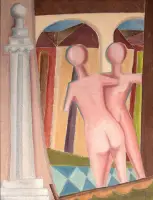
Giorgio de Chirico was an Italian painter, the main representative of "metaphysical painting", an artistic movement precursor of surrealism. Born on July 10, 1888, in Volos, Greece, where his father worked, Giorgio lived part of his childhood between Greece, Italy and Germany, experiences that shaped his artistic universe. Fascinated by the painting of Swiss symbolist Arnold Böcklin, he began to develop his own enigmatic and solitary architectural scenarios from 1909 onwards. From that time on, his works began to reflect an atmosphere of mystery and symbolism, using objects heterogeneous to create a dreamlike and subconscious reality.
De Chirico moved to Paris in 1911, where his painting, with a sense of silence and loneliness, gained great recognition. In 1912, he held his first solo exhibition, which was widely admired by artists such as Picasso and Apollinaire. During the First World War, he met the painter Carlo Carrà, with whom he founded the "Scuola Metaphysics" in 1917. reality", more spiritual and metaphysical. De Chirico's compositions, full of architectural elements such as columns, towers, squares and neoclassical monuments, generated empty and mysterious spaces, where human figures, often represented by faceless mannequins, emerged in scenarios that evoked strangeness and loneliness.
Between 1914 and 1915, by Chirico began to include mannequins in his works, such as "The Disquieting Muses" (1916) and "Heitor and Andromache" (1917), half-human figures, half-statues, which symbolized the disconnection and strangeness of the human being in relation to his environment. His metaphysical painting, with its unusual perspectives and juxtapositions of objects without apparent sense, had a great influence on surrealism, especially with regard to the use of the unconscious, dream and mystery. Chirico departed from the metaphysical style and adopted a classicist style, closer to academic art. Although he participated in the surrealist exhibition of Paris in 1925, he distanced himself from the movement, rejecting surrealism in favor of a more traditional art and focused on mythological and classical themes. This departure generated a certain strangeness in the artistic world, since De Chirico was considered one of the precursors of surrealism. He returned to Italy, where his style was consolidated even more towards the academic. Despite his change of style, his work continues to be studied and admired, especially for the impact he had on the artistic avant-gardes of the 20th century. Giorgio de Chirico's legacy remains relevant to this day, with his works influencing surrealist artists such as Salvador Dalí and René Magritte. His painting, with its enigmas and dreamlike atmospheres, continues to fascinate and inspire, making it one of the most important names in modern art.