Carlos Oswald (Florence, Italy 1882 - Petrópolis RJ 1971)
Recorder, painter, stainer, designer, decorator, teacher, writer.
Graduate Physics-mathematical in 1902, by the Galileo Galilei Institute in Florence. The following year, he joined the Accademia di Belle Arti di Firenze. He travels to Brazil for the first time in 1906 and holds in Rio de Janeiro the first solo exhibition in the country. He returns to Europe in 1908, studies engraving with the American Carl Strauss (1873-1957) in Florence and travels to Munich, where he learns the technique of strong water. In 1911, he participated in the decoration of the Pavilion of Brazil, in the International Exhibition of Turin. He makes his second trip to Rio de Janeiro in 1913 and holds an exhibition with Eugênio Latour (1874-1942) at the National School of Fine Arts (ENBA). The following year, he was appointed professor of engraving and drawing at the Lyceum of Arts and Crafts in Rio de Janeiro, and carried out in 1930. That year, he made the final design of the Monument to Christ the Redeemer. The work is carried out in France by sculptor Paul Landowski (1875-1961) and installed in Morro do Corcovado, Rio de Janeiro, in 1931. From 1946, he teaches an engraving course at Fundação Getúlio VARGAS - FGV. In 1957, he published the autobiography as I became a painter.
Critical Comment
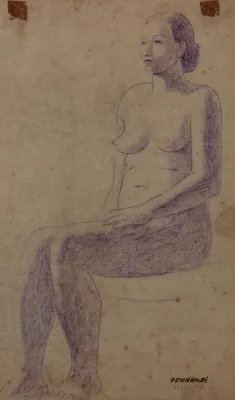
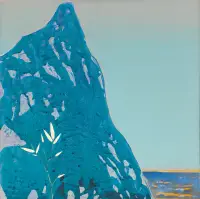
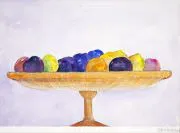
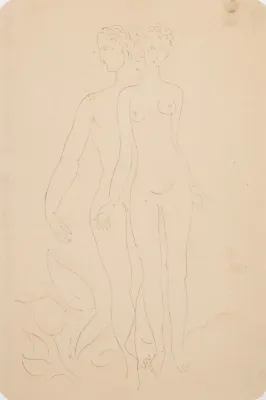
Carlos Oswald has a very diverse production. He is dedicated to the execution of landscapes and still-natures, but, as the art historian Quirino Campofiorito (1902-1993) points out, religious themes are imposed in his painting, always committed to liturgical characteristics. He also carries out several decorative works for the São Joaquim Palace and Pedro Ernesto Palace, in Rio de Janeiro.
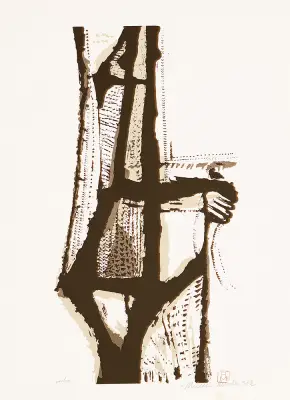
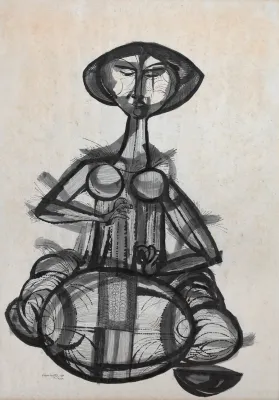
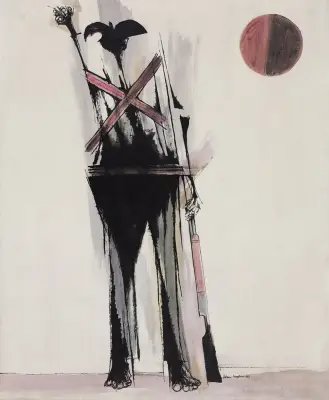
Pioneer of metal engraving (heavywater and ink-water) In Brazil, his work allows us to affirm the expressive character of the technique. In engravings such as Boi à Tarde, 1908, Carrying Madeiras, 1909 or Bois Rescando, 1910, it is possible to observe the dialogue with the works of Italian artists such as Giuseppe de Nittis (1846-1884) and Giovanni Fattori (1825-1908). For Oswald, engraving is the most spiritual of the visual arts, as it is based on the line and the point, whose immateriality makes it possible to express artistic states of soul.
Carlos Oswald is responsible for the formation of new generations of recorders in Brazil, as Poty (1924-1998), Darel (1924), Fayga Ostrower (1920-2001), Renina Katz (1926), Henrique Oswald (1918-1965) and Orlando Dasilva (1923).
Criticism
"The work of Carlos Oswald always has its focus on form. Even in painting in phases such as the studies of artificial light (portrait of Azeredo Coutinho) or the Petropolitana (street in Petropolis), in which color is a prominent part, the form is important in the structure of the painting (...). This preference already demonstrated when changing the musical study for learning in an engineering school. We also see the understanding of the form when making drawings for sculptures, highlighting the studies on which the construction of the Monument to Christ the Redeemer was based, so nothing more natural than his affection for the drawing and especially for the engraving.
The verbal form does not go unnoticed, as we can see in the writer of how I became a painter and in the collaborator frequent in newspapers and magazines, always preferring to disclose the primors of the engraving".
Orlando Dasilva
Carlos Oswald. Text by Orlando Dasilva. Presentation by Alcidio Mafra de Souza. Rio de Janeiro: MNBA, 1982.
"A painter is demonstrated with very personal characteristics, as, among Brazilians, it is only verified with Eliseu Visconti, always willing to extend a work with lively marks by a restless artist and Attentive to activities that were not restricted to the handling of brushes or modeling. Visconti went to the industrial arts and valued them as a creative mister. Carlos Oswald, sir, also, of how much painting offers, went to the graphic arts, which in Brazil They continued to be discredited in parallel with the arts taken, still, as greater (...) Carlos Oswald breaks the prejudice and is the first artist in Brazil to add engraving on metal ('strongwater' and 'ink water') to the most legitimate activities of artistic activity. Develops a personality that has not stopped showing unrestrained professional enthusiasm, activating the creative feeling in both painting and drawing, engraving and illustration, to which one must add to the literary activity in which much has been extended to knowledge and ideas artistic activities, particularly with regard to sacred art.
His long permanence in Florence, where all his condition as an artist has training, accentuates the predominant influences on the part of his work that develops until 1913. From then on, what can be called a period Brazilians extend into a permanent evolution that always identifies him among our greatest artists. The way in which he also defines himself as a painter, draftsman and engraver - absolutely safe in the three different terrains - is already singular in Brazilian art. No identical example is found among our artists, until Carlos Oswald becomes Lord of the Three Techniques, in all being carried out in a decided way".
Quirino Campofiorito
Campofioritus, Quirino. History of Brazilian painting in the 19th century. Rio de Janeiro: Pinakotheke, 1983. p. 263-264.
"The trajectory of artists who felt the presence of symbolism in the first vintage of the century, but finally headed for a predominance of academic solutions, can be represented by Carlos Oswald (...). On oil screens he made a portrait of Azevedo Coutinho and Boi with a red car (...), known works in a symbolist range. However, in pictorial decorations, in buildings, it will mainly carry out academic works. also from the strong engraving of its Italian phase declines to academicism in portraits and works of religious sentiment".
Walter Zanini
ZANINI, Walter, Org. General History of Art in Brazil. Presentation by Walther Moreira Salles São Paulo: Instituto Walther Moreira Salles, Djalma Guimarães Foundation, 1983.
Testimonies
"Surely another artist, sooner or later, would have taken my place From the pioneer of engraving in the early 1900s, the indisputable fact is that I was the one to direct, to start, to accompany the graphic art movement in Brazil to maturity. I am proud of this and it would be a false modesty to want to be hidden and forgotten. I know that worldwide the awakening of the interest in print was born and developed in our century for the reasons that everyone knows: 'synthetism', in opposition to the exaggerated polychromy of post-impressionists; enthusiasm for the resurrection of this art that had been killed by the mechanical processes derived from photography; the mysterious of its light-dark effects and its alchemist technique; Her practice that facilitated her repetition in many copies and that made her a more harmonious art with our democratic customs; a democratic art, in short; And, finally, its novelty character that made its eyes widen not only to the general public, but to most of the artists themselves when they were talking about armored water, dry-point, ink, mezzotinta, butcher-sweet, woodcutting, etc."
Carlos Oswald 1957
Brazilian engraving/texts by Leon Kossovitc and Mayra Laudanna, Ricardo Resende, presentation Ricardo Ribenboim São Paulo: Cosac & Naify/Itaú Cultural, 2000, p. 38.
"By examining my father's life, trying to abstract my condition as a daughter, I always admire me not only with its versatility, but also with its dynamism. Its diary allows us to follow the rich days of activities, projects and achievements, as well as a vision of concepts of great interest. Used to registering, at the end of the day, everything he had done, sometimes perplexes me at the amount and diversity of his occupations. I come to the conclusion that despite his thin appearance he had iron health. Or would it be the strength of the spirit dominating the body and mind? No genre he failed to address, sometimes concomitantly. He did mural and easel painting, engraving, drawing and illustrations, he was a viralist, teacher and columnist, all of which without failing to maintain an intense social life attending concerts, meetings and exhibitions. And he was always present as a father in our lives, although his activities even more multiplied when he answered any call relating to the subject of art. He was part of the most diverse institutional commissions, taking a deeper interest in what he did, giving himself anything to anyone with whom he decided to collaborate. Anyone who knew him socially would have no idea of the depth of his religious life. her did not speak. The works spoke. He accepted people as they were, he did not intend to transform anyone or tried to instill his own convictions in others. This does not mean that he did not like, very much, a controversy about art, when he ignited all the ardor of Italian blood, as Manuel Bandeira quoted."
Maria Isabel Oswald Monteiro
Monteiro, Maria Isabel Oswald. Carlos Oswald (1882-1971): Painter of Light and Reflexes. Rio de Janeiro: Casa Jorge Editorial, 2000, p. 159.
Individual exhibitions
1904 - Florence (Italy) - Individual
1906 - Rio de Janeiro RJ - Individual, at the School of Music
1906 - Rome (Italy) - Individual
1907 - Rio de Janeiro RJ - Individual, at Rua Chile
1910 - Munich (Germany) - Individual
1911 - Paris (France) - Individual
1917 - São Paulo SP - Individual, at Galeria Jorge
1918 - São Paulo SP - Individual, at Rua Libero Badaró, 111
1920 - Rio de Janeiro RJ - Individual, at Galeria Jorge
1938 - Rio de Janeiro RJ - Individual, at the gallery Heubergen
1955 - Rio de Janeiro RJ - Individual, in the MNBA
1962 - Rio de Janeiro RJ - Individual, in the MNBA
Collective exhibitions
1904 - Rio de January RJ - 11th General Exhibition of Fine Arts, at ENBA - 2nd Degree Honorable Mention
1906 - Rio de Janeiro RJ - 13th General Exhibition of Fine Arts, at Enba - Silver Medal
1907 - Rio de Janeiro RJ - 14th General Exhibition of Fine Arts, at ENBA
1908 - Rio de Janeiro RJ - 15th General Exhibition of Fine Arts, at Enba
1909 - Rio de Janeiro RJ - 16th General Exhibition of Fine Arts, at Enba - Honorable Mention of 1st Degree
1911 - Paris (France) - Paris Arts Salon
1911 - Turin (Italy) - International Exhibition of Turin
1912 - Florence (Italy) - Collective - Firenze Province Award
1912 - Rio de Janeiro RJ - 19th General Exhibition of Fine Arts, ENBA - Bronze Medal
1912 - São Paulo SP - Second Brazilian Exhibition of Fine Arts, High School of Arts and Crafts
1913 - Rio de Janeiro RJ - 20th General Exhibition of Fine Arts, ENBA - Small Gold Medal
1913 - Rio de Janeiro RJ - Carlos Oswald and Eugênio Latour ENBA
1914 - Rio de Janeiro RJ - 21st General Exhibition of Fine Arts, at Enba
1915 - Rio de Janeiro RJ - 22nd General Exhibition of Fine Arts, at Enba
1916 - Rio de Janeiro RJ - 22nd General Exhibition of Fine Arts Janeiro RJ - 23rd General Exhibition of Fine Arts, at ENBA - Great Silver Medal
1917 - Rio de Janeiro RJ - 24th General Exhibition of Fine Arts, at Enba
1918 - Rio de Janeiro RJ - 25th General Exhibition of Fine Arts, at ENBA
1919 - Rio de Janeiro RJ - 26th General Exhibition of Fine Arts, at ENBA
1919 - Rio de Janeiro RJ - Carioca Engraving Exhibition A Strong water
1920 - Rio de Janeiro RJ - 27th General Exhibition of Fine Arts, at ENBA
1921 - Rio de Janeiro RJ - 28th General Exhibition of Fine Arts, at ENBA 
1922 - Rio de Janeiro RJ - 29th General Exhibition of Fine Arts, at Enba
1922 - Rio de Janeiro RJ - Exhibition of the Centenary of Independence
1924 - Rio de Janeiro RJ - 31st General Exhibition of Fine Arts, at Enba
1925 - Rio de Janeiro RJ - 32nd General Exhibition of Fine Arts, at Enba
1927 - Rio de Janeiro RJ - 34th General Exhibition of Fine Arts, at ENBA
1928 - Rio de Janeiro RJ - 35th General Exhibition of Fine Arts, at Enba
1929 - Rio de Janeiro RJ - 36th General Exhibition of Fine Arts, at Enba
1929 - Rosário (Argentina) - 11th Rosario Art Salon, at the Municipal Fine Arts Comisión
1930 - Rio de Janeiro RJ - 37th General Exhibition of Fine Arts, at Enba
1931 - Rio de Janeiro RJ - Revolutionary Hall, at Enba
1933 - Rio de Janeiro RJ - 40th General Exhibition of Fine Arts, at Enba
1934 - São Paulo SP - 1st Salão Paulista de Belas Artes, at Rua 11 de Agosto
1937 - Rio de Janeiro RJ - 43rd National Salon of Fine Arts, at MNBA 
1938 - Rio de Janeiro RJ - 44th National Salon of Fine Arts, at MNBA
1939 - Rio de Janeiro RJ - 45th National Salon of Fine Arts, at MNBA
1940 - Rio de Janeiro RJ - 46th National Salon of Fine Arts, at MNBA
1940 - Rio de Janeiro RJ - Carlos Oswald and Hans Steiner, at the Ibeu Copacabana Gallery
1942 - Rio de Janeiro RJ - 48th National Salon of Fine Arts, MNBA
1943 - London (England) - Brazilian Art Exhibition, at Burlington House
1943 - Rio de Janeiro RJ - 49th National Salon of Fine Arts, at MNBA 
1943 - Rio de Janeiro RJ - Religious painting, at MNBA
1944 - London (England) - Exhibition of Modern Brazilian Paintings, at the Royal Academy of Arts
1944 - Norwich (England) - Exhibition of Modern Brazilian Paintings, at Norwich Castle and Museum
1944 - Rio de Janeiro RJ - 50th National Salon of Fine Arts, MNBA
1945 - Bath (England) - Exhibition of Modern Brazilian Paintings, at the Victory Art Gallery
1945 - Bristol (England) - Exhibition of Modern Brazilian Paintings, at the Bristol City Museum & Art Gallery
1945 - Edinburgh (Scotland) - Exhibition of Modern Brazilian Paintings, at the National Gallery
1945 - Glasgow (Scotland) - Exhibition of Modern Brazilian Paintings, at Kelingrove Art Gallery
1945 - Manchester (England) - Exhibition of Modern Brazilian Paintings, Manchester Art Gallery
1946 - São Paulo SP - 12th Paulista Salon of Fine Arts, at the Prestes Maia Gallery
1950 - Rio de Janeiro RJ - A century of Brazilian painting: 1850-1950, at MNBA
1954 - Goiânia GO - Exhibition of the National Congress of Intellectuals
1958 - Rio de Janeiro RJ - Work in the art, at MNBA
1969 - Ouro Preto MG - Salão de Ouro Preto
Exhibitions Posthumous
1971 - Rio de Janeiro RJ - Individual, Galeria Aliança Française
1972 - Petrópolis RJ - Individual, Salon Wim van Dijk
1974 - São Paulo SP - Brazilian engraving show, Fundação Bienal
1977 - Rio de Janeiro RJ - Individual, Cesar Aché Gallery
1978 - Rio de Janeiro RJ - 1st National Salon of Plastic Arts, National Museum of Fine Arts
1978 - Rio de Janeiro RJ - Individual, National Library Foundation
1978 - São Paulo SP - Carlos Oswald: engravings and drawings, Graphus Art Gallery
1979 - Curitiba PR - 2nd Annual Engraving Exhibition City of Curitiba, Center for Creativity
1981 - Rio de Janeiro RJ - Individual, National Museum of Fine Arts
1981 - Washington (United States) - A Pionner of Printmarking in Brazil, Brazilian-American Cultural Institute
1982 - Rio de Janeiro RJ - Carlos Oswald: One hundred years, National Museum of Fine Arts
1982 - Rio de Janeiro RJ - Individual, PUC/RJ. Solar Grandjean de Montigny
1982 - Rio de Janeiro RJ - Football universe, Museum of Modern Art
1982 - São Paulo SP - Italian painters in Brazil, Museum of Modern Art
1983 - São Paulo SP - Carlos Oswald: Engravings from various eras, Lasar Segall Museum
1984 - Fortaleza CE - 7th National Salon of Plastic Arts
1984 - Porto Alegre RS - Engravings: a trajectory in time, Cambona Centro de Arte
1984 - Rio de Janeiro RJ - Recent donations 82-84, National Museum of Fine Arts
1984 - Rio de Janeiro RJ - Salão de 31, Funarte
1984 - São Paulo SP - Tradition and rupture: synthesis of Brazilian Art and Culture, Bienal Foundation
1986 - Curitiba PR - 7th Collection of the National Gravure Museum - Casa da Engraving, Guido Viaro Museum
1986 - São Paulo SP - Nineteenth century: a turn in the century, Pinacoteca do Estado
1988 - Curitiba PR - Oswaldo Goeldi and Carlos Oswald - MNBA, Centro Cultural Palacete Leão Junior
1988 - São Paulo SP - Brasiliana: O Homem e a Terra, Pinacoteca of the State
1989 - Fortaleza CE - Brazilian art of the 19th and 20th centuries in the Ceará collections: paintings and drawings, Unifor Cultural Space
1990 - Rio de Janeiro RJ - Ibeu: 1940-1990, Gallery Ibeu Copacabana
1991 - São Paulo SP - Project: 100 years of Paulista, Casa das Rosas
1992 - Rio de Janeiro RJ - Art engraving in Brazil: proposal for a mapping, Centro Cultural do Banco do Brazil
1994 - São Paulo SP - Bienal Brasil Century 20th Century, Bienal Foundation
1994 - São Paulo SP - A critical look at the collection of the 19th century, Pinacoteca do Estado
1994 - São Paulo SP - Poética da Resistance: Aspects of Brazilian engraving, SESI Art Gallery
1996 - São Paulo SP - Ex Libris/Home Page, Paço das Artes
1998 - Rio de Janeiro RJ - Negotiated Images: Portraits of the Brazilian Elite, Cultural Center of the Bank do Brasil
1998 - Rio de Janeiro RJ - O Rio Não Visa, Centro Cultural do Banco do Brasil
1999 - Rio de Janeiro RJ - Collection of the Solar Grandjean de Montigny, PUC/RJ. Solar Grandjean de Montigny
1999 - Rio de Janeiro RJ - Exhibition Rio Engraving. Armando Sampaio Collection: Brazilian engraving, Calouste Gulbenkian Arts Center
1999 - Rio de Janeiro RJ - Rio Engraving Show. Brazilian modern engraving: collection National Museum of Fine Arts, National Museum of Fine Arts
2000 - Porto Alegre RS - National Library: Rares, Rio Grande do Sul Art Museum
2000 - Porto Alegre RS - by Frans Post A Eliseu Visconti: National Museum of Fine Arts Collection - RJ, Rio Grande do Sul Art Museum
2000 - São Paulo SP - Investigations. The Brazilian engraving, Itaú Cultural
2001 - Brasília DF - Investigations. The Brazilian engraving, Itaugaleria
2001 - Penápolis SP - Investigations. The Brazilian engraving, Itaugaleria L
2001 - São Paulo SP - Trajectory of Light in Brazilian Art, Itaú Cultural
2002 - Brasília DF - Barão do Rio Branco: its work and its time, Ministry of Foreign Affairs. Palácio do Itamaraty
2002 - Rio de Janeiro RJ - Brazilian Art in the Fadel Collection: from the restlessness of the modern to the autonomy of language, Centro Cultural Banco do Brasil
2002 - São Paulo SP - Brazilian art in the Fadel: Restlessness of the modern to the autonomy of language, Centro Cultural Banco do Brasil
2002 - São Paulo SP - Image and identity: a look at history in the collection of the Museum of Fine Arts, Instituto Cultural Banco Santos
2003 - Brasília DF - Brazilian art in the collection Fadel: from the restlessness of the modern to the autonomy of language, Centro Cultural Banco do Brasil
2005 - Campos dos Goytacazes RJ - besieged image, Sesc
2005 - Petrópolis RJ - besieged image, gallery Sesc Petrópolis
2005 - Rio de Janeiro RJ - besieged image, Galeria Sesc Copacabana
2010 - Porto Alegre RS - Guignard and the East: China, Japan and Minas, Rio Art Museum Grande do Sul Ado Malagoli
2010 - São Paulo SP - Carlos Oswald 1882-1971: the rescue of a master, cultural box. Paulista Gallery
2010 - São Paulo SP - Guignard and the East: China, Japan and Minas, Instituto Tomie Ohtake
2010 - São Paulo SP - 6th SP-Arte, Biennial Foundation
Source: Itaú Cultural