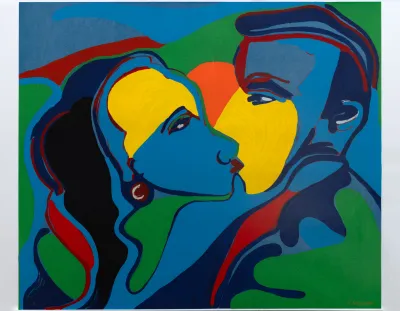
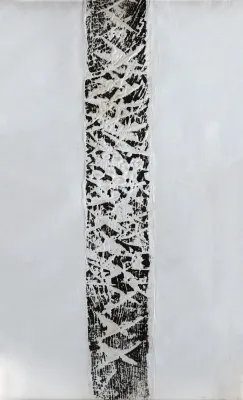
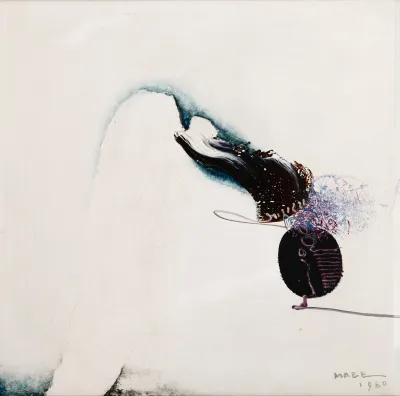
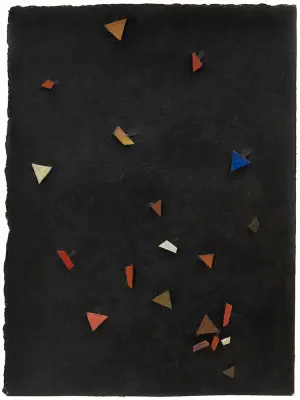
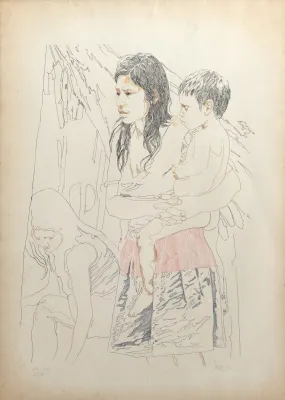
Almir Mavignier (Rio de Janeiro RJ 1925)
Pintor, graphic artist.
Almir da Silva Mavignier began his studies with Arpad Szenes (1897 - 1985), Axl Leskoschek (1889 - 1975) and Henrique Boese (1897 - 1982) in 1945, in Rio de Janeiro. Between 1946 and 1951, he founded the Painting and Modeling Atelier of the Occupational Therapeutics Section of the Psychiatric Hospital of Engenho de Dentro (currently the Unconscious Images Museum) with the psychiatrist Nise da Silveira (1905 - 1999). It accompanies the work developed by the inmates Emygdio de Barros (1895 - 1986), Raphael (1912 - 1979) and Carlos Pertuis (1910 - 1977), among others. After getting to know the theories of Mário Pedrosa (1900 - 1981), according to the thesis the influence of the Gestalt theory on the work of art, he begins research in the area of abstraction. In 1949, he participated in the first abstract art group in Rio de Janeiro, with Ivan Serpa (1923 - 1973), Abraham Palatnik (1928) and Mário Pedrosa. He organizes with Léon Dégand and Lourival Gomes Machado the exhibition 9 artists from Engenho de Dentro, at the Museum of Modern Art of São Paulo - MAM/SP, in 1950, when he also held his first solo show at the Institute of Architects of Brazil in Rio de Janeiro - IAB/RJ. The following year, he travels to Paris, where he frequents the Académie de la Grande Chaumière. In Germany, between 1953 and 1958, he studied with Max Bense and Josef Albers (1888 - 1976) at the Hochschule für Gestaltung [upper school] in Ulm, and maintains contact with Max. Bill (1908 - 1994). Participates in Group Zero, between 1958 and 1964, with Heinz Mack (1931), Otto Piene (1928), Yves Klein (1928 - 1962), Jean Tinguely (1925 - 1991). Designs and organizes the exhibition New Trends, the first International OP Art Exhibition in Yugoslavia, in 1960. He is a painting professor at Hochschule für Bildende Kunste, in Hamburg, Germany, between 1965 and 1990.
Critical Comment
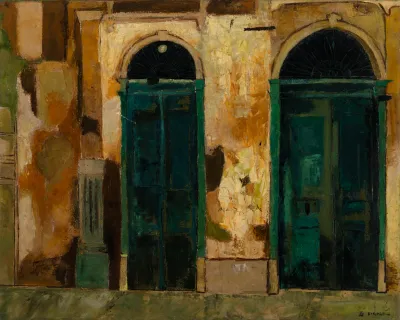
Almir Mavignier begins artistic learning in the courses of the Brazilian Drawing Association, in 1946. In the same year, he frequents the studio of the Hungarian artist Arpad Szenes (1897 - 1985), from whom it receives influence. Also at that time, he participated in the foundation of the Painting and Modeling Atelier of the Occupational Therapeutic Therapy Section of the Psychiatric Hospital of Engenho de Dentro (current Museum of Images of the Unconscious), created by the psychiatrist Nise da Silveira (1905 - 1999). There, he guides inmates such as Raphael (1912 - 1979), Emygdio de Barros (1895 - 1986) and Isaac (1906 - 1966). A year later, Szenes returns to Europe, and the courses in his studio are now taught by Axl Leskoschek (1889 - 1975). Simultaneously, Mavignier follows the classes of Leskoschek and those of the German painter Henrique Boese (1897 - 1982). Paints interior scenes and still lifes. His painting is figurative and lyrical, bearing similarities with the work of French artists such as Pierre Bonnard (1867 - 1947) and Édouard Vuillard (1869 - 1940).
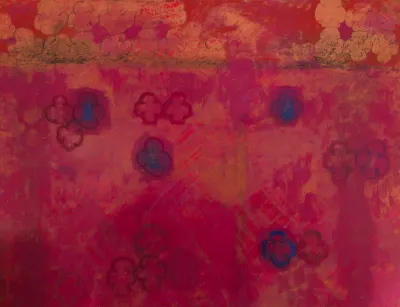
During the learning, approaches Ivan Serpa (1923 - 1973) and Abraham Palatnik (1928). With them, it forms the first core of abstract painting in Rio de Janeiro. The interest in non-figurative language is aroused by contact with the critic Mário Pedrosa (1900 - 1981). According to Mavignier: "Pedrossa's thesis The influence of the Gestalt theory on the work of art informed me that the content of a form is not found in its association with nature forms. associations".1 In 1949, Mavignier makes the first abstract watercolor: study. Subsequently, he performs paintings with geometric organic shapes, in which he reduces the number of colors, but maintains the half-tones and the expressive brushstroke of his figurative work.
In 1950, he travels to São Paulo with Pedrosa, Palatnik and Mary Vieira (1927 - 2001) and visits the exhibition of the Swiss concrete artist by Max Bill (1908 - 1994) at the São Paulo Museum of Art Assis Chateaubriand - MASP. This show is decisive in the formation of Mavignier. At that moment, it comes into direct contact with the constructive production, which becomes its central influence. In the same year, he held his first solo exhibition. It displays abstract and figurative paintings at the Institute of Architects of Brazil in Rio de Janeiro - IAB/RJ. In 1951, he sets up another individual at the Museum of Modern Art in São Paulo - MAM/SP, with abstract works and moves to Paris, with a scholarship from the French government. He frequents the workshops of the Académie de la Grande Chaumière. In the studio of the abstract painter Jean Dewasne (1921 - 1999) he makes the first concrete canvases. Works with enamel on a wooden surface. The paintings are shown in the May 1952 salon and at the Salão das Realités Nouvelles both in Paris, a year later.
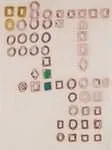
In 1954, he began his visual communication course at Hochschule für Gestaltung. [upper school of form] in Ulm. His work incorporates aesthetics and procedures of concretism in a systematic way. In this period of study, he is influenced by the artist and professor Josef Albers (1888 - 1976). Like Albers's, his canvases are also organized in square shapes. Mavignier makes quadrilaterals fragmented by color points that make up tonal or relief variations. In 1957, he made his first poster, starting an important trajectory in the graphic arts. A year later, he completed his course at Ulm's school and continues to live in the city, where he works as a painter and graphic artist.
his painting, in the 1960s, approaches the op art. The works, such as those of the 1962 Convex and Convex series, are shown in the Documenta de Kassel and the Venice Biennale in 1964. In 1965, the artist participates in the OP Art exhibition, The Responsive Eye, dedicated to the movement, at the Museum of Modern Art - MoMA in New York. In the same year, he moved to Hamburg, where he began his teaching career at Hochschule für Bildende Künste [Visual Arts School], where he taught until 1990. His first retrospective show was organized in 1967, and mounted in Munich and Hanover. In 1989, the Museum of Contemporary Art of the University of São Paulo - MAC/USP sets up an exhibition with the graphic work by Mavignier. Five years later, the artist has part of his work shown at the Bienal Brasil Século 20th show. In 2000, researcher Aracy Amaral sets up an exhibition in honor of the artist's 75th birthday at MAM/SP. Mavignier becomes German in 1981.
Notes
1 MAVIGNIER, Almir. testimonial. In: AMARAL, Aracy (org.). Brazilian constructive project in art: 1950-1962. Rio de Janeiro: MAM, 1977. p.177
Criticism
"The decision for concrete art was imposed with the reflection and experience of its first months in the Old World. 1953 He remained at length at Hochschule Fur Gestaltung, delving into visual communication. Among his masters was Albers, who owes a new interpretation of the color problem, a major mark even today in all my work'. But exposing it regularly in Brazil, he developed a painting based on the lining of pure color dots, which interact rhythmically to provoke optical vibrations. structural of his production in the serigraphy and particularly in the posteristic message. ´From the Brazilian point of view, this is a rare case of an artist in my country to assimilate quickly and with such positive results one of the typical aspects of German civilization, generally not very close to our nature: the invention technique', says Murilo Mendes about Mavignier, to whom he also refers to someone who contributed to 'demonstrating the myth of the impossibility of the coexistence of a humanist spirit and industrial civilization' ".
Walter Zanini
ZANINI, Walter (org. ). concrete and neoconcrete art in Brazil. In: ______. General History of Art in Brazil. São Paulo: Walther Moreira Salles Institute: Djalma Guimarães Foundation, 1983. v. 2, p. 658.
"Apart from Mavignier we are not just facing an exceptional graphic artist, of exemplary achievements. We are facing a painter who does not give up his vocation as a plastic artist, and whose work nurtures the posterism that made him recognized in the Europe, but whose painting is also nourished by the intimacy with the mysteries of color, juxtapositions and chromatic overlaps it uses as a graphic artist.
In fact, one might ask: what remains of its origins, from Brazil, in this graphic artist and painter for almost five decades living outside his country of birth? I would immediately say that the structural and compositional rigor of his entire work undoubtedly mirrors the Hochschule für Gestaltung, the Higher School of Forma, of Ulm, which he is proud to have Attended, with masters with whom he was able to live together, this stance seized in Ulm is reflected in his personal space, his great Hamburg studio, impeccable in his order and organization, as he directs the design of his posters and his painting. The series dedicated to the Albers alphabet incorporated in several posters of Mavignier - including the exhibition poster that celebrated its 70th anniversary - reflects this respect. Like the cult of classical antiquity, so genuinely Germanic, it is already integrated into the personality and taste of this artist from Rio de Janeiro who does not hesitate to say that 'without a past there is no future or present'. Even if in the case of a Brazilian it is a past, like the Egyptian antiquity so dear to Mavignier, borrowing through admiration for a civilizing process other than our own. that in Europe, yes, has a nexus, having passed through the Mediterranean to Greece and then Rome, and from there to European territory, but from us it is at a stellar distance.
This artist's 'small studio', and his home They exude the spirit of Ulm, transport us to the organization of the space and the master of our century, such as Saarinen, Le Corbusier, Alvar Aalto, Charles Eames, among others. The obsession of detail, or the perfectionism pursued in the design of each light take, of each doorknob, in the paper baskets, in the choice of the television set, in each glass, lamp, cup or teapot brought to the table. It is like a destiny assuming from a vocation, for life. Perhaps it all seems to us to live a little 'out of the world', or rather, within the world preserved from a 'school', as is the environment of so many architects from all over the world.
But where does Brazil emerge, in his work? I would say that in color, in the pure pigment the luminosity of the tropical country remains. I would say that, in his painting, in the sensuality of the touch of points/pigments this physical approach - non-existent in northern Europe - is equally very Brazilian. and that even in its extensive series of ten 'monochromatic' square screens from the 1970s, color/light vibrates as the exuberance of our nature, although built/delimited by the rigor of ulm's strict discipline."
Aracy Amaral
AMARAL, Aracy. Mavignier 75. In: MAVIGNIER, Almir. Mavignier 75. São Paulo: MAM, 2000. p. 8.
Testimonies
"Pedrosa's thesis, the influence of the gestalt theory on the work of art, informed me that the content of a way is not found in its association with forms of nature, it is found in the proper character of the form. This knowledge allowed me to abandon a naturalistic painting and start a painting of concrete researches of free forms of associations".
Almir Mavignier a Aracy Amaral, 1976
Amaral, Aracy. Almir Mavignier. In: CANONGIA, Ligia (coord.). Geometric abstraction 1: Concretism and neoconcretism. Rio de Janeiro: Funarte, 1987. p. 24.
"Engenho de Dentro
It is the neighborhood of Rio de Janeiro where
the Psychiatric Center is located
I proposed an exhibition of the studio to the first director of the Museum of Art
Moderna de São Paulo, Léon Dégand,
who replied:
'I don't show crazy.
I exhibit artists'
Recognizing the quality of the pin-
tures and sculptures, Projected the
Exhibition, which was held in 1949.
He gave the title:
'9 artists from Engenho de Dentro'
with Adelina, Carlos, Emygdio, José,
Kleber, Lucio, Raphael, Vicente and Wilson
.
Arthur Amora, Emygdio de Barros,
Raphael Domingues, Fernando Diniz,
Adelina Gomes, Isaac Liberato e
Carlos Pertuis, were artists of
Importance, whom I met in 1946/51
They carried out independent works
of the traditional influence of art
.
being a monitor of the studio, I was the
responsible for the work environment and for technical education
to paint
I was able to recognize as an artist the talents that emerged providing
for them the necessary material at
end of Painting large canvases
A painting studio for the inter-
Psychiatric Center Swimmings
was my proposal
for the direction of the therapeutic occupation service
I organized and directed the studio until 1951
Initially interested in my own studio, I gave the room too
also for artists who needed tranquility
to paint, what It was not possible in the collective hall
worked with them as a colleague
and not as a vigilant monitor
Personalities and works emerged that were unique phenomena.
It is therefore a misunderstanding
to expect, today, identical artists in the studio
(...)."
Almir Mavignier
MAVIGNIER, Almir. Mavignier 75. In: ________. Mavignier 75. São Paulo: MAM, 2000. p. 10
Individual exhibitions
1950 - Rio de Janeiro RJ - First Individual, at IAB/RJ
1951 - São Paulo SP - Individual, at MAM/SP
1955 - Bern (Switzerland) - Individual, at Galerie 33
1957 - Stuttgart (Germany) - Individual, at Gänsheide Gallery 26
1957 - Ulm (Germany) - Individual, at the Ulmer Museum
1957 - Zurich (Switzerland) - Individual, at Neumarkt 17 Ag
1959 - Ulm (Germany) - Individual, at Studio F
1960 - Milan (Italy) - Individual, at Galeria Azimut
1960 - Zurich (Switzerland) - Individual, at Suzanne Bollag Gallery
1961 - Kaiserslautern (Germany) - Individual, at Pfälzische Landesgewerbeanstalt
1961 - Munich (Germany) - Individual, in Gallery Note
1962 - Ulm (Germany) - Individual, at Studio F
1963 - Rio de Janeiro RJ - Individual, at MAM/RJ
1963 - Rome (Italy) - Individual, at the Galer d'Arte della Casa do Brasil
1963 - São Paulo SP - Individual, at FAAP
1963 - ULM (Germany) - Individual, at the Ulmer Museum
1964 - Antwerp (Belgium) - Individual, at the Galerie ad libitum
1965 - Munich (Germany) - Individual, at the Consulate General of Brazil
1966 - Berlin (Germany) - Individual, at the Europa-Center
1966 - Colony (Germany) - Individual, at Galerie der SPIEGEL
1967 - Munich (Germany) - Individual, at the Consulate General of Brazil
1967 - Warsaw (Poland) - Individual, at the Zacheta Museum
1968 - Hannover (Germany) - Individual, at Kestner-Gesellschaft
1969 - Hamburg (Germany) - Individual, at Hamburger Kunsthalle
1970 - Bremen (Germany) - Individual, At Galeria Rewolle
1970 - Frankfurt (Germany) - Individual, at Galeria Loehr
1970 - Hamburg (Germany) - Individual, in the Dröscher Gallery
1970 - Munich (Germany) - Individual, at the Heseler Gallery
1970 - Saulgau (Germany) - Individual, at the Galerie Die Fähre
1972 - São Paulo SP - Individual, in the Documenta Galeria de Art
1973 - Düsseldorf (Germany) - Individual, at Galerie Denise René Hans Mayer
1973 - Düsseldorf (Germany) - Individual, at Kunstmuseum Dussseldorf
1974 - Rio de Janeiro RJ - Individual, at the Bonino Gallery
1974 - São Paulo SP - Individual, at the Documenta Galeria de Arte
1974 - Zurich (Switzerland) - individual, Kunstgewerbemuseum
1975 - Munich (Germany) - Individual, at die Neue Sammlung
1977 - São Paulo SP - Individual, at MASP
1981 - Düsseldorf (Germany) - Individual, at Galerie Schöeller
1981 - Essen (Germany) - Individual at Deutsches Plakatmuseum
1981 - Hamburg (Germany) - Individual, at the Museum für Kunst und Gewerbe
1984 - Hamburg (Germany) - Individual, at the Galerie Edition Meissner
1985 - Berlin (Germany) - Individual, at the Bauhaus-Archiv Museum für Gestaltung - Stankowski Award
1985 - Bottrop (Germany) - Individual, at Josef Albers Museum
1986 - ULM (Germany) - Individual, at the Museum und Kunstverein
1987 - Otterndorf (Germany) - Individual, at Studio A
1988 - Shanghai (China) - Individual, at the Academy of Art
1989 - Brasília DF - Individual, at MAB
1989 - Porto Alegre RS - Individual, at UFRGS. Art Institute
1989 - São Paulo SP - Almir Mavignier: posters, at MAM/SP
1989 - ULM (Germany) - Individual, at Forschungsinstitut für Anwendungsorientierte WissensVerrbeitung
1990 - Munich (Germany) - Almir Mavignier: Retrospective at Staatliche AntikensamMlungen UND Glyptothek
1990 - Hamburg (Germany) - Almir Mavignier: Retrospective at Hamburger Kunsthalle
1990 - Herning (Denmark) - Almir Mavignier: Retrospective, at Herning Kunstmuseum
1995 - Berlin (Germany) - individual, at Mies van der Rohe Haus
1995 - Ulm (Germany) - individual, at the Stadt Haus
2000 - São Paulo SP - Mavignier 75, at MAM/SP
Collective exhibitions
1947 - Rio de Janeiro RJ - Collective, at Atelier Silvestre
1951 - Rio de Janeiro RJ - Exhibition of still lifes, at the Food and Social Security Service
1951 - São Paulo SP - 1st International Biennial of São Paulo, at the Trianon Pavilion
1952 - Paris (France) - 38th Salon of May
1953 - Paris (France) - Salon des Réalités Nouvelles
1957 - São Paulo SP - 4th International Biennial of São Paulo, in the Pavilion Ciccilo Matarazzo Sobrinho
1958 - Düsseldorf (Germany) - Group Zero
1959 - Leverkusen (Germany) - First collective exhibition of Brazilian artists in Europe
1959 - Milan (Italy) - Stringenz: New German trends, at the Pagani Gallery
1959 - Munich - first collective exhibition by Brazilian artists in Europe, at Kunsthaus
1959 - Vienna (Austria) Brazilians in Europe
1960 - Lisbon (Portugal) - First collective exhibition of Brazilian artists in Europe
1960 - Madrid (Spain) - First collective exhibition of Brazilian artists in Europe
1960 - Paris (France) - First collective exhibition of Brazilian artists in Europe
1960 - Utrecht (Netherlands) - First collective exhibition of Brazilian artists in Europe
1960 - Hamburg (Germany) - First collective exhibition of Brazilian artists in Europe
1960 - Zurich (Switzerland) - Konkrete Kunst, at Helmhaus
1961 - São Paulo SP - 6th São Paulo International Biennial, at the Ciccilo Matarazzo Sobrinho Pavilion
1961 - Zagreb (Yugoslavia, present-day Croatia) - 1st New Trends
1962 - Amsterdam (Holland) - NUL Exhibition at the Stedelijk Museum Amsterdam (Germany) - Konstruktivisten, at the Morsbroich Museum
1963 - Hamburg (Germany) - Angewandte Kunst in Europa Nach 1945, at the Museum Für Kunst Und Gewerbe
1964 - Kassel (Germany) - 3rd Documenta, at the Fridericianum Museum
1964 - Venice (Italy) - 32nd Venice Biennale
1964 - Washington (United States) - Collective, at the Livraria de Congresso
1965 - New York (United States) - The Responsive Eye, at MoMA
1965 - Tokyo (Japan) - 8th Tokyo Biennial
1965 - Kyoto (Japan) - 8th Tokyo Biennial
1965 - Nagoya (Japan) - 8th Tokyo Biennial
1966 - Philadelphia (United States) - Three Graphic Artists
1966 - Warsaw (Poland) - 1st Poster Biennial - 2nd Prize
1967- New York (States) United States) - Three Graphic Designers, at MoMA
1968 - Hannover (Germany) - Ars Multita, no Kunstverein
1968 - Hannover (Germany) - Deutsche Kunst Heute at the Kunstverein
1968 - Kassel (Germany) - 4th Documenta, at the Fridericianum Museum
1968 - Wuppertal (Germany) - Krieg, Kiwet, Mavignier, Vostell, at the Kunst Und MuseumVerein
1968 - New York (United States) - Word and Image, at MOMA
1968 - Tokyo (Japan) - International Biennial Exhibition of Prints - Best Recorder Award
1968 - Warsaw (Poland) - 2nd Poster Biennial
1968 - Venice (Italy) - 34th Venice Biennale
1969 - Nuremberg (Germany) - 1st Nuremberg Biennial
1969 - São Paulo SP - 10th São Paulo International Biennial, at the Biennial
1969 - Wuppertal (Germany) - Optical Art at the Kunst und Museumsverein
1971 - Nuremberg (Germany) - 2nd Biennial of Nuremberg
1972 - Munich (Germany) - Group Zero, at the Heseler Gallery
1972 - São Paulo SP - 2nd International Engraving Exhibition, at MAM/SP
1973 - São Petersburg (Russia) Participant Artist(s) - Hamburg Graphic (1973 : Saint Petersburg, Russia) - State Hermitage Museum (Saint Petersburg, Russia)
1973 - St. Petersburg (Soviet Union, present-day Russia) - Hamburg Graphic, at the State Hermitage Museum
1973 - Hamburg (Germany) - Hamburg Graphic
1977 - Rio de Janeiro RJ - Brazilian constructive project in art: 1950-1962, at MAM/RJ
1977 - São Paulo SP - Brazilian constructive project in art: 1950-1962 (1977 : São Paulo, SP) - Pinacoteca do Estado
1978 - Stuttgart (Germany) - 12 collections of 30 sheets: contemporary art, at the Institut für Auslandsbeziehungen
1979 - Hong Kong (China) - Meissner Edition, at Art Center
1979 - São Paulo SP - Theon Spanudis Collection, at MAC/USP
1979 - Zurich (Switzerland) - Gruppe Zero, Kunsthaus
1980 - Rio de Janeiro RJ - Homage to Mário Pedrosa, at the Jean Boghici Gallery
1981 - Hamburg (Germany) - 12 in Hamburg, Kunsthaus
1983 - Milan (Italy) - Programmate and Kinetic Art: 1953-1963, at Pallazzo Reale
1984 - Milan (Italy) - Azimuth & Azimut, at Padiglione d'Arte Contemporanea
1985 - Salzburg (Austria) - Zero: a European movement at the Carolino Augusteum Museum
1986 - Berlin (Germany) - Foreign artists in Germany at Grosse Orangerie Schloss
1986 - Bochum (Germany) - foreign artists in Germany at the Bochum Museum Bochum
1986 - Frankfurt (Germany) - foreign artists in Germany, at Paulskirche
1986 - Saarbrücken (Germany) - foreign artists in Germany at Stadtgalerie
1986 - Stuttgart (Germany) - foreign artists in Germany, Kultur Unterm Turm
1986 - Rio de Janeiro RJ - War Times: International Hotel, at the Banerj Art Gallery
1986 - Rio de Janeiro RJ - War Times: Pensão Mauá, at the Banerj Art Gallery
1986 - São Paulo SP - War Times: Pensão Mauá - Brazil in the War, at the Bienal Foundation
1986 - Belo Horizonte MG - War Times: Pensão Mauá - Brazil in the War
1986 - Venice (Italy) - 42nd Venice Biennale
1987 - Berlin (Germany) - Hochschule für Gestaltung, at the Bauhaus-Archiv Museum für Gestaltung
1987 - Rio de Janeiro RJ - 1st Geometric Abstraction: Concretism and Neoconcretism, at Funarte
1987 - São Paulo SP - 1st Geometric Abstraction: Concretism and Neoconcretism, at MAB/FAAP
1987 - Stuttgart (Germany) - exotic posters, at the Graph Sammlung d. Staats Galerie
1987 - ULM (Germany) - Collective, at the Ulm Forma High School
1988 - Paris (France) - Hochschule für Gestaltung Ulm, at the Center Georges Pompidou
1988 - Zurich (Switzerland) - 30 years of concrete art at Galerie Suzanne Bollag
1989 - Ferrara (Italy) - Black and white at Palazzo Dei Diamanti
1989 - Hamburg (Germany) - Aurora: 222 years of School of Fine Arts
1989 - Moscow (Soviet Union, current Russia) - Lenz Collection Schönberg
1990 - ULM (Germany) - Hochschule für Gestaltung: posters, at the HFG-file
1991 - São Paulo SP - Constructivism: poster 40/50/60, at MAC/USP
1992 - Essen (Germany) - Group Zero: a European vanguard, at the Neher Gallery
1992 - Rio de Janeiro RJ - 1st on the way to Niterói: João Sattamini Collection, at the Paço Imperial
1992 - Zurich (Switzerland) - Brasilien: Entdeckung und Selbstendeckung, at Kunsthaus Zürich
1994 - São Paulo SP - Bienal Brasil Século 20th Century, at the Fundação Bienal
1994 - São Paulo SP - Engravings: Subtleties and Mysteries, Printing Techniques, at the Pinacoteca do Estado
1994 - São Paulo SP - Poetics of Resistance: Aspects of Brazilian Engraving, at the Sesi Art Gallery
1996 - Cologne (Germany) - Kunst im Anschlag, at the Museum für Angewandte Kunst
1996 - Rio de January RJ - Constructive Trends in the MAC/USP Collection: Construction, Measurement and Proportion, at CCBB
1996 - São Paulo SP - Brazilian Art: 50 years of history in the MAC/USP collection: 1920-1970, in the MAC/USP
1998 - Essen (Germany) - Zero-Heute, at Galerie Neher
1998 - Hamburg (Germany) - Küstlerplakate, at the Für Kunst Museum und Gewerbe
1998 - São Paulo SP - Constructive Art in Brazil: Adolpho Leirner Collection, at MAM/SP
1999 - Berlin (Germany) - Geometrie ALS Gestalt, Neue Nationalgalerie
1999 - Rio de Janeiro RJ - Constructive Art in Brazil: Adolpho Leirner Collection, at MAM/RJ
1999 - Rio de Janeiro RJ - Rio Engravura Show. Monica and George Kornis Collection, at the Correios Cultural Space
2000 - Lisbon (Portugal) - 20th century: Art of Brazil, at the Calouste Gulbenkian Foundation. José de Azeredo Perdigão Modern Art Center
2000 - Rio de Janeiro RJ - When Brazil was modern: plastic arts in Rio de Janeiro from 1905 to 1960, at Paço Imperial
2000 - São Paulo SP - Brazil + 500 Rediscovery Exhibition, at Fundação Bienal
2002 - Londrina PR - Are they or are they not engravings?, at the Museum of Art of Londrina
2002 - Rio de Janeiro RJ - Brazilian Art Fadel: from the restlessness of the modern to the autonomy of language, at the CCBB
2002 - Rio de Janeiro RJ - Caminhos do Contemporâneio 1952-2002, at Paço Imperial
2002 - São Paulo SP - Brazilian art in the Fadel collection: from the restlessness of the modern to the autonomy of language, in the CCBB
2002 - São Paulo SP - Modernism: from the week of the 22nd to the Art Section of Sérgio Milliet, at the CCSP
2003 - Brasília DF - Brazilian art in the Fadel collection: from the restlessness of the modern to the autonomy of language, in the CCBB
2003 - Mexico City (Mexico) - Cuasi Corpus: Arte Concreto y Neoconcreto de Brasil: Una Seleción del Collection of the Museum of Modern Art of São Paulo and La Colección Adolpho Leirner, at the Museo Rufino Tamayo
2003 - São Paulo SP - Constructivism and the form of clothing, at MAM/SP
2004 - São Paulo SP - Constructive and Kinetic, at the Berenice Arvani Gallery
Source: Itaú Cultural