Abelardo da Hora (São Lourenço da Mata PE 1924 - Recife PE 2014)
Sculptor, draftsman, printmaker, ceramist, teacher.
Abelardo Germano da Hora was a Brazilian visual artist, illustrator, set designer, teacher, poet, lawyer and political activist. In the visual arts, he was a sculptor, draftsman, printmaker, painter, ceramist, illustrator and graphic artist. He graduated in Visual Arts from the Escola de Belas Artes do Recife and in Law from the Faculdade de Direito de Olinda.
He was born on July 31, 1924, at the Usina Tiúma sugar mill in São Lourenço da Mata (PE / Brazil). As a teenager, he took the technical course in Decorative Arts at the Escola Técnica de Pernambuco in Recife. In 1939, Abelardo entered the Escola de Belas Artes do Recife. That same year, he enrolled in the institution's sculpture course. He studied drawing, printmaking, painting and sculpture with a generation of great masters older than himself, excelling with mastery and virtuosity in every technique.
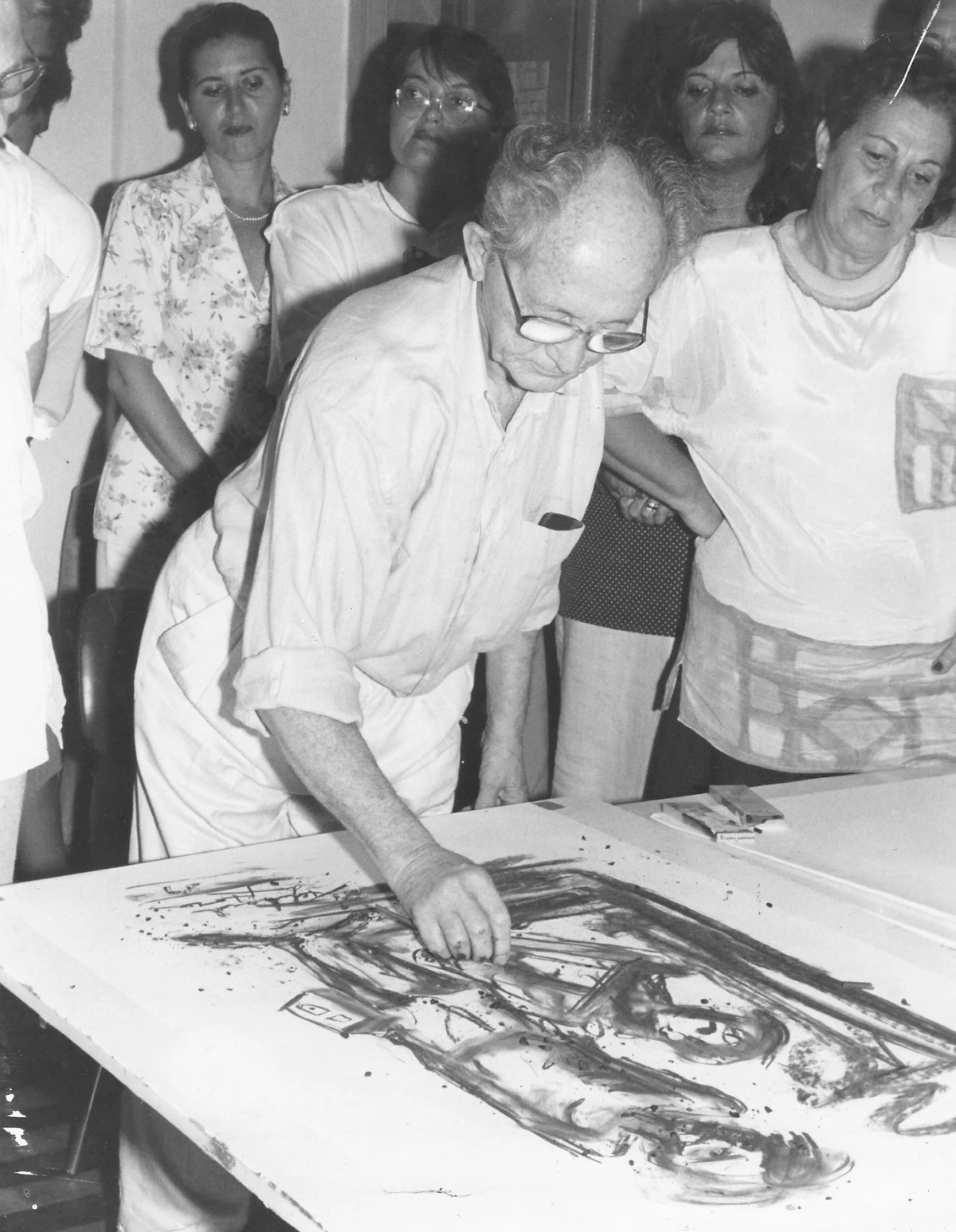
Abelardo da Hora
From 1940, he became a member of the Student Board of the Escola de Belas Artes, and was elected its president in 1941, when he began encouraging students to go out and see “life outside”, leading groups of students to draw and paint urban and rural landscapes, as well as the woods and the bustling life of Recife's suburbs. His work caught the attention of the industrialist Ricardo Brennand, who had a residence in the area and hired him; he worked with Brennand from 1943 to 1945 on various projects related to regional themes, fauna and flora, cultural traditions, and daily life at the mill and its surroundings, as well as commissions from the ceramics company's clients, producing reliefs in clay, art ceramics and terracotta(1).
In 1945, he traveled to Rio de Janeiro and settled in a boarding house in the city center. There he met the brothers Augusto and Abelardo Rodrigues, and began following the activities of the Partido Comunista do Brasil (PCB) in the Chamber of Deputies of what was then the federal capital. He made the sculpture “A Família” [The Family] to take part in the Salão de Belas Artes, which was suspended by President Dutra. In 1946, he returned to Recife(2). Abelardo spent 1947 preparing his first exhibition of sculptures, held in April 1948 at the Associação dos Empregados do Comércio de Pernambuco. At the exhibition opening, he founded the Sociedade de Arte Moderna do Recife (SAMR), together with the architect Hélio Feijó and the artist Ladjane Bandeira, and was president of the SAMR for ten years.
From the 1950s, Abelardo da Hora became a key figure in the cultural life of Pernambuco, contributing decisively to the way the state would be seen by the rest of Brazil in the arts. The SAMR gave rise to the Ateliê Coletivo (1952 to 1957), of which Abelardo was president and where he coordinated activities in various areas of the visual arts, teaching and forming groups of new artists, and fostering regional, national and international exchanges, especially with the Printmaking Clubs of other states(3). At the Ateliê, he trained and worked alongside other great artists, such as Corbiniano Lins, Ladjane Bandeira, José Cláudio, Gilvan Samico, Wilton de Souza, Ivan Carneiro, Wellington Virgolino and Reynaldo Fonseca, among others. In politics, he was one of the founders of the Movimento de Cultura Popular, under the administration of the then mayor of Recife, Miguel Arraes de Alencar, in 1960.
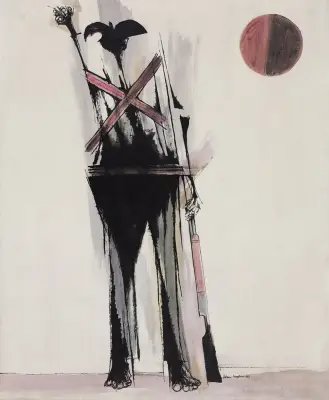
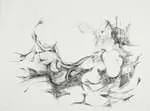
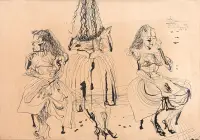
Between 1961 and 1963, he created the series “Meninos do Recife” [Boys of Recife], pen-and-ink drawings in which the master denounces the poverty and vulnerability of the city's street children, with a line and style close to Cubism with an expressionist slant, typical of his work(4). In the 1950s and 1960s, he filled the city of Recife with sculptures on popular themes and rounded forms – typical of the Northeastern and Pernambuco tradition dating back to Vitalino – as well as street furniture and monuments; he also made the first large-scale public sculpture of “Space Dynamism” (or Kinetic Art) in Brazil, in 1961: the lighting tower that stood in what is now the Torre neighborhood in Recife – destroyed by the military during the coup. He also produced murals, both for Recife and for other Northeastern capitals – work he continued until the end of his life, completing in 2012 a series of murals for the façades of public hospitals in Pernambuco(5).
Alongside his work as an artist, he was equally involved in politics, as a member of the PCB until the 1964 military coup and as an important figure in the country's return to democracy. With the coup, Abelardo was removed from his post as Secretary of Education and Culture of the Recife city government and arrested, together with the party leader Gregório Bezerra. After this, he, Gregório and other party members (such as Jorge Amado and Oscar Niemeyer) left the PCB, but remained progressive activists.
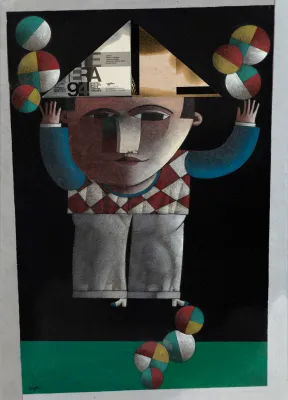
Unable to work in Recife, Abelardo moved to São Paulo, where he was welcomed by his friend Lina Bo Bardi and her husband Pietro Maria Bardi, director of the Museu de Arte de São Paulo (Masp). In that city, he launched the drawing collection “Danças Brasileiras Populares de Carnaval” [Brazilian Popular Carnival Dances], a meticulous evocation of typically Brazilian dances from various regions, in which he used his unmistakable ink drawing and line, adding acrylic colors, with an opening at the Galeria Mirante das Artes. From 1966, he worked at TV Tupi, where he designed sets for the channel's productions, notably for the soap opera “A Ré Misteriosa”, whose design won an award at the 4th International Industry Fair (known as Fenit). On his return to Recife in the 1970s, he went into business with his brother Luciano in the fishing and seafood trade, while continuing his artistic activity.
Also in the 1970s, he spent time in Paris, working, mixing with the local art scene and taking part in group exhibitions. On returning to Recife, he resumed intense production, both a new series of sculptures on the theme of women – which he continued until the end of his life – and ceramic works with motifs of fauna, flora and Afro-Brazilian culture, especially the deities of Candomblé.
Abelardo always played a decisive role in shaping the playful landscape of the city of Recife from the 1950s on, with the creation of numerous sculptures on popular themes for the city's public squares and the iconic concrete slides in its playgrounds, and with his proposal to the authorities that sculptures be placed in built areas of more than a thousand square meters (approved by the Recife City Council and made law). From the 1980s, he began to fill the city's private buildings and shopping centers with his sculptures of gigantic women in concrete.
“When he models the arm of one of his goddesses, we have the unique sensation of being granted the privilege of witnessing the birth of Venus, of Ceres, of beauty and fertility, at the moment when God created flesh”.
(José Cláudio)(6)
In the 1980s, he took part in major exhibitions around the country, including in cities such as São Paulo and Rio de Janeiro. In 1983, he was elected president of the Associação dos Artistas Plásticos de Pernambuco and appointed a member of the Municipal Culture Council by the Recife city government. In 1986, the Espaço de Esculturas Abelardo da Hora was created, belonging to the Recife city government, on the banks of the Capibaribe River, one of the city's landmarks. That same year, he exhibited again in Paris, at the Centre International d'Art Contemporain(7).
An intellectual trained in Art and Law, from the 1990s to the 2010s he was a constant presence in the Pernambuco media, offering his views on issues concerning the state, the country and the world. During this period he received numerous tributes and honors, including the Medal of the Order of Merit of Guararapes, from the then governor of Pernambuco Eduardo Campos, the Order of Cultural Merit (Grand Cross), from then President Dilma Rousseff, and the Order of Rio Branco (Commander), from then President Fernando Henrique Cardoso. In 2004, during his lifetime, he founded the Instituto Abelardo da Hora (iAH), with Abelardo Filho as Executive Director and his grandson Daniel da Hora as Cultural Director. Through the iAH's projects, his work came to be published on various print and digital platforms and toured in exhibitions in many cities in Brazil and abroad, even after his death.
His work was always marked by a deep concern with social issues, presenting, according to the critic Geraldo Ferraz, “an expressionism of contortions, of incisions, of bitter and deep, deepened drawing, in cement, bronze or marble, particularly in the first of these materials, which the artist prefers for its hard, rough character, which adds suffering to the figures”. A friend to a whole generation of other important artists, intellectuals and politicians, he was a respected figure and one of the most celebrated creators in Brazil, having taken part throughout his career in solo and group exhibitions in many Brazilian capitals, especially São Paulo, Rio de Janeiro, Curitiba, João Pessoa and Recife. He also took part in international exhibitions in several European countries, including France, Italy, England and Portugal, as well as in the United States, Canada, Russia, Israel, Mongolia, Argentina, Peru, Romania and China.
He celebrated his 90th birthday in July 2014 by unveiling yet another monument, this time dedicated to football, which stands in front of the Arena Pernambuco (the stadium built for the 2014 FIFA World Cup). On September 23, 2014, Abelardo da Hora died in hospital in Recife of respiratory complications.
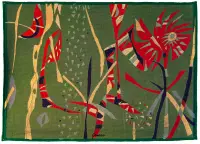
In 2014 and 2015, a retrospective exhibition toured the country, ending in the city of Recife. In March 2022, the Memorial Abelardo da Hora opened in João Pessoa (PB-BRA), a museum dedicated to the master's legacy, with more than 250 works, including sculptures, drawings, paintings, prints and tapestry, as well as studies, models, projects and unfinished works. With curatorial and exhibition design coordination by his grandson Daniel da Hora, it became the largest biographical museum devoted to an expressionist artist in all the Americas(8).
Context and Work (analysis)
Sculpture in Brazil can be characterized from two points of view: the popular, vernacular root, notably in the depiction of its traditions, exemplified by Mestre Vitalino (1909 – 1963), also from Pernambuco; and the strand linked to the European schools, from the Baroque onward, starting with Aleijadinho. In this respect, perhaps the greatest revolution in this art form in Brazil took place precisely in a region that had always been cosmopolitan and a privileged port of contact with Europe – Recife. It was there, in 1948, that everything known about sculpture in Brazil changed radically, with Abelardo da Hora's first exhibition.
By working, from his early training at the Escola de Belas Artes in the 1930s, with themes connected to his land and his people and their conditions of poverty and destitution, especially through sculpture (unprecedented in Brazilian art), Abelardo inaugurated a new view of what the themes of a work of art should be and of how sculpture would be seen in Brazil – in contrast to what was taught in Brazilian academies(9).
“His art, sensitive to the plastic and visual values of modernism, is neither episodic nor makes concessions”.
(Mário Barata)10
Much has been said about the influences that marked Abelardo's work. Certainly, during his training, with teachers such as Baltazar da Câmara, Casimiro Correia, Murillo La Greca and Emílio Franzozi, the echoes of European modernism were already in full flight. Or perhaps the first echoes came from Recife's tradition of being modern before the official modernists, starting with Cícero Dias, Lula Cardoso Ayres or Vicente do Rêgo Monteiro – a little-known fact: in the 1930s, Recife was the first city in Brazil to host an exhibition of works by Picasso, Léger, Miró and Braque – the so-called “School of Paris”.
The vision and possibility of a “Brazilian art” had always been present among artists and intellectuals in Recife since the turn of the 20th century, and in Brazil from the 1920s. But Abelardo, in portraying the migrant, the slum dweller, the boy from the mocambo, the mother with her malnourished children, starts from a truth and a standpoint that are rightfully his, yet sublimates it all through an expressionist art strongly influenced by Cubism, as other great Brazilian artists of his time did.
“(…) Abelardo da Hora's solutions were confined, as they still are today, to an expressionism of contortions, of incisions, of bitter and deep, deepened drawing, in cement, bronze or marble, particularly in the first of these materials, which the artist prefers for its hard, rough character, which adds suffering to the figures. Thus Abelardo da Hora achieved, for his themes, an expressiveness all his own, at once quivering and hard, aggressive and outspoken to the highest degree, which gives him a very prominent place in Brazilian sculpture, so lacking in living protest”.
(Geraldo Ferraz)11
Bringing his expressionist vision to social themes connected to his people, and with a sculptural “drawing” close to Cubism, in his first phase (the 1940s) Abelardo presented to Brazil and the world an astonishing mastery of sculptural technique, form and proportion, but – above all – he brought something new to the use of concrete, turning something hard and robust into something plastic and flexible. Sculptures such as “A Família” [The Family] and “A Fome e o Brado” [Hunger and the Cry] bear this unmistakable mark of the artist.
This combination, Abelardo and concrete, was fundamental in establishing the landscape of Modern Art in the Northeast, with repercussions in other regions. Considered the greatest expressionist sculptor in Brazil, this genius of form, master of generations of other artists of great importance on the national scene, made art full of love and solidarity, combining social critique and beauty, and moving with equal mastery through other techniques, such as drawing, printmaking, painting and ceramics, in a body of work as rich and complex as Brazilian art itself.
“It would be impossible to try to view two facets of Abelardo da Hora in isolation. The artist drawing, sculpting, teaching, or the political man fighting and arguing for the ideal of uniting a class, of a Brazilian, Northeastern creation. Impossible to separate them. The battles for the Sociedade de Arte Moderna do Recife and the Atelier Coletivo are the same ones he still wages today with clay, spatulas and huge plaster molds. And he conveys all of this in his work. This fighting spirit, this expressionist vigor that influenced a certain group of Pernambuco artists, are defining traits of Abelardo”.
(Alex Molt’Elberto)12
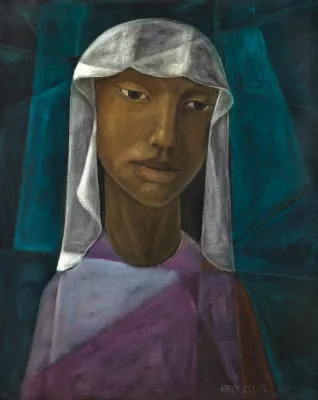
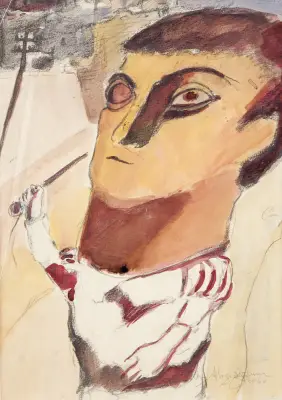
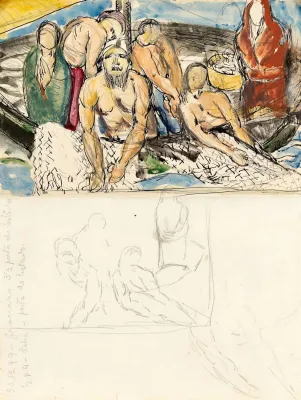
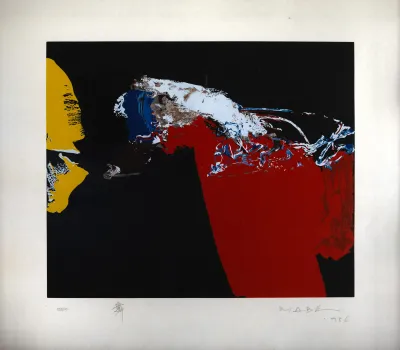
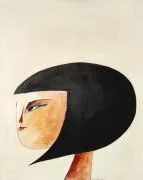
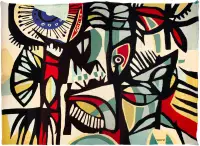
In his drawings and paintings, a variety of themes are constantly present, ranging from local fauna and flora, popular festivities and the depiction of the mysteries of Afro-Brazilian culture to female beauty and the innocence of children. In his panels and murals, we see a “philosophical” influence from the Mexican movement of the 1920s and 1930s, but Abelardo uses more simplified lines and a more limited color palette, continuing in his vein closest to Cubism.
Abelardo was an artist ahead of his time, and he will be eternal. His work and legacy will continue to resonate strongly and firmly, with their ever-present eloquence, enchanting people and making them think – the ultimate role of art and the constant endeavor of the best artists.
Notes
1 – LEAL, Weydson B. Ensaio com Abelardo da Hora. Recife: CEPE, 2005.
2 – BRASIL: arte do Nordeste. Rio de Janeiro: Spala, 1986.
3 – CLÁUDIO, José. Memórias do Atelier Coletivo: Recife 1952-1957. Recife, Artespaço.
4 – ARTE no Brasil. São Paulo: Abril Cultural, 1979.
5 – CAVALCANTI, Carlos; AYALA, Walmir, org. Dicionário brasileiro de artistas plásticos. Brasília: MEC/INL, 1980.
6 – CLÁUDIO, José. Memórias do Atelier Coletivo: Recife 1952-1957. Recife, Artespaço.
7 – LEAL, Weydson B. Ensaio com Abelardo da Hora. Recife: CEPE, 2005.
8 – GOVERNO DA PARAÍBA – site: Governador inaugura Memorial Abelardo da Hora, 2022.
9 – O DESENHO em Pernambuco. Apresentação de Renato Magalhães Gouvêa. Texto de Adão Pinheiro. Recife: Gatsby Arte, 1976.
10 – in ZANINI, Walter (Coord.). História geral da arte no Brasil. São Paulo, Instituto Moreira Salles.
11 – in BRUSCKY, Paulo; LEITE, Ronildo Maia (org.). Abelardo de todas as horas. Recife: Fundarpe.
12 – in CAVALCANTI, Carlos (org.). Dicionário brasileiro de artistas plásticos. Brasília, Record.
Bibliographic References
AMARAL, Aracy. Arte para quê?: a preocupação social na Arte brasileira 1930-1970: subsídio para uma história social da Arte no Brasil. São Paulo: Nobel, 1984.
ARTE no Brasil. São Paulo: Abril Cultural, 1979.
BRASIL: arte do Nordeste. Rio de Janeiro: Spala, 1986.
BRUSCKY, Paulo (org.); LEITE, Ronildo Maia (org.). Abelardo de todas as horas. Recife: Fundarpe, 1988. 80 p., il.
CLÁUDIO, José. Memória do Atelier Coletivo: Recife 1952-1957. Recife: Artespaço; São Paulo: Renato Magalhães Gouvêa – Escritório de Arte, 1978.
CATÁLOGO pernambucano de arte. Recife: Grupo X, 1987. [84] p., il. color.
CAVALCANTI, Carlos; AYALA, Walmir, org. Dicionário brasileiro de artistas plásticos. Apresentação de Maria Alice Barroso. Brasília: MEC/INL, 1973-1980. (Dicionários especializados, 5).
DICIONÁRIO brasileiro de artistas plásticos. Organização Carlos Cavalcanti e Walmir Ayala. Brasília: Instituto Nacional do Livro, 1973-1980. 4v. (Dicionários especializados, 5).
O DESENHO em Pernambuco. Apresentação de Renato Magalhães Gouvêa. Texto de Adão Pinheiro. Recife: Gatsby Arte, 1976.
PINACOTECA: Museu do Estado de Pernambuco. Recife: Museu do Estado de Pernambuco, 1991. Pemep 1991
ZANINI, Walter (org.). História geral da arte no Brasil. São Paulo: Fundação Djalma Guimarães: Instituto Walther Moreira Salles, 1983.
Source: Artist's website / By: Daniel da Hora (Teacher, researcher, curator and visual artist.)