Eliseu Visconti (Salerno, Italy 1866 - Rio de Janeiro RJ 1944)
Painter, designer, teacher.
Eliseu d'Angelo Visconti comes With his family to Rio de Janeiro, between 1873 and 1875, and, in 1883, he began to study at the Lyceum of Arts and Crafts, with Victor Meirelles (1832 - 1903) and Estêvão Silva (ca.1844 - 1891). The following year, without leaving high school, he joined the Imperial Academy of Fine Arts - AIBA, with Zeferino da Costa as teachers (1840 - 1915), Rodolfo Amoedo (1857 - 1941), Henrique Bernardelli (1858 - 1936), Victor Meirelles and José Maria de Medeiros (1849 - 1925). In 1888, he left AIBA to integrate the free studio, which aims to update traditional teaching. With the changes that took place with the Proclamation of the Republic, AIBA became the National School of Fine Arts - ENBA. Visconti returns to attending it and receives, in 1892, the award for travel abroad. goes to Paris and joins the École Nationale et spéciale des Beaux-Arts [National School and Special of Fine Arts]; He studies decorative art at École Guérin, with Eugène Samuel Grasset (ca.1841 - 1917), one of the introducers of Art Nouveau in France. He travels to Madrid, where he makes copies of Diego Velázquez (1599 - 1660), at the Museo del Prado [Museu do Prado], and to Italy, where he studies the Florentine painting. In 1900, he returned to Brazil and, the following year, exhibited for the first time at ENBA. executes the ex-libris for the National Library, in Rio de Janeiro, and wins the contest for postage stamps and ticket letters, in 1904. In 1905, he was invited by the mayor of the city, Engenheiro Pereira Passos, to carry out panels for the decoration of the Municipal Theater from Rio de Janeiro. Between 1908 and 1913, he is a professor of painting at ENBA, a position he resigns out of discontent with the norms of teaching. Returns to Europe to also carry out, between 1913 and 1916, the decoration of the Foyer of the Municipal Theater of Rio de Janeiro and only settles definitively in Brazil in 1920. According to some scholars, he is considered a practitioner of Art Nouveau and the industrial and graphic design. in Brazil, with works in ceramics, fabrics and lamps.
Critical Comment
Eliseu Visconti, frequents, in 1883, the Liceu de Artes e Ofícios, in Rio de Janeiro; He later studies at the Imperial Academy of Fine Arts - AIBA, where he has as professors Victor Meirelles (1832 - 1903), José Maria de Medeiros (1849 - 1925), Henrique Bernardelli (1858 - 1936) and Rodolfo Amoedo (1857 - 1941). In 1888, he studied at Ateliê Livre, created by Henrique Bernardelli, Rodolfo Amoedo and Rodolfo Bernardelli (1852 - 1931), in protest of the traditional teaching of Aiba and structured along the lines of the Académie Julian, de Paris.
With the Republic, the direction of Aiba is modified, which is renamed the National School of Fine Arts - ENBA. Eliseu Visconti returns to attend the institution and with the re-establishment of the travel award abroad, is the first student to receive him, in 1892. He perfects himself in Paris at the École Nationale et Spéciale des Beaux-Arts [National School and Special of Fine Arts]. He also studies decorative art at École Guérin, with Eugène Samuel Grasset (ca.1841 - 1917), from which his interest in the Art Nouveau movement comes. The contact with the works of Italian masters of the Renaissance, especially Sandro Botticelli (ca.1444 - 1510) and with the symbolism, is translated in his painting mainly by the linearity of the figures, as in Giuventú (1898) and the Dança das Oréades (1899), awarded at the Paris International Exhibition, in 1900, the year he returned to Brazil.
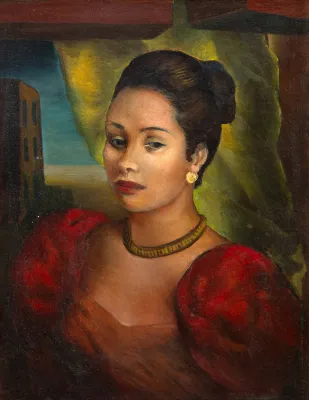
Living a moment of modernization of art in Brazil, his work opens to the main international trends of the end of the century 19th and early 20th century. It seeks to strengthen the relations between art and industry and holds in Rio de Janeiro, in 1901, an individual exhibition that includes its projects for objects in iron, ceramics, marquetry, stained glass windows, fabric printing and wallpaper. From 1903 onwards, it alternates periods in France and Brazil. In 1904, he executed the ex-libris for the National Library, in Rio de Janeiro, and wins a contest for postage stamps and letters. In 1905, he performed a portrait of the sculptor Nicolina Vaz de Assis (1874 - 1941), one of his most representative works in the genre, in which he seeks to highlight the elegance and dignity of the figure. In the same year, he is invited by the mayor of Rio de Janeiro, engineer Pereira Passos, to carry out the decoration (mouth cloth, circular decorative panel of the ceiling light and frieze on the proscenium) of the Municipal Theater of Rio de Janeiro. It reveals a great influence of Impressionism and starts to use lighter and more luminous colors. The theater's mouth cloth is one of his most allegorical works, with a slightly symbolist character. Relating to the progress of the arts and civilization, he presents a meeting of famous men: artists, musicians and poets from different eras, foreigners and Brazilians, in a procession whose main figure is the composer Carlos Gomes (1836 - 1896). In addition to these characters, there are female figures who dance wrapped in flowing drapes, on the background of blues and roses, carried out with light brushstrokes.
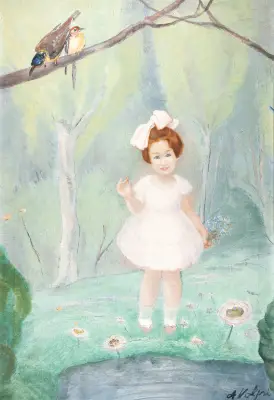
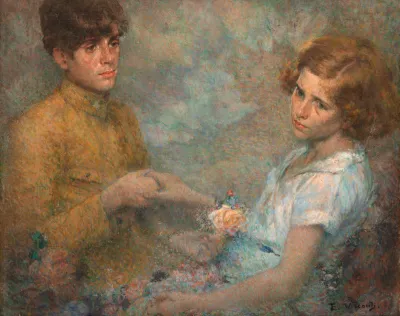
The models for their paintings, largely, become his wife, Louise. Visconti (1882 - 1954), and his sons. The artist begins to stand out for his qualities as a colorist. In maternity (1906), they can be seen in the blue of the woman's silk skirt, with silver reflections, and in the white of the blouse and hat. For the art critic Mário Pedrosa (1900 - 1981) the contrast of colors and the beauty of the textures of the cloths are the main subjects of the canvas. It is a work that results from research carried out in direct contact with nature, such as the landscape studies that make the Luxembourg Garden in Paris. He is appointed in 1906, still in France, a professor of the painting chair at ENBA, a position he holds from 1908 to 1913. In this period, his work is close to pointillism, such as in A Rosa (1909). In The Portrait of Gonzaga Duque (1908/1910), he paints the greatest art critic of the period, realistically, with a well-composed superposition of brown tones on a dark background.
In 1913, he returned to France to make The decoration of the Foyer of the Municipal Theater, composed of three panels: music, poetic inspiration and musical inspiration, in which it shows ethereal, vaporous figures, in the background of soft and undefined tones, creating an atmosphere of dream. In 1920, he returned definitively to Brazil. He paints countless landscapes, such as Cura de Sol (1920), whose setting is his small property in St. Hubert, on the outskirts of Paris. In Moça no Trigal (s.d.) presents a delicacy of tones and half-paints, "gold, yellow, with slight curves descending to the purple bass and without remounting the greens". Landscape in Brazil, years later, paints landscapes of Teresópolis, Rio de Janeiro, such as Quaresmas (1942) or Extended Clothing (1944), in which it seeks to capture the atmospheric steam from the mountains, with great concern with color and light. For the scholar Maria José Sanches, Visconti presents the manifestation of Brazilian luminosity, without ceasing to be linked to the impressionist technique.
Eliseu Visconti performs many self-portraits. More sober at the beginning of the century, they are worked with light and vibrant colors and wide brushstrokes, during the 1930s and 1940s. In several of them, he represents himself as a painter, holding the palette or brushes, as in Lost Illusions (1933). An eclectic artist, he dedicates himself with freedom to his artistic production, in which he dialogues with contemporary trends such as Art Nouveau, Symbolism, Pointillism and Impressionism, seeking to update the art in the country.
Notes
1 PEDROSA, Mário. visconti before modern generations. In: _____. Academics and Modern: Chosen Texts III. São Paulo: Edusp, 1998. p.119-133.
Criticism
"With Rodolfo Amoedo, Henrique Bernardelli, J. Medeiros and Zeferino da Costa, learned a craft - the painter's craft. But it was with himself, passing in Europe through a useful stage of observation of the masters, especially the Venetians, who learned something more serious and deeper, which is the painting itself, the painting that gave us in maturity and that counts regardless of the influence that they may have our senses the themes they represent. He was not content to paint by molds or imitate what he has already done. He created a style. He established a personality. And for that reason, because he has exceeded the limits of the craft, he is the great painter who is. The decay of painting begins when the need to create is, insensibly, the desire to imitate. This state of decay will never find it in Eliseu Visconti. 1891, from when he was still a student at the school. What a promising personality revealed at that time, in adolescence! The School of Fine Arts was then, as in a way, it remains, a simple extension, with another label, of the teaching methods of the Imperial Academy, despite the apparent renewal of paintings promoted by the Republic. Eliseu Visconti came from the Academy and, of course, in a work of that time, limiting influences must be latent. In the landscape to which I am referring, the sense of the open air still lacks, the light light, the color frees from the tyranny of the lands. But go to look at it, ladies and gentlemen, so that you can judge for yourselves, comparing it with what you have done later in Brazil, of the strength that it shows us from the great painter that emerged! Eliseu Visconti could have stopped there, varying only the themes, and would have done as much as most of his contemporaries did. His personality, however, was mortar in dissatisfaction, movement, evolution. would never stop. He always repeated, to disciples and friends, that art is movement and that the artist, eternal dissatisfied, like life, only death can stop. And she alone, in fact, stopped him."
Frederico Barata
BARATA, Frederico. Eliseu Visconti and his time. Rio de Janeiro: Zelio Valverde, 1944. p. 192-194.
"Visconti was the most important artist of the first third of the century in the country not only because he knew how to paint, but because he painted, despite everything, a new thing. It was not, in his case, to conserve residues of neoclassicism or allegorical academicism. He always vibrated unison with problems of his time, despite being generationally late (...) to have been a vanguard artist. So he didn't intellectualize or become radicalized. But in the concept of intimacy that infused his notion of art was alive and transformed, he created a delicious world of tenuous color (...)". (Org. ) Brazilian Dictionary of Plastic Artists. Brasília: MEC: INL, 1973.
"Visconti will be the exponential figure of the emergence of modern painting in the country, which from it will not cease to enrich itself with the Fruits of the constant movements of renewal that will be presented in the cultural turmoil of the great European centers. Introducing, finally, Impressionism and Divisionism in Brazilian painting, Visconti is the precursor of this update that will take place until Anita Malfatti; with its exhibition of 1917 and then radicalized by the Week of Modern Art in São Paulo (1922). What does Visconti's action mean in our modernist movement emerges, inestimable, in this new declaration of yours, which reveals all its artistic objectivity: 'The spirit wants renewal and it is nature itself that impels us to this universal movement. Nothing is stopped in it' ".
Quirino Campofiorito
Campofioritus, Quirino. History of Brazilian painting in the 19th century. Rio de Janeiro: Pinakotheke, 1983.
"Impressionism is the revelation of your true personality; The palette approaches the purity of the solar prism, and he can then surrender to the tenor's corners of his color. Hardly distinguishes between accessories and main, between backgrounds and characters. The municipal's own decorations (ceiling and foyer) are only in part defended, and that's right only because of the lightness of the tones, the chromatic vibration of the divided invoice, the melody (to our sweet taste too much) of the roses and blues, in the midst of which the figures, Plastically poor, they flutter, lost, without highlights or privileges. Even after this intimate business, with the impressionist sensation and improvisation, and when he still mitigates the divisionist process, limiting it now to funds sometimes to certain isolated figures (chrysalis), the colorist does not disarm. In St. Hubert, where the painter's individuality is accentuated until reaching the precise contours of the Brazilian final phase of the landscapes of Teresópolis, he does not resist the charms of a tonal melope that flows from green to yellow and from red to purple, without stumbling. (Autumn, St. Hubert). The sweet atmosphere, measured from the island of France, rocks it. The tonal sequence is melodic, current, poorly interrupted by red syncopations. The artist is excited by purely pictorial and coloristic problems: the delicacy of tones and half-paints, golden, yellow, with slight curves descending to the purple bass and without going back to the greens (Trigal). And, street flowers, St. Hubert, with their short brushstrokes, the figurines that play on the sidewalk, what are they? Spots, tones, flowers, like those that hang from the branches and lean over walls. Later, in Brazil, under the tropical light still untamed in our painting, Visconti is an atmosphere conqueror. And that science of light and coloring that you learned in France will now serve you to master the atmospheric vapor. This will be the great contribution".
Mário Pedrosa
Pedrosa, Mário. Academics and Moderns: Chosen Texts III. São Paulo: EDUSP, 1998. p. 128.
Testimonies
"I'm a presentist. Art cannot stop. permanently modified. It now pleases what was once detested. This is evolution and it is not possible to escape its effects. The man doesn't stop. It always goes on. The futurists, the cubists are all respectable expressions, artists who grope, looking for something they haven't yet achieved. They shake, shake, renew. They are therefore worthy of all admiration."
Eliseu Visconti
SANCHES, Maria José. Viscontinian Impressionism. 1982. 139p. Dissertation (Master's) - School of Communications and Arts of the University of São Paulo - ECA/USP, São Paulo, 1982. p.14.
Individual exhibitions
1901 - Rio de Janeiro RJ - Individual, NA ENBA
1903 - São Paulo SP - Individual, in the main hall of the Construto e Agrícola Bank
1905 - Rio de Janeiro RJ - Exhibition of the sketch of the mouth cloth of the Municipal Theater of Rio de Janeiro, at Casa Vieitas
1908 - Paris (France) - Exhibition of part of the work of the cloth of the mouth of the Municipal Theater of Rio de Janeiro, at the Puvis de Chavannes studio
1910 - Rio de Janeiro RJ - Individual, at Casa Vieitas
1920 - Rio de Janeiro RJ - Individual, at Galeria Jorge
1926 - Rio de Janeiro - Retrospective, at Galeria Jorge
Collective exhibitions
1888 - Rio de Janeiro RJ - General Exhibition of Fine Arts, at AIBA - Silver Medal
1889 - Rio de Janeiro RJ - Exhibition Atelier Livre, in a townhouse located at Rua do Ouvidor
1890 - Rio de Janeiro RJ - General Exhibition of Fine Arts, in the ENBA - Honorable Mention
1893 - Chicago (United States) - Colombian International Exhibition
1893 - Paris (France) - Paris Salon
1894 - Paris (France) - Paris Salon
1894 - Rio de Janeiro RJ - 1st General Exhibition of Fine Arts, at ENBA - Second Class Gold Medal
1895 - Paris (France) - Paris Salon
1896 - Munich (Germany) - Salão de Munich
1896 - Rio de Janeiro RJ - 3rd General Exhibition of Fine Arts, at Enba
1897 - Paris (France) - Paris Salon
1897 - Rio de Janeiro RJ - 4th General Exhibition of Fine Arts, NA ENBA - 1st Class Gold Medal
1898 - Paris (France) - Paris Salon
1898 - Rio de Janeiro RJ - 5th General Exhibition of Fine Arts, at Enba
1899 - Paris (France) - Paris Salon
1900 - Paris (France) - Universal Exhibition of Paris - Silver Medal
1900 - Paris (France) - Pedro Weingartner, Pedro Américo and Eliseu Visconti
1900 - Paris (France) - Paris Salon
1900 - Saint Louis (United States) - National Exhibition of Saint Louis
1902 - Rio de Janeiro RJ - 9th General Exhibition of Fine Arts, ENBA - Medal 1903 - Rio de Janeiro RJ - 10th General Exhibition of Fine Arts, at Enba
1904 - Rio de Janeiro RJ - 11th General Exhibition of Fine Arts, at Enba
1904 - Rio de Janeiro RJ - 11th General Exhibition of Fine Arts January RJ - Salão dos Aquarelistas
1904 - Saint Louis (United States) - Exhibition of Saint-Louis
1905 - Paris (France) - Paris Salon
1905 - Rio de Janeiro RJ - 12th General Exhibition of Fine Arts, at Enba
1906 - Paris (France) - Paris Motor Show
1906 - Rio de Janeiro RJ - 13th General Exhibition of Fine Arts, at Enba
1908 - Rio de Janeiro RJ - 15th General Exhibition of Fine Arts, at ENBA
1909 - Chicago (United States) - Chicago Exhibition - Gold Medal
1909 - Rio de Janeiro RJ - 16th General Exhibition of Belas Artes, at Enba
1910 - Rio de Janeiro RJ - 17th General Exhibition of Fine Arts, at ENBA
1910 - Santiago (Chile) - International Exhibition of Bellas Artes
1911 - Rio de Janeiro RJ - 18th General Exhibition of Fine Arts, at ENBA
1911 - São Paulo SP - First Brazilian Exhibition of Fine Arts, at the Liceu de Artes e Ofícios
1912 - Rio de Janeiro RJ - 19th General Exhibition of Fine Arts, at Enba
1912 - São Paulo SP - Second Brazilian Exhibition of Fine Arts, at the Liceu de Artes e Ofícios
1913 - Rio de Janeiro RJ - 20th General Exhibition of Fine Arts, at Enba
1920 - Rio de Janeiro RJ - 27th General Exhibition of Fine Arts, at Enba
1921 - Rio de Janeiro RJ - 28th General Exhibition of Fine Arts, at Enba
1922 - Rio de Janeiro RJ - 29th General Exhibition of Fine Arts, NA ENBA - Medal of Honor
1922 - Rio de Janeiro RJ - Centenary Exhibition of Independence - Medal of Honor
1923 - Rio de Janeiro RJ - 30th General Exhibition of Fine Arts, ENBA
1924 - Rio de Janeiro RJ - 31st General Exhibition of Fine Arts, at Enba
1925 - Rio de Janeiro RJ - 32nd General Exhibition of Fine Arts, at Enba
1926 - Rio de Janeiro Janeiro RJ - 33rd General Exhibition of Fine Arts, at Enba
1927 - Rio de Janeiro RJ - 34th General Exhibition of Fine Arts, at Enba
1928 - Rio de Janeiro RJ - 35th General Exhibition of Belas Artes, at Enba
1928 - São Paulo SP - Grupo Almeida Júnior, at Palácio das Arcadas
1929 - Rio de Janeiro RJ - 36th General Exhibition of Fine Arts, at Enba
1930 - Rio de Janeiro RJ - 37th General Exhibition of Fine Arts, at ENBA
1933 - Pittsburg (United States) - Pittsburg Exhibition
1933 - Rio de Janeiro RJ - 39th General Exhibition of Fine Arts, at Enba
1934 - Rio de Janeiro RJ - 40th National Salon of Fine Arts, at Enba
1934 - São Paulo SP - 1st Paulista Salon of Fine Arts, at Rua 11 de Agosto
1935 - Pittsburgh (United States) - The 1935 International Exhibition of Painting, at the Carnegie Institute
1935 - Rio de Janeiro RJ - 41st National Salon of Fine Arts, at Enba
1936 - Cleveland (United States) - The 1935 International Exhibition of Painting at the Toledo Museum of Art 1936 - Toledo (United States) - The 1935 International Exhibition of Painting
1937 - Rio de Janeiro RJ - 43rd National Salon of Fine Arts, at MNBA 
1938 - Rio de Janeiro RJ - 44th National Salon of Fine Arts, at MNBA 
1939 - Rio de Janeiro RJ - 45th National Salon of Fine Arts, at MNBA 
1940 - Rio de Janeiro RJ - 46th National Salon of Fine Arts, at MNBA 
1940 - São Paulo SP - Retrospective exhibition: works of the great masters of painting and his disciples
1941 - Rio de Janeiro RJ - 47th National Salon of Fine Arts, at MNBA 
1942 - Rio de Janeiro RJ - 48th National Salon of Fine Arts, at MNBA 
1943 - Rio de Janeiro RJ - 49th National Salon of Fine Arts, at MNBA
1944 - Rio de Janeiro RJ - 50th National Salon of Fine Arts, at MNBA
Postounco exhibitions
1945 - Rio de Janeiro RJ - 51st National Salon of Fine Arts, at MNBA 
1945 - São Paulo SP - 11th Paulista Salon of Fine Arts, at the Prestes Maia Gallery
1949 - Rio de Janeiro RJ - Eliseu Visconti: retrospective, at MNBA
1950 - Rio de Janeiro RJ - A century of Brazilian painting: 1850-1950, at MNBA
1953 - São Paulo SP - 2nd São Paulo International Biennial, at the Pavilion of the States
1958 - Rio de Janeiro RJ - Salão do Mar
1961 - Rio de Janeiro RJ - The river in Brazilian painting, at the State Library of Guanabara
1967 - Rio de Janeiro RJ - Individual, at MNBA
1967 - São Paulo SP - Gomide, Osir and Visconti, at Art Galeria
1970 - São Paulo SP - Pinacoteca of the State of São Paulo 1970, at the Pinacoteca do Estado
1972 - São Paulo SP - the week of 22: antecedents and consequences, at Masp
1974 - Rio de Janeiro RJ - O Mar, at Galeria IBEU Copacabana
1976 - São Paulo SP - The portrait in the collection of the Pinacoteca, in the Pinacoteca do Estado
1977 - Rio de Janeiro RJ - Aspects of the Brazilian landscape: 1816-1916, MNBA
1977 - São Paulo SP - Individual, at Galeria Arte Global
1978 - Belo Horizonte MG - Individual, at Palácio das Artes
1978 - Salvador BA - Individual, at MAM/BA
1978 - Brasília DF - Individual, at the Cultural Foundation of the Federal District
1978 - Olinda PE - Individual, at the Museum of Sacred Art
1978 - Rio de Janeiro RJ - Individual, at MNBA
1980 - Buenos Aires (Argentina) - Ochenta Años de Arte Brasileño, at Banco Itaú
1980 - Santiago (Chile) - 20 Brazilian painters, at the Chilean Academy of Bellas Artes
1980 - São Paulo SP - The Brazilian landscape: 1650-1976, at the Paço das Artes
1982 - Bauru SP - 80 years of Brazilian art
1982 - Marília SP - 80 years of Brazilian art
1982 - Rio de Janeiro RJ - Eliseu Visconti and Decorative Art, at Solar Grandjean de Montigny
1982 - São Paulo SP - 80 years of Brazilian art, at MAB/FAAP
1982 - São Paulo SP - Italian painters in Brazil, at MAM/SP
1983 - Belo Horizonte MG - 80 years of Brazilian art, at the Clóvis Salgado Foundation. Palácio das Artes
1983 - Campinas SP - 80 years of Brazilian art, at Macc
1983 - Curitiba PR - 80 years of Brazilian art, at MAC/PR
1983 - Ribeirão Preto SP - 80 years of Brazilian art
1983 - Rio de Janeiro RJ - Brazilian self-portraits, at the Banerj Art Gallery
1983 - Santo André SP - 80 years of Brazilian art, at the Municipality of Santo André
1984 - São Paulo SP - Tradition and rupture: synthesis of Brazilian art and culture, at the Bienal Foundation
1985 - São Paulo SP - 100 Obras Itaú, at Masp
1986 - São Paulo SP - Nineteenth century: a turn in the century, in the Pinacoteca do Estado
1987 - São Paulo SP - Brazil painted by national and foreign masters: 18th - 20th centuries, at MASP
1989 - Fortaleza CE - Brazilian art of the 19th and 20th centuries in the Ceará collections: Paintings and drawings, at Unifor's Cultural Space
1989 - Rio de Janeiro RJ - Rio de Janeiro by Machado de Assis, at CCBB
1991 - São Paulo SP - Desire at the Academy: 1847-1916, in the Pinacoteca do Estado
1992 - Rio de Janeiro RJ - Nature: Four centuries of art in Brazil, at CCBB
1993 - Rio de Janeiro RJ - Brazil 100 years of modern art, in the MNBA
1994 - Rio de Janeiro RJ - Commemorative of the 50th anniversary of the painter's death, at the MNBA
1994 - São Paulo SP - Bienal Brasil Século 20th, at the Bienal Foundation
1994 - São Paulo SP - A critical look at The 19th century collection, at the Pinacoteca do Estado
1996 - Rio de Janeiro RJ - Visions of Rio, at MAM/RJ
1997 - Rio de Janeiro RJ - Air: Exhibition of Plastic Arts, Toys, Objects and Mockups, at the Paço Imperial
1999 - Rio de Janeiro RJ - Collection of the Solar Grandjean de Montigny, at the Solar Grandjean de Montigny
2000 - Lisbon (Portugal) - 20th century: Art of Brazil, at the José de Azeredo Perdigão Modern Art Center
2000 - Porto Alegre RS - National Library: Rare Works, at Margs
2000 - Porto Alegre RS - From Frans Post to Eliseu Visconti: Collection National Museum of Fine Arts - RJ, at Margs
2000 - Rio de Janeiro RJ - When Brazil was modern: Fine Arts in Rio de Janeiro from 1905 to 1960, at Paço Imperial
2000 - São Paulo SP - A Figura Humana at the Itaú Collection, at Itaú Cultural
2000 - São Paulo SP - Brazil + 500 Rediscovery Exhibition, at the Bienal Foundation
2000 - São Paulo SP - Eliseu Visconti - Body Studies, Pinacoteca do Estado
2000 - São Paulo SP - O Café, at Banco Real
2001 - Rio de Janeiro RJ - Brazilian Watercolor, at the Light Cultural Center
2001 - São Paulo SP - 30 masters of painting In Brazil, at MASP
2001 - São Paulo SP - Aldo Franco Collection, at the Pinacoteca do Estado
2001 - São Paulo SP - Brazilian Art Museum: 40 years old, at MAB/FAAP
2001 - São Paulo SP - Trajectory of light in Brazilian art, at Itaú Cultural
2002 - Brasília DF - Barão do Rio Branco: his work and his time, in the Ministry of Foreign Affairs. Palácio do Itamaraty
2002 - Niterói RJ - Brazilian art on paper: 19th and 20th centuries, at Solar do Jambeiro
2002 - Rio de Janeiro RJ - Brazilian art in the Fadel collection: from the restlessness of the modern to autonomy of language, at CCBB
2002 - São Paulo SP - Brazilian art in the Fadel collection: from the restlessness of the modern to the autonomy of language, in the CCBB
2002 - São Paulo SP - Image and identity: a look at the history in the collection of the Museum of Belas Artes, at the Banco Santos Cultural Institute
2003 - Brasília DF - Brazilian art in the Fadel collection: from the restlessness of the modern to the autonomy of language, at the CCBB
2003 - Rio de Janeiro RJ - Art in Motion, at Espaço BNDES
2004 - São Paulo SP - The price of seduction: from corset to silicone, at Itaú Cultural
Source: Itaú Cultural