Alberto Martins (Santos SP 1958)
Printmaker, sculptor, writer and poet.
Alberto Alexandre Martins holds a master's degree in Brazilian literature from the Faculdade de Filosofia, Letras e Ciências Humanas da Universidade de São Paulo - FFLCH/USP. In the early 1980s, he studied printmaking with Evandro Carlos Jardim (1935) in the Visual Arts Department of the Escola de Comunicações e Artes da Universidade de São Paulo - ECA/USP. In 1985, he received a Capes/Fulbright advanced-study grant and studied intaglio, woodcut and art history at the Pratt Graphics Center in New York. Since then, he has devoted himself to woodcut, sculpture and poetry, and works as an illustrator. He is the author of the books Poemas [Poems] (Duas Cidades, 1990) and Cais [Quay] (Editora 34, 2002), illustrated with his own prints. He also writes for children and young readers, and published the books Goeldi - História de Horizonte [Goeldi - Story of a Horizon] (Paulinas, 1995), for which he received the Jabuti Prize, and A Floresta e o Estrangeiro [The Forest and the Foreigner] (Companhia das Letrinhas, 2000), a poem based on gouaches and watercolors by Lasar Segall (1891 - 1957). In 2000, he completed his doctorate in visual poetics at ECA/USP with the work titled Cais - a set of drawings, woodcuts, sculptures and poems presenting images made with formal economy and constantly revisited: ship hulls, boats, cranes, volumes and crates, all present in the port landscape of his hometown.
Critical Commentary
In the 1980s, Alberto Martins took a printmaking course with Evandro Carlos Jardim at the Escola de Comunicações e Artes da Universidade de São Paulo - ECA/USP. In 1985, he attended an art course at the Pratt Graphics Center in New York on a Capes/Fulbright grant. Since then, he has devoted himself to woodcut, sculpture and poetry, while also working as an illustrator. He is the author of the books Poemas (1990) and Cais (2002), illustrated with his own prints. As the poet Antonio Fernando de Franceschi (1942) notes, his literary expression and that of the visual artist preserve their autonomy, despite permeating each other. In his most recent work, the artist explores the emotional charge that can be attached to a place or a landscape.
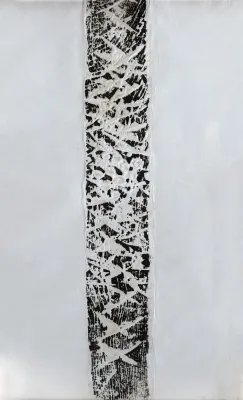
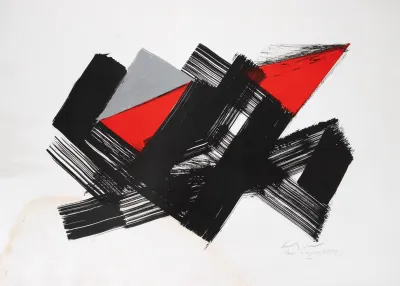
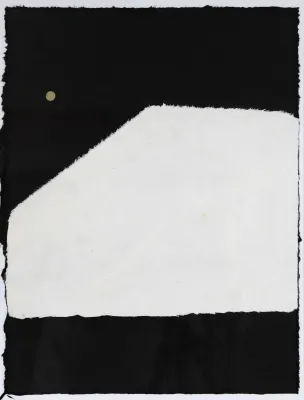
In the woodcut series titled Cais (1990s), he revisits part of the landscape of Santos, São Paulo, his hometown. Ship hulls, cranes, cargo and boats recur constantly: icons cut out from the port landscape, handled with graphic economy, almost at the limit of suggestion.
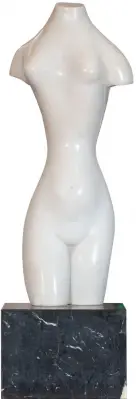
In the sculptures made in the 1990s, he uses rigorous geometry and abstract cuts. Later, he turned to representing elements that recur in his prints. His sculptural output remains close to his graphic work, also standing out for the rigor of its line and formal concision.
Critiques
"It should be made clear from the outset that Alberto Alexandre Martins, besides being a visual artist, is also a poet. In our milieu, the most notable examples of the convergence of visual and poetic expression in the work of a single artist are probably Manoel Araújo Porto Alegre and Jorge de Lima. The absence of critical studies on these cases of dual creative endowment shows how little studied this terrain of Brazilian intellectual history is. That alone would be enough to draw our attention to the emergence of an artist like Martins. But what is most impressive in his work is the way the two forms of expression, which he practices with equal talent, preserve their autonomy despite deep mutual permeation. Their points of contact do not arise from formal proximity, but from the coherence with which each, in its own way, takes up fundamental questions of art. (...) As a creative experience, poetry in Martins is consubstantial with visual art. He reveals that, when working in the studio, he often feels as if he were 'writing through things'. One of the hallmarks of this extraterritorial writing is certainly a constructive concern. In 1989, the artist went to Montevideo to see the work of Joaquin Torres-Garcia, on a journey - or rite of initiation - that seems to have sealed his commitment to the canon proposed by the Uruguayan master of constructivism: rigor of syntax and imagination. Of these two precepts, the latter predominates in Martins's recent works. Breaking with the tight geometry and abstract cuts that vigorously marked his early output, the artist no longer avoids figuration. Precise profiles of keels and cranes recur throughout the extensive series of Prints. They are not, however, drawings of existing objects, but icons cut out from the quay. Patches of light and shadow are set against each other with such force that one can perceive, by refraction, the weight of the ships. The procedure is strict and spare; there is no room for emphasis or ornament, and the construction is organized solely with the resources of a dense core".
Antonio Fernando de Franceschi
MARTINS, Alberto. Esculturas, relevos e gravuras. São Paulo: Instituto Moreira Salles, 1996.
"In the pages of Alberto Martins's work on visual poetics, the poems play with the woodcuts, setting up a combinatorial game between the two fields. In it, a print may repeat while the poems follow one another across the pages, producing further permutations. The two relate to each other in presence, so that illustration, as the representation of something absent, has no place: the print does not set out the poetry, nor does the poetry explain the print. The simultaneity of the two arts casts them toward a common reference: the city, the port, the shoreline, the sea. There is, therefore, no factual circumscription of such a city, which is constructed in the turning of reference, as much in shell mounds and travelers' accounts as in the view from the top of the mountain range sweeping over the Baixada, in the multiplication of visual sites. Corresponding to this landscape, another is exposed: that of the subject, both in the statement and in the act of enunciation. The subject's intensities shift, homologously, within the discourse. The prints, too, can be displayed in succession, which contradicts the Enlightenment notion that representation is simultaneous and discourse successive. Yet the repetition of the same section of a print reinforces, like punctuation, the poetic succession. When the book presents other prints, one sees ships, cranes, cargo, sections with pieces of keels, pieces of cargo, pieces of port, pieces of sea, where the subject multiplies, intensive. Despite the compactness of the woodcut forms, their notation is shorthand, and the effect of such presence contradicts, but only apparently, the lightness of the poetry, anchoring the one and disembarking the other".
Leon Kossovitch e Mayra Laudanna
GRAVURA: arte brasileira do século XX. São Paulo: Itaú Cultural: Cosac & Naify, 2000. p. 31.
Testimonials
A - How did your relationship with printmaking begin?
B - It was in 1981, in Evandro Jardim's classes; first at Faap and then at ECA. At the time, I barely knew what printmaking was. I sensed it was something to do with line and, since line was the driving force of the drawing I was doing then, I went after printmaking. There were people from many fields in the classes - architecture, music, dance, even geography and economics. . . I came from literature. Some attended the classes and left; but many stayed on. I stayed. Printmaking has a curious quality (perhaps this is true of all the arts, but in my case it came through printmaking): the more you give, the more it asks, and the more it asks, the more it gives back. So I soon realized that we were not learning only printmaking there, but many other things, and in a way those classes were for me a continuation of the Brazilian literature classes I had taken in my literature degree, because they offered a standpoint, a place in the world, from which to think about one's action.
A - But what exactly from those classes remained in your work?
B - What remained for me and my colleagues was understanding printmaking as a poetic way of thinking in its own right. That is: not a genre, not the translation of something conceived in another medium and then transposed into a print. But a thinking in itself - a vertical making.
A - I'm not sure I understand. . .
B - Well. . . Printmaking as vertical making means that printmaking is a specific way of apprehending the world, different from painting, different from sculpture. From that realization, a whole series of consequences follows. . .
A - Who are the colleagues you mentioned?
B - I'll name four or five who actually represent a larger group. In my case, conversations with Mubarac, Buti and Laurita Salles were valuable. Back in the 1980s and early 1990s, those conversations were important for building common ground. [...] Several of these questions came to the surface in the printmaking exhibition Sônia Salzstein organized at the Centro Cultural São Paulo in 1990. Besides them, there were also Elisa Bracher, PT - Paulo de Tarso, Herman Tacasey and others... But it can't be narrowed down to four or five, because there are more people and, in the end, each one deals with it in their own way... And there are younger colleagues...
A - You spent some time in the United States.
B - It was in 1985, at Pratt Graphics in New York. I worked in intaglio; I attended painting and sculpture classes, all with poor results. In the last few months, I took eight woodcut classes... And that was my salvation. The need to resolve the image concisely, without additions, helped me to build. From then on I took up woodcut.
A - And sculpture?
B - Sculpture was always close at hand. Today I see that I had wanted to make sculpture for a long time, but didn't have the means. I didn't know how. So I gradually brought the cutting of woodcut closer to the making of sculpture, with more or less success depending on the work. But there came a point, around 1992, 1993, when the imagery of sculpture began to invade the prints - and neither worked. The sculpture wasn't happening, and the prints didn't have enough tension. So I had to stop printmaking, and for a year, a year and a half, I gave free rein to sculpture. Then I found my focus again. The later prints - those of hulls, boats, cranes and cargo - are somehow related to the sculptures I'm making today, which are masses of wood and iron grappling with each other. But now printmaking is printmaking and sculpture is sculpture. At least that's how I see it.
Alberto Martins - São Paulo, June 2000
GRAVURA: arte brasileira do século XX. São Paulo: Itaú Cultural: Cosac & Naify, 2000. p. 206.
Solo Exhibitions
1995 - Poços de Caldas MG - Sculptures, Reliefs and Prints, at Casa da Cultura de Poços de Caldas
1996 - São Paulo SP - Sculptures, Reliefs and Prints, at Instituto Moreira Salles
1999 - Rio de Janeiro RJ - Friends of Printmaking: Alberto Martins, at Museu da Chácara do Céu/Museus Castro Maya
Group Exhibitions
1981 - Santos SP - 8th Santos Young Art Salon - drawing prize
1982 - Santo André SP - 10th Santo André Contemporary Art Salon, at Paço Municipal
1983 - São Paulo SP - Paper, at Galeria Tenda
1984 - Curitiba PR - 6th Curitiba City Printmaking Show, at Fundação Cultural de Curitiba
1986 - Curitiba PR - 7th Curitiba City Printmaking Show, at Casa da Gravura Solar do Barão
1987 - São Paulo SP - São Paulo Impressions, at Galeria Sesc Paulista
1988 - Curitiba PR - 8th Curitiba City Printmaking Show, at Casa da Gravura Solar do Barão
1989 - Rio de Janeiro RJ - 11th National Visual Arts Salon, at Funarte - acquisition prize
1990 - Amadora (Portugal) - 2nd Amadora Biennial
1990 - Mexico City (Mexico) - Processo Histórico de La Gráfica Brasileña
1990 - São Paulo SP - 21st Panorama of Current Brazilian Art, at MAM/SP
1990 - São Paulo SP - Printmakers, at CCSP
1990 - São Paulo SP - Annual Visual Arts Exhibition Program, at CCSP
1991 - Curitiba PR - 48th Paraná Salon, at MAC/PR
1991 - Valparaíso (Chile) - 10th Valparaíso International Art Biennial
1992 - Curitiba PR - 10th Curitiba City Printmaking Show. America Show, at Museu da Gravura
1992 - Santiago (Chile) - Grabados de Artistas Brasileños Contemporáneos, at Museu Nacional de Bellas Artes
1993 - João Pessoa PB - Woodcut: From Cordel to the Gallery, at Fundação Espaço Cultural da Paraíba
1993 - Maastricht (Netherlands) - The First International Print Biennial Maastricht
1993 - Ribeirão Preto SP - Prints, at Museu de Arte de Ribeirão Preto
1993 - Santos SP - 4th Santos National Biennial, at Centro Cultural Patrícia Galvão
1994 - Brasília DF - São Paulo Printmaking, at Galeria Rubem Valentim
1994 - São José dos Campos SP - 1st São José dos Campos Printmaking Biennial
1994 - São Paulo SP - Alberto Martins, Déborah Paiva and Teresa Viana: Module II, at Espaço Cultural Citibank
1994 - São Paulo SP - Continuous Printmaking, at CCSP
1994 - São Paulo SP - Woodcut: From Cordel to the Gallery, at Metrô
1995 - São Paulo SP - Group Show 34, at Adriana Penteado Arte Contemporânea
1995 - São Paulo SP - Goeldi: Our Time, at MAB/Faap
1995 - São Paulo SP - São Paulo Printmaking, at Galeria de Arte São Paulo
1996 - São Paulo SP - Sculpture Garden, at CCSP
1997 - Belo Horizonte MG - 25th Belo Horizonte National Art Salon, at MAP
1997 - Curitiba PR - The Contemporary Art of Printmaking, at Museu Metropolitano de Arte de Curitiba
1998 - São Paulo SP - Journeys, at Itaú Cultural
1999 - Rio de Janeiro RJ - Rio Printmaking Show. São Paulo: Printmaking Today, at Palácio Gustavo Capanema
1999 - São Paulo SP - A Smallholding, an Oasis, at Museu Lasar Segall
2000 - São Paulo SP - Investigations. Brazilian Printmaking, at Itaú Cultural
2001 - Brasília DF - Investigations. Brazilian Printmaking, at Galeria Itaú Cultural
2001 - Penápolis SP - Investigations. Brazilian Printmaking, at Galeria Itaú Cultural
2003 - São Paulo SP - Printmaking Is Doing Fine, Thank You: Historical and Contemporary Brazilian Printmaking, at Espaço Virgílio
2004 - São Paulo SP - 8th Cultura Inglesa Festival, at Centro Brasileiro Britânico
2004 - São Paulo SP - New Acquisitions: 1995 - 2003, at MAB/Faap
Source: Itaú Cultural